
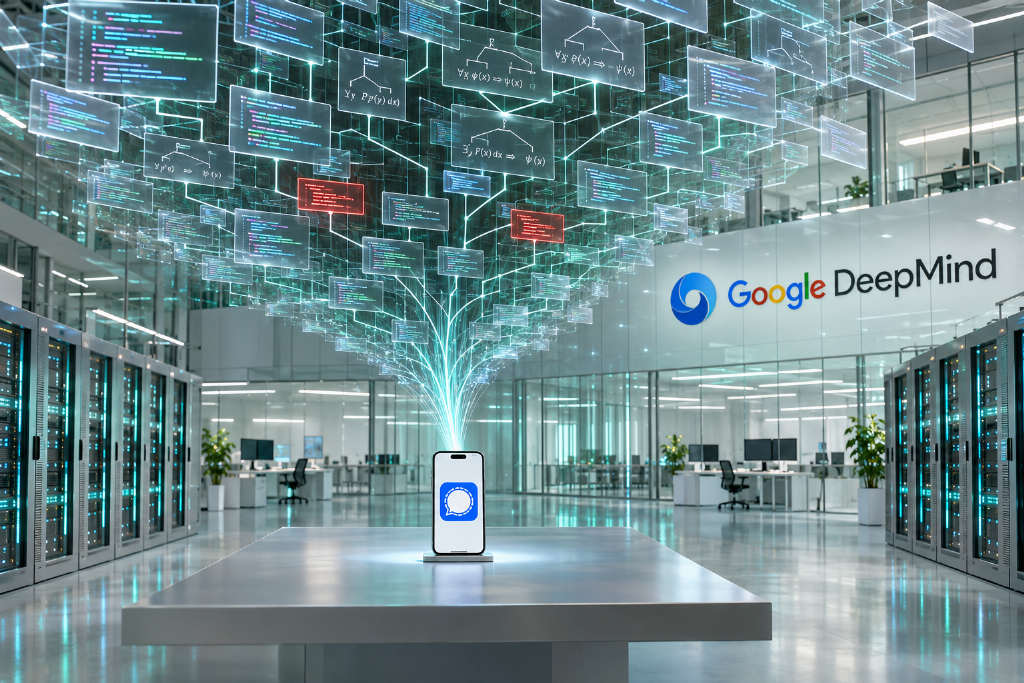
AI reaches the code running on Signal devices
Google DeepMind said on Nov. 10 that its AlphaProof Code system had formally verified the code that actually runs Signal’s encryption protocol on devices. The announcement appeared on DeepMind’s official blog. A group of AI agents used mathematical proofs to show that the implementation met the core security properties set by experts.
Signal’s protocol is used by Signal itself and by other communication software, including Google Messages. It protects billions of private conversations. DeepMind described the work as the first time AI has formally verified a widely used cryptographic protocol at this depth. It also said that, regardless of whether AI is involved, this is the first complete formal verification of the implementation of such a protocol.
The verification took four weeks. DeepMind said the traditional approach would generally require an expert team to spend several years on the same type of work.
From a protocol design to compiled code
Formal verification uses mathematical proofs to establish that software behaves according to its specifications and contains no vulnerabilities. It is regarded as the highest level of security assurance, but it has historically required heavy manual effort.
DeepMind said most protocol verification stops at the design layer. That can show that a design is secure, but vulnerabilities in real systems often arise in the gap between the design and its implementation. AlphaProof Code followed the proof all the way to the compiled code running on a device.
The verified properties included cases in which messages remain protected before and after a device is temporarily compromised. These properties were checked at the level of the code actually executed on the device, which made the proof substantially more difficult than verifying a design alone.
More than 6 million lines of Lean proofs
AlphaProof Code divided the work between human experts and AI agents. People and AI models first decided what needed to be proved. A group of agents then worked through the proofs.
In the first stage, researchers worked with multiple models to translate Signal’s security goals into formal mathematical specifications. Human experts reviewed every specification. Agents powered by Gemini 4 Carbon then produced more than 6 million lines of Lean code.
Lean is a programming language used to write mathematical proofs. A computer can check each step automatically. After producing the proofs, the agents audited their own work and marked the sections that required another human review. Those sections represented 1% of the full codebase. Lean checked the rest automatically, allowing experts to focus on the parts that required human judgment.
The system detected two reintroduced vulnerabilities
To test whether AlphaProof Code could distinguish correct code from flawed code, researchers placed two real vulnerabilities that had previously existed in Signal and had since been fixed back into the code inside an isolated environment.
In both cases, the system generated machine-checked proofs showing that the vulnerable versions were unsafe.
Ehren Kret, Signal’s chief technology officer, wrote in a blog post that earlier formal-verification efforts could cover only a smaller portion of the system. Confirming that production code strictly matches the cryptographic design required substantial human work, he said. Having AI agents automatically translate online code into valid Lean theorems was, in his words, a major breakthrough.
Kret also said AI-driven cybersecurity threats are increasing. With its core protocol subjected to rigorous verification, Signal has greater confidence in the privacy guarantees provided by its own code.
Open-sourced results and possible use in critical systems
DeepMind has open-sourced the formal-verification results and released a technical paper with them. The company said the same method could be applied to medical-device firmware and power-grid software. Scaling the approach to those systems, however, will require more research.
DeepMind is not the only company working on AI-assisted formal verification. In October, Anthropic partnered with Theorem to use Claude to formally verify 123 open-source libraries. The process uncovered hundreds of errors.
Vitalik Buterin, co-founder of Ethereum, also argued during the opening speech of Devcon 8 that open and verifiable systems should replace reliance on trust alone. He specifically identified chips, communications and AI as fields that need systems capable of being verified.



