
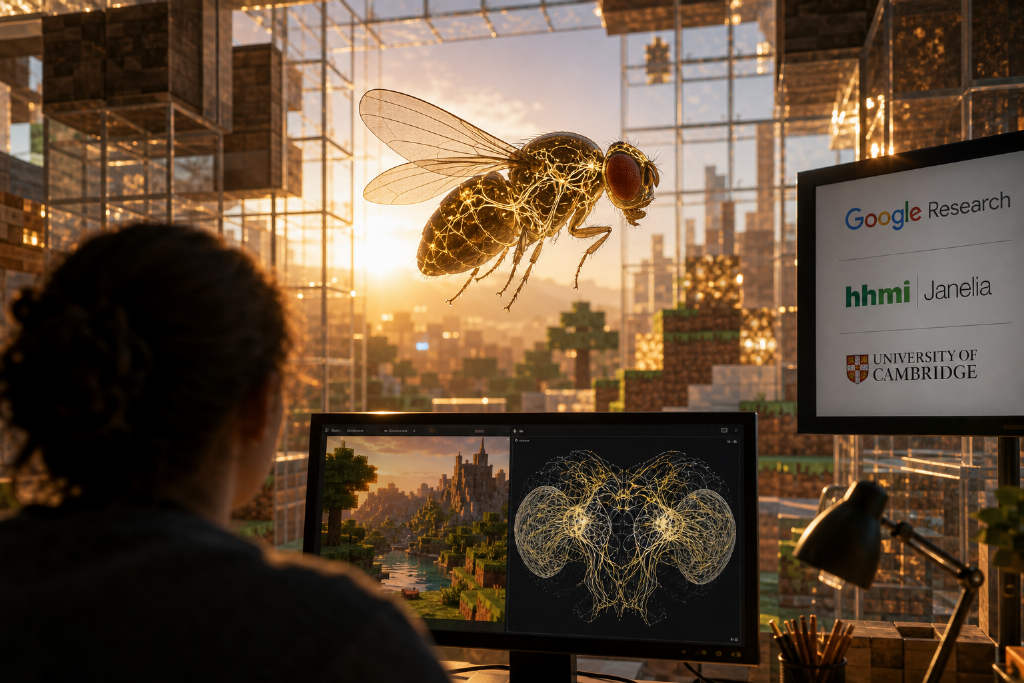
A virtual fruit fly is flying inside Minecraft, and the system driving it is not a routine game script. According to the source article, its movement is being generated from a full male fruit fly central nervous system connectome.

The scene is simple: a small red-brown fly suspended in a transparent room made of glass blocks, turning, rolling and changing direction against Minecraft’s blue-sky backdrop. Behind those movements, the report says, 166,700 neurons are firing in simulation, with neural activity directly determining each turn.
The connectome, MaleCNS v1.0, was produced over 10 years by Howard Hughes Medical Institute Janelia, the University of Cambridge, and Google Research. The article says the work required 44 person-years of manual proofreading and was published in Cell on Sept. 3. Two days later, it had already been pushed into a game environment.
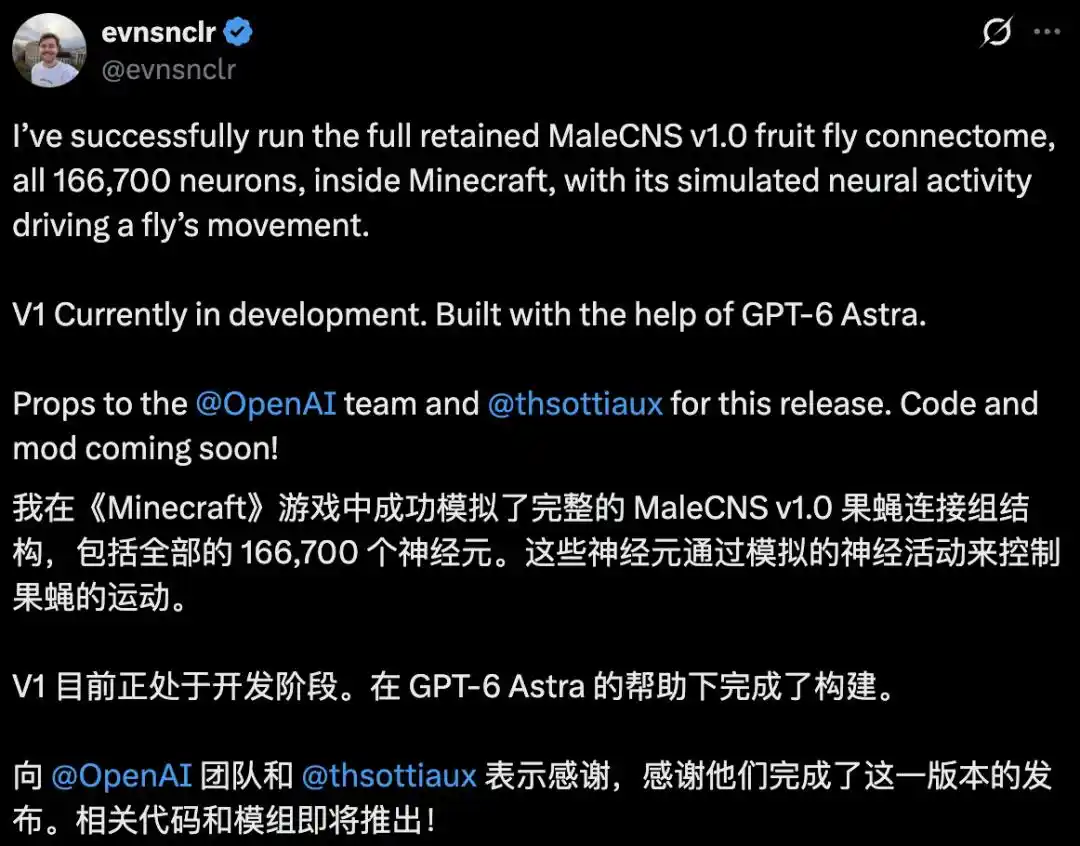
The person behind that step was identified as Evan Smith, a graduate student at the Georgia Institute of Technology. In the original post cited by the article, Smith wrote that version one is still under development, that it was built with help from GPT-6 Astra, and that the code and mod will be released soon.
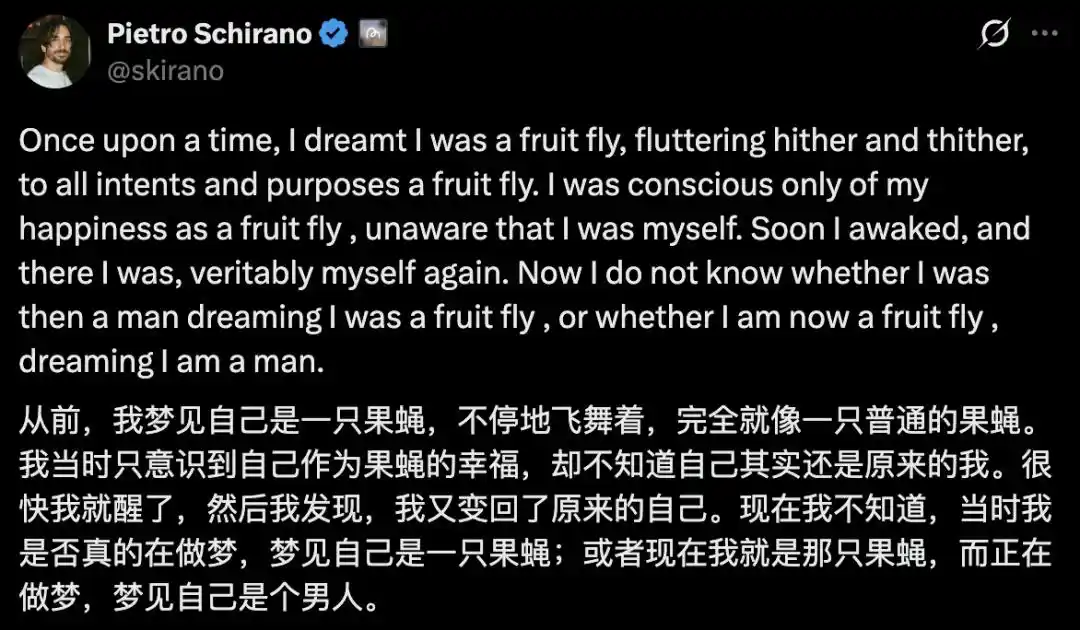
The reaction was immediate. The article says commenters called it a fruit-fly version of The Matrix and linked it to simulation theory. Former OpenAI designer Pietro Schirano added a line adapted from Zhuangzi, saying he no longer knew whether he had dreamed he was a fruit fly or whether he was a fruit fly dreaming he was human.

What MaleCNS contains
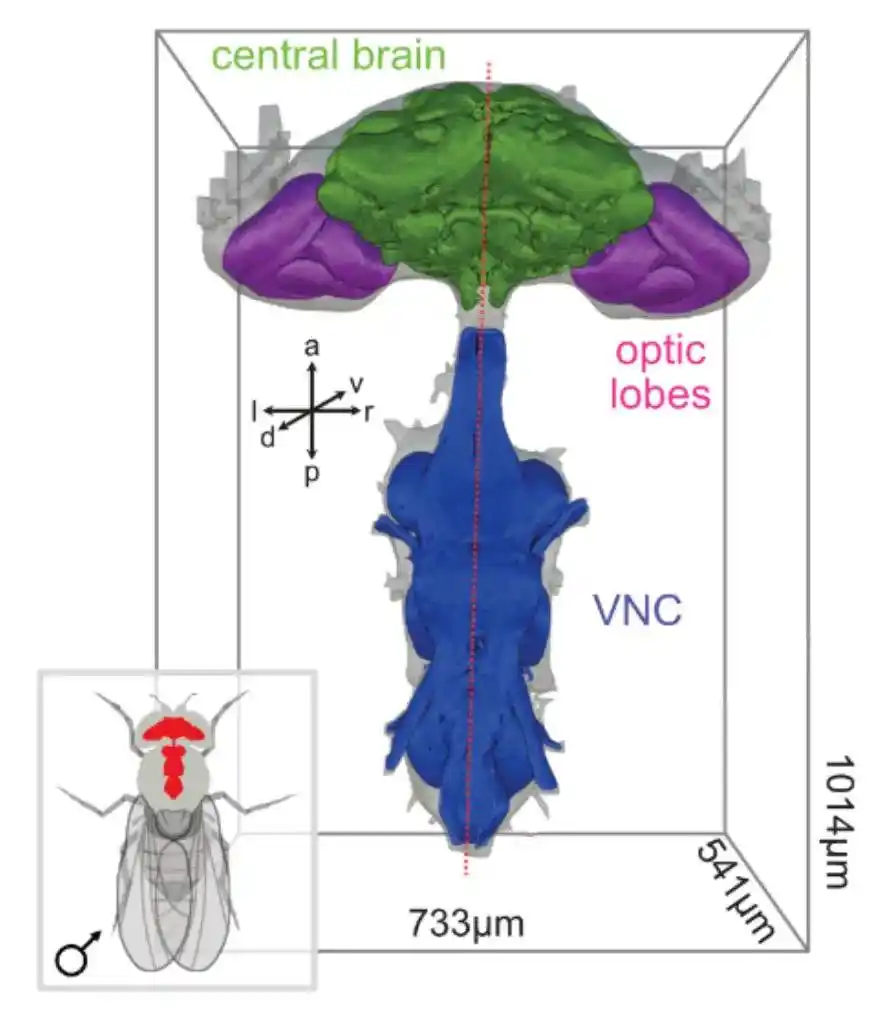
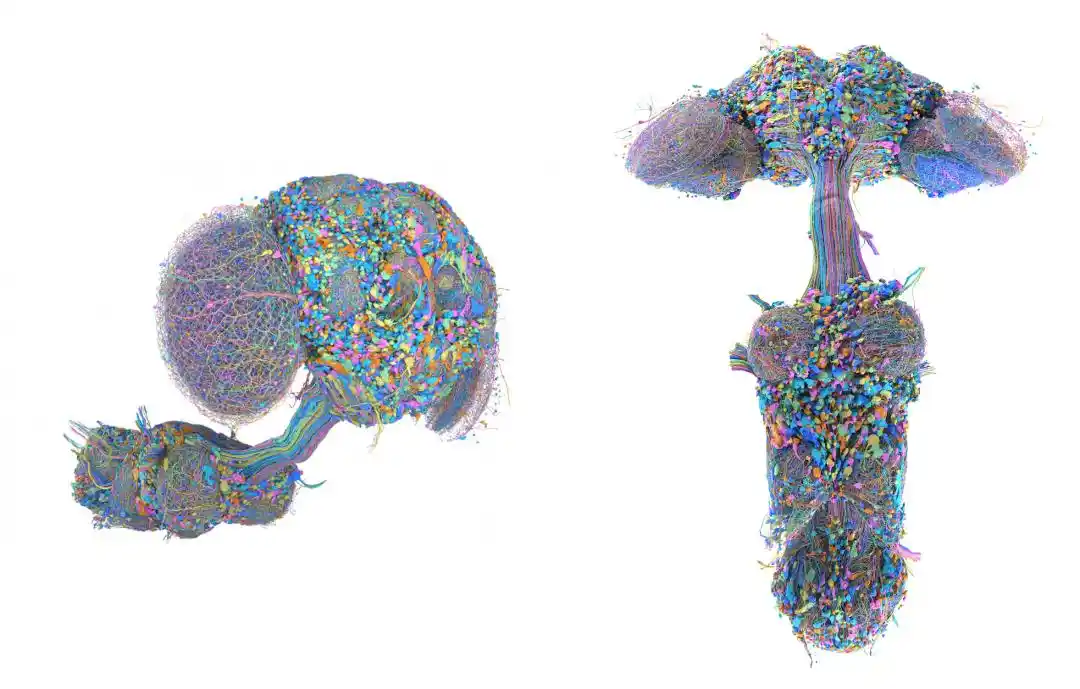
MaleCNS is described as the first complete connectome of the male fruit fly central nervous system. It is not limited to the brain. The dataset spans the central brain, the optic lobes, and the ventral nerve cord, which the article compares to a fruit fly’s spinal cord. It also preserves the neck connections, which the report says allows the command path from brain to body to be traced on a single map for the first time.
The source breaks the dataset into three major regions: central brain, optic lobes and ventral nerve cord. Auditory, visual and olfactory inputs are linked to motor outputs within the same structure.
Researchers also found 262 male-specific cell types and 114 cell types with different morphology between males and females. According to the article, those differences cluster in higher-order brain regions. The report says that helps explain sex differences in courtship and aggression and also shows how small circuit changes can produce effects across the broader brain.
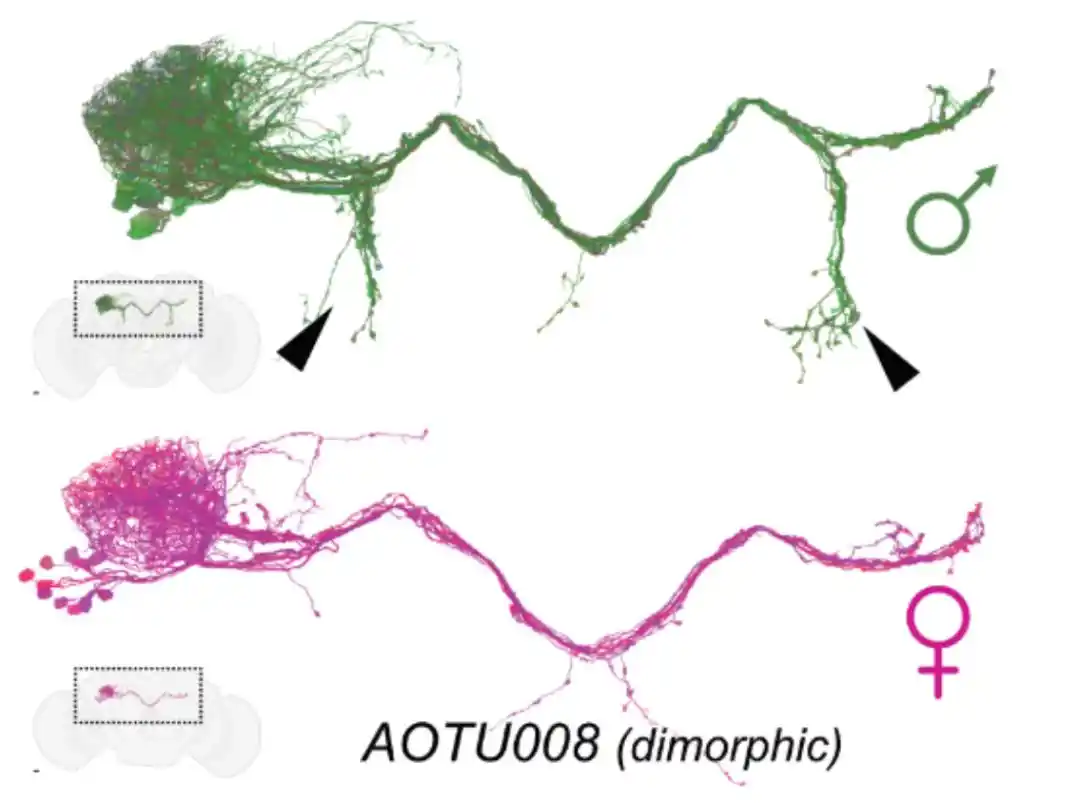
One example mentioned in the piece is neuron type AOTU008, which differs between males and females, with the male form carrying two additional projections.
By scale, the map contains 125 million synaptic connections and is described in the article as the largest brain map so far by neuron count. To build it, researchers sliced a fruit fly into millions of thin sections for electron microscopy scans. Google then used flood-filling networks and a system called PATHFINDER to reconstruct 3D neuron morphologies from large volumes of 2D imagery. Janelia specialists then manually proofread and annotated the results neuron by neuron.
The final dataset was released under a CC-BY license. The article says a user can register, obtain a token, run a single pip install command and then use a few lines of code to pull upstream and downstream connections for any neuron to a local machine. In that form, a brain containing 125 million synapses becomes an open file that anyone can download.
How a wiring diagram becomes a moving fly
A connectome on its own is still a static wiring map. The article says three engineering steps are needed to turn that structure into a virtual organism that can move inside a game.
The first is neuron dynamics. Each neuron needs a mathematical model for how it accumulates input and when it fires. The article names the leaky integrate-and-fire model as a standard approach in the field. Once that layer is added, the static map can become an active flow of neural signals.
The second is sensory input. Light, glass blocks and distance inside Minecraft have to be encoded into the fly’s visual neurons.
The third is motor output. Electrical activity from the nervous system must then be translated into physical motion in the game world.
The article says the new Cell paper happened to provide a ready-made route for that interface: a fully mapped visual-to-motor chain running from R1 to R6 visual neurons to DNg13 motor neurons. If the interfaces along that path are wired correctly, the report argues, a virtual fly that sees a block in front of it should react in a biologically grounded way.
Why the barrier fell so fast
The article attributes the speed of the project to three pieces arriving at once.
- First, a fully open connectome with nanometer-scale structural data and directly usable APIs.
- Second, stronger AI coding tools. Turning a connectivity table with hundreds of thousands of neurons into a working simulator means handling data ingestion, network construction, dynamical models and engine integration. The article says GPT-6 Astra reduced that engineering burden to something a graduate student could manage in spare time.
- Third, an accessible sandbox engine. Minecraft already has a modding ecosystem, physics rules, lighting and collisions. A glass wall can serve as an obstacle test, and a torch can serve as a light-following test.
In the source article’s framing, the connectome supplies structure, AI lowers the engineering threshold, and the game provides a visual world that is easy to reproduce. Combined, they turn a project that once required funding, formal planning and a team into something much closer to a repeatable open-source build.
The report compares that shift with earlier whole-brain simulation efforts. OpenWorm worked with a nematode that has only 302 neurons, yet it still took an open-source community of scientists and engineers more than a decade to make a virtual worm move in simulation. The article also points to Eon Systems, which about half a year ago connected a FlyWire female fly brain model to the MuJoCo physics engine and got a virtual fly to walk, groom and feed. That setup, the report says, still depended on a dedicated company and a lab-grade engine.
This time, the article says, the neuron count is more than 500 times that of the worm, while the setup has dropped to a graduate student, an AI system and a computer capable of running Minecraft. It adds that Neuralink founder Elon Musk also reacted in the comment section.
Behavior is not the same as consciousness
The demonstration naturally pulls discussion toward bigger philosophical questions. Schirano’s post pushed it in that direction by echoing the old Zhuangzi butterfly dream.
But the source article draws a clear line: behavior does not prove consciousness. What the current project can show is that simulated neural activity can drive movement in a digital body.
The block-world fly circling inside a glass room cannot smell and cannot sense temperature, according to the article. Whether it has subjective experience or whether it dreams remains unknown.
What does change is the way hypotheses can be tested. The source asks a series of practical questions: if the game environment is altered, will the fly respond consistently; if a few neural connections are scrambled, will the flight path change; if part of the neural activity is shut down, will the system fail immediately? The article says that in the past, answering questions like these often meant long wet-lab cycles involving animal rearing, gene knockouts and waiting for results. Now, researchers can first break a few lines of code, run the simulation, and decide which hypotheses are worth taking back into real biological experiments.
The piece also mentions a separate example: a 6-day-old larval zebrafish with about 140,000 neurons highlighted across its transparent body outline. The article describes that as the first connectome covering an entire vertebrate brain, with whole-brain activity recordings from the same fish aligned to it.
Once Smith’s code is released, the article says, the same fruit fly brain could be connected to Unity, Unreal Engine or even physical robotic bodies. One map could then produce many different digital flies.
For a long time, getting a fruit fly brain to move inside a digital body required a company and a lab-class physics engine. In this demonstration, the requirement was reduced to a graduate student, an AI tool and a PC that can run Minecraft.
Whether that fly dreams is still unanswered. The article’s stronger claim is narrower and more concrete: the threshold for hands-on whole-brain experimentation has dropped, and people who want to probe that question no longer need backing from a top lab before they can begin.