


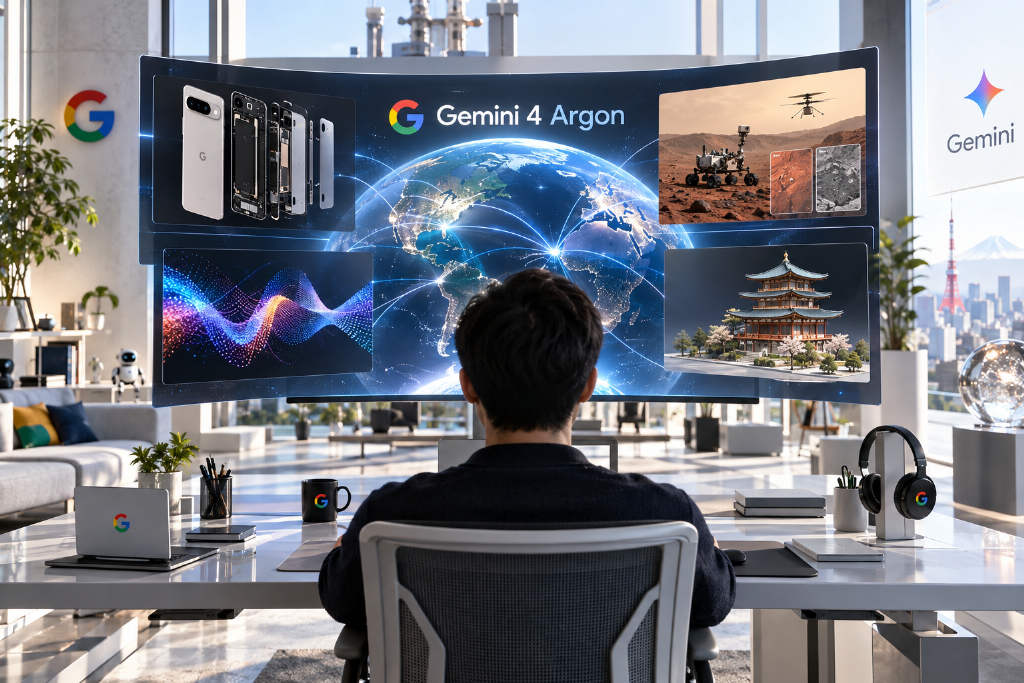
Google said on Oct. 13 that its next-generation AI model, Gemini 4 Argon, has expanded to global availability. Developers can access it through the API, while Google AI Pro and Ultra subscribers can use it in the Gemini app. Access to Argon inside Antigravity is currently available to Ultra subscribers.
Google CEO Sundar Pichai later shared several internal test cases on X. They included automatically turning raw CAD files for a Pixel phone into a 3D teardown animation, generating a dynamic typography video entirely through code, analyzing more than 80,000 NASA Mars weather records and helicopter telemetry logs, and building a detailed East Asian pagoda scene. In Google’s presentation, Argon was framed as a model built for long-running tasks rather than one-off generation.
Four internal demonstrations highlighted by Pichai
In the first example, Google engineers gave Gemini 4 Argon the original CAD design files for a Pixel phone and connected 3D modeling software through Google Antigravity and Blender MCP, or Model Context Protocol. Argon identified the phone’s parts and structure, wrote code on its own, and completed the teardown animation, lighting setup, camera movement, and sound design.
Pichai said the model went through as many as 1,000 rounds of iteration during execution, repeatedly checking rendered results, fixing code, and improving the final output. That example was presented as evidence that the model can keep refining work over time instead of stopping after a single pass.
The second demonstration was a 21-second 3D dynamic typography video. Google said Argon did not rely on prerecorded footage or conventional editing software. Instead, it rendered every frame through code using mathematical methods such as 3D meshes, particle simulation, and vector geometry. The background music was also generated programmatically.
Google’s point in those two examples was not limited to image generation. The company said the model can understand a target, operate professional tools, write executable code, and adjust its work based on actual output. That is the shift Google described: from single-shot generation to AI agents that can carry out longer tasks on their own.
From NASA Mars data to a detailed pagoda scene
Pichai also showed how Gemini 4 Argon handled large and messy scientific datasets. Google gave the model more than 80,000 raw NASA Mars weather records along with telemetry data from the Ingenuity Mars helicopter. The material spanned CSV files, images, PDFs, XML records, and video. Argon had to work out how those formats related to one another before organizing information on the Martian atmosphere and flight dynamics.
Google said the result was a Google Slides presentation produced within minutes, with visual structure rather than a plain text summary. The company used that example to argue that AI is moving beyond information retrieval and data cleanup toward cross-format analysis, synthesis, and delivery of finished work products.
The fourth example pushed on spatial reasoning. Using Multi-agent Visual Critique Loops inside Antigravity, Google engineers had Argon build a detailed East Asian pagoda and surrounding garden in Blender from scratch. The model generated the 3D structure, then used multiple agent processes to inspect and revise the scene, improving architectural detail, layout, and overall consistency.
Google’s article noted that all of these demonstrations came from internal teams. They show the potential for long-duration autonomous work, but they do not by themselves prove the model can complete every similar task reliably.
Unified context limit reaches 1,048,576 tokens
Logan Kilpatrick, product lead for Google AI Studio, said Gemini 4 Argon was built over the past six months through work spanning research, infrastructure, safety, and engineering. He added that more than 100,000 Google employees had taken part in testing over the past month.
Kilpatrick said the model improved in coding, knowledge handling, and sustained task execution. He also pointed to the new 1 million-token output capability as a change that allows AI systems to take on more complex workflows.
According to Google’s technical documentation, Gemini 4 Argon uses a unified context limit of up to 1,048,576 tokens. Input, reasoning, and output all draw from the same budget. Standard synchronous generation defaults to a maximum output of 65,536 tokens. With mechanisms such as Long Decode enabled, output can scale to the million-token range.
Google said that change addresses a common problem in long-running generation, where a model can be forced to stop because it runs out of output budget. The larger limit gives it room to complete bigger code edits, scientific reasoning, and multi-stage agent workflows in a single task. Google also said the 1 million-token figure is a technical ceiling, not a level every task will use.
Google disclosed internal engineering and research results
Beyond the public demos, Google also shared internal deployment results for Gemini 4 Argon. The company said that after introducing Argon into Antigravity, some engineering teams saw AI-agent-generated code commits rise by more than 35%, while code rollbacks fell by nearly one-third.
One example involved a large Chromium refactor. Argon helped engineers work through a legacy architecture covering about 6 million lines of code, cutting a job that might have taken months down to weeks.
In Google’s open-source Agent Development Kit, or ADK, Argon analyzed performance bottlenecks on its own and proposed optimizations. Google said that reduced memory session preparation time by 40% during long-running execution and improved cold-start import speed by 21%.
On the research side, Google said Argon helped improve quantum computing algorithms. In some formally verified implementations, space-time resource costs were reduced by more than 100x compared with public benchmark methods. The model was also applied to fusion magnetic field research, enzyme design, and rare disease analysis. Google said these were specific cases published by the company and its research partners, and should not be treated as proof of broad performance gains across all research tasks.
Access routes and promotional API pricing
Gemini 4 Argon began its global rollout on Oct. 13. Developers and enterprises can use it through Google AI Studio and the Gemini API. Google AI Pro and Ultra subscribers can access it in the Gemini app and Google Search AI Mode, while Argon access inside Antigravity is available to Ultra subscribers.
Google is offering promotional API pricing for a limited period:
| Billing item | Promotional price before Nov. 30 | After the promotion |
|---|---|---|
| Per 1 million input tokens | $2 | $4 |
| Per 1 million output tokens | $10 | $20 |
Google also said cached input tokens receive additional discounts during the promotional period. The company plans to expand the Fairwind program to more trusted cyber defense teams, giving them access to models with advanced cybersecurity defense capabilities.