
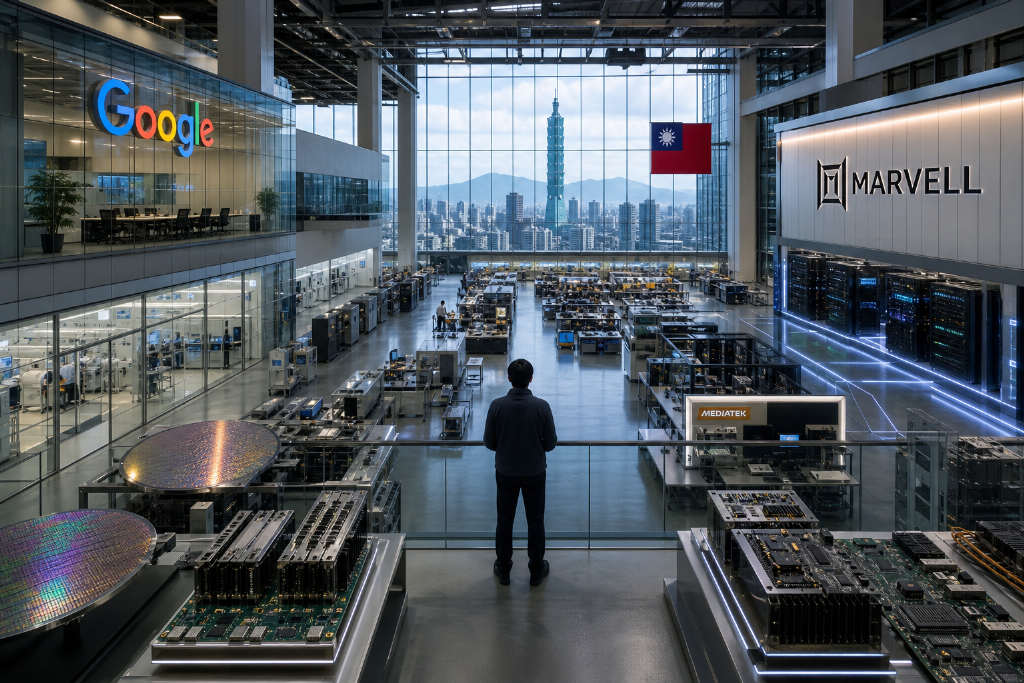
Google’s large-scale partnership with Marvell is giving investors a new lens for reading the recent pullback in MediaTek shares. ABMedia said the agreement points to a faster shift by major cloud service providers toward the Customer-Owned Tooling, or COT, model, where customers keep control of system architecture and core compute die design while handing selected back-end work and key modules to outside suppliers.
Google and Marvell deepen ties through an equity-linked structure
Citing a public SEC 8-K filing, the report said Google’s arrangement with Marvell is not only large in size but also structured with an equity component. Marvell will develop custom chips within Google’s TPU ecosystem, including AI inference accelerators, network interface controllers, or NICs, and near-memory computing products. The work is described as complementary to Google’s existing main TPU design, not a replacement for it.
Under the structure described by ABMedia, Marvell issued warrants tied to as much as roughly 7% of its equity. If fully exercised, the value would be about $12.2 billion. Vesting is linked to cumulative revenue from custom products of up to $120 billion. If the full amount vests, Google would become Marvell’s fifth-largest shareholder.
The article said the arrangement helps Google build a multi-supplier line of defense and leaves Marvell among a small group of companies positioned to serve Amazon, Microsoft and Google at the same time in custom silicon.
COT changes the economics of traditional ASIC outsourcing
ABMedia said Google is moving closer to an “Apple model” in which it keeps tighter control over critical chip decisions. In that setup, in-house development shifts away from a fully outsourced approach and toward one where core architecture stays with the customer while back-end work and certain modules are outsourced.
In the COT framework described in the report, the customer controls system architecture and the design of the core compute die, then works directly with foundries such as TSMC on tape-out and production. That can cut AI chip manufacturing costs. As chiplet-based design and advanced packaging mature, Google can outsource only the technical areas it lacks, such as SerDes high-speed interconnect technology. The result, according to the article, is a smaller markup opportunity for traditional ASIC service providers and more bargaining power for the customer.
MediaTek’s AI ASIC position brings growth and risk
MediaTek is presented as one of the direct beneficiaries of the COT shift. ABMedia said the company won a key role related to Google TPU, described in the report as AI accelerator cooperation. It has also raised its full-year AI ASIC revenue outlook from $1 billion to $2 billion, with mass production expected to start in the fourth quarter of this year.
Still, the same trend could weigh on future economics. If Google pulls more of the design process in-house, suppliers such as MediaTek may face pressure on value-add and margins. That has fed market concern that some vendors could end up serving as transitional partners rather than long-term gatekeepers.
Share-price weakness coincides with institutional selling
MediaTek’s recent market performance has added to the debate. The ABMedia article said the stock has retreated from a high of NT$4,970 in early June to above NT$3,000 and remains below its quarterly moving average. The report linked the move to expectations of structural change across the supply chain as well as recent position adjustments by institutional investors.
It also said foreign investors and local investment trusts have recently been net sellers. Chen Chuan-yao, the fund manager of Uni-President Taiwan Growth ETF (00981A), referred to in the article by the market nickname “Yaochi Jinmu,” cut 200 lots of MediaTek shares last week, adding to pressure on retail sentiment.
Potential room for China ASIC orders later this year
On the demand side, the article cited financial commentator Gu Ai, who argued that while COT is an unavoidable trend, global AI chip demand is still expanding and the pace of market growth does not necessarily point to a negative outcome for MediaTek.
ABMedia also cited a MediaTek insider as saying that, with U.S.-China tech tensions still in place, the company may still have room by year-end to benefit from a rise in ASIC orders from Chinese customers, which could support revenue. The report did not disclose the size of any potential orders.