
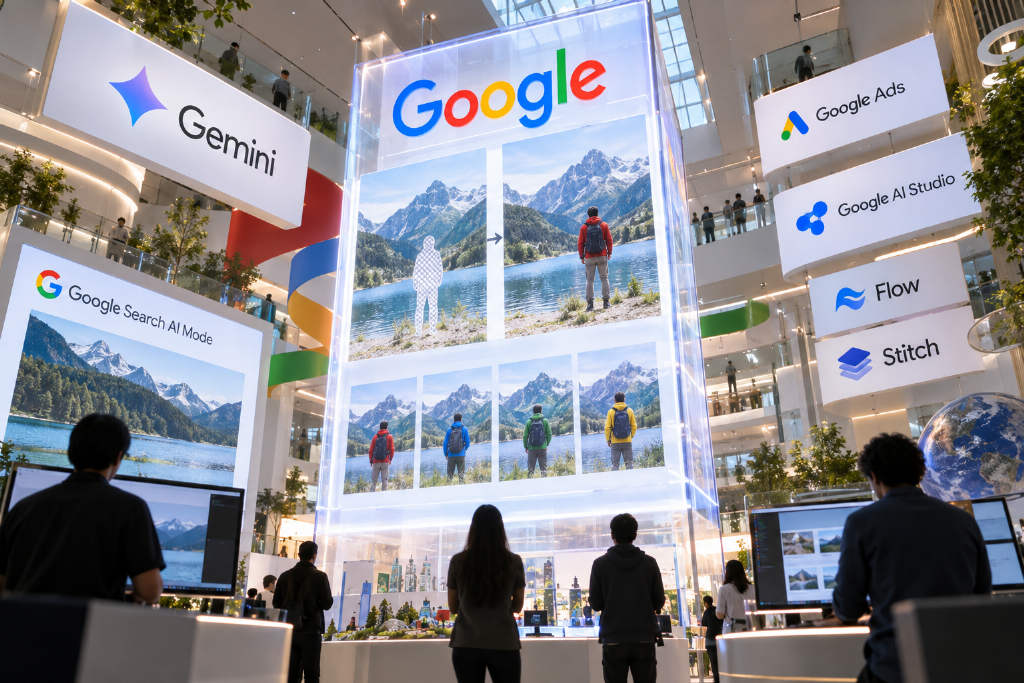
Google on Tuesday released Nano Banana 2.1, the latest version of its AI model for turning text prompts into images and editing existing photos.
The rollout covers the Gemini app, Google Search’s AI Mode, Google Ads, and developer tools including Google AI Studio, Flow, and Stitch.
The original Nano Banana helped drive Gemini’s momentum. In September 2025, its feature for turning selfies into collectible figurines pushed Gemini to No. 1 on both major app stores, ending ChatGPT’s run at the top after nearly three years.
During the same period, Alphabet’s market capitalization crossed $3 trillion.
What changed in Nano Banana 2.1
Version 2 had arrived in February, built on Gemini 3.1 Flash Image. Its main feature was the ability to check Google Search before generating depictions of real-world people or events, improving the odds that those images would be accurate.
Google highlighted three upgrades in Nano Banana 2.1:
- better visual design,
- sharper mask-based editing, where only the marked region changes,
- and stronger subject consistency, so a person or object keeps its identity across several edits.
In a post on X, Google wrote: "Meet Nano Banana 2.1, our latest image generation and editing model 🍌 This upgraded version outperforms our previous models across the board, with notable leaps in visual design, mask-based editing, and subject consistency to help you create more natural-looking images."
Scores and model capacity
In overall preference tests for text-to-image generation, Nano Banana 2.1 scored 1,050 ELO points. Nano Banana 2 scored 990, while Nano Banana Pro scored 935. Under the ELO system, higher is better. The report noted that the scale has no ceiling, making it a qualitative measure.
On specifications, the model can handle up to 14 reference images at once, track up to four characters and 10 objects, produce output up to 4K, and support aspect ratios as wide as 8:1.
Developer controls and lower pricing
Developers can also choose how long the model "thinks" before generating an image, from minimal to high, and can ground outputs using Google Search and Google Image Search. Put simply, the model can look up information before drawing.
Through Google’s developer API, which allows third-party apps to use the model, a standard 1K image costs $0.0336. That is roughly half the $0.067 charged for Nano Banana 2.
A 4K image costs $0.0756, compared with $0.151 for the previous version. Batch jobs, meaning large sets of images processed in bulk rather than instantly, receive another 50% discount.
At the standard 1K rate, generating 1,000 images through the API now costs about $33.60, down from $67 on Nano Banana 2. The article said the new model stands out not only for image quality, but also for efficiency and cost effectiveness.