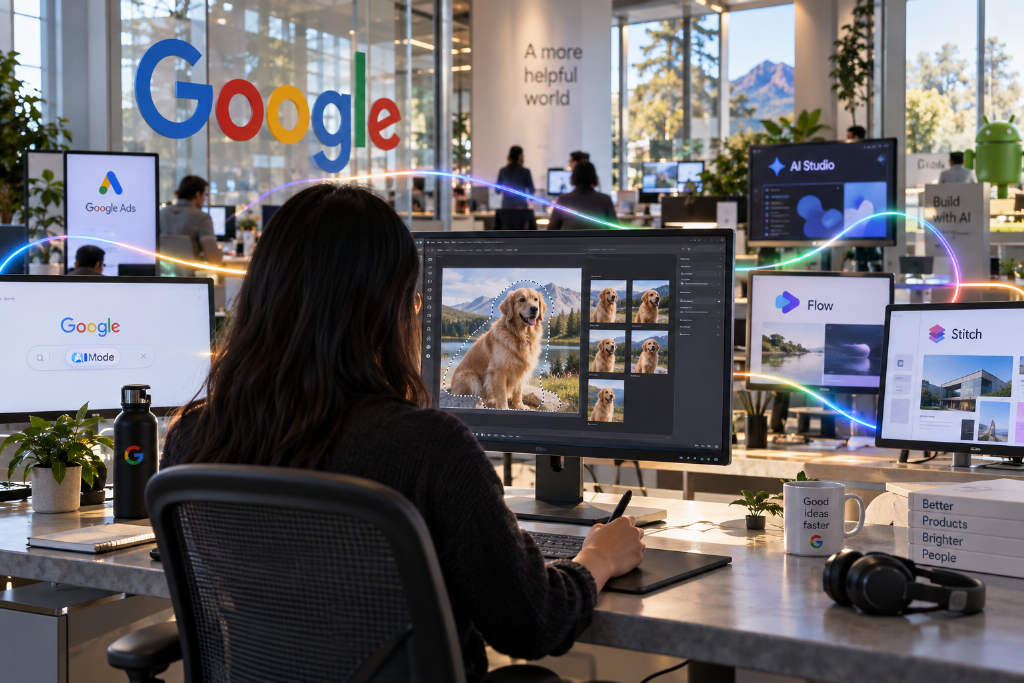
Google on Oct. 6 released Nano Banana 2.1, its latest image generation and editing model, and rolled it out across the Gemini app, Google Search’s AI mode, Google Ads, and developer products including Google AI Studio, Flow and Stitch. The model can create images from text prompts and edit existing photos.
Google said the update focuses on three areas: visual design, mask-based editing and subject consistency. In practical terms, mask-based editing lets users mark a specific region so only that part changes, while subject consistency is designed to keep a person or object’s core traits intact across repeated edits.
In Google’s overall text-to-image preference testing, Nano Banana 2.1 scored 1050 ELO, above Nano Banana 2 at 990 and Nano Banana Pro at 935. Google also said the model can handle up to 14 reference images at once, track 4 characters and 10 objects, output up to 4K resolution, and support aspect ratios up to 8:1. Developers can set how long the model thinks before generation and enable fact-checking based on Google Search and Google Images. Via Google’s developer API, standard 1K image generation is priced at $0.0336, versus $0.067 for Nano Banana 2, while 4K images cost $0.0756 compared with $0.151 for the previous generation. Batch jobs receive an additional 50% discount. Google said the performance figures come from its own testing.
According to ChainCatcher, Google released Nano Banana 2.1, its latest image generation and editing model, on Oct. 6. The model has already been rolled out in the Gemini app, Google Search’s AI mode, Google Ads, and developer tools including Google AI Studio, Flow and Stitch.
Nano Banana 2.1 can generate images from text prompts and edit existing photos.
Google highlights three areas of improvement
Google said the upgrade centers on visual design, mask-based editing and subject consistency.
In mask-based editing, only the marked area changes after a user selects a region. Subject consistency refers to the model keeping the original traits of a person or object intact through multiple rounds of editing.
Test scores and model specs
In overall text-to-image preference testing, Nano Banana 2.1 received an ELO score of 1050, above Nano Banana 2 at 990 and Nano Banana Pro at 935.
Google said the model can process up to 14 reference images at the same time, track 4 characters and 10 objects, produce output up to 4K resolution, and support aspect ratios as high as 8:1. Developers can also choose how long the model spends thinking before generation and have it fact-check against Google Search and Google Images.
API pricing comes in below the previous generation
Through Google’s developer API, a standard 1K image costs $0.0336, about half of the $0.067 charged for Nano Banana 2. A 4K image costs $0.0756, compared with $0.151 for the previous generation. Batch tasks qualify for an additional 50% discount.
Google said the performance data was based on its own testing.
This article was originally published by Bit.Fan. For more cryptocurrency news and market insights, visit www.bit.fan. Disclaimer:
The market information, project data, and third-party content displayed on this platform are for industry information sharing only and do not constitute any form of investment advice or return commitment.
Cryptocurrency trading carries high risks. Users should fully assess their risk tolerance and make independent decisions. All profits, losses, and legal responsibilities are borne by the users themselves.