
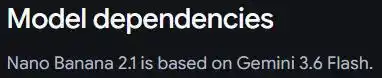
Google has released Nano Banana 2.1, a new image model in the Gemini 3 lineup. The model is built on Gemini 3.6 Flash and carries a knowledge cutoff of March 2026. Based on Google’s earlier naming pattern, the source article says it could also be understood as Gemini 3.6 Flash Image.
The update is centered on image generation and editing. Google is highlighting mask-based local editing, subject consistency across repeated revisions, multilingual text rendering, and direct output up to 4K. Developers can already access it in AI Studio under the model name gemini-nano-banana-2.1.
A Flash-tier model aimed at image work
According to the source article, Nano Banana 2.1 remains part of the Gemini 3 family, but its performance now exceeds Google’s own flagship Nano Banana Pro in several image-related areas. Google’s official benchmarks, as cited in the article, show strong results in visual design, editing, and consistency.
The same article notes that the model still has room to improve in small text rendering, 3D reasoning, and factuality. Even so, it describes the release as a notable upgrade for users who need image generation and editing services. The capabilities highlighted in the report include:
- creating and editing images with professional-grade precision and control, while supporting fast repeated iteration;
- producing clear text for posters and complex charts;
- using long-context real-world knowledge;
- rendering localized text across multiple languages.
Ranking gains on Arena
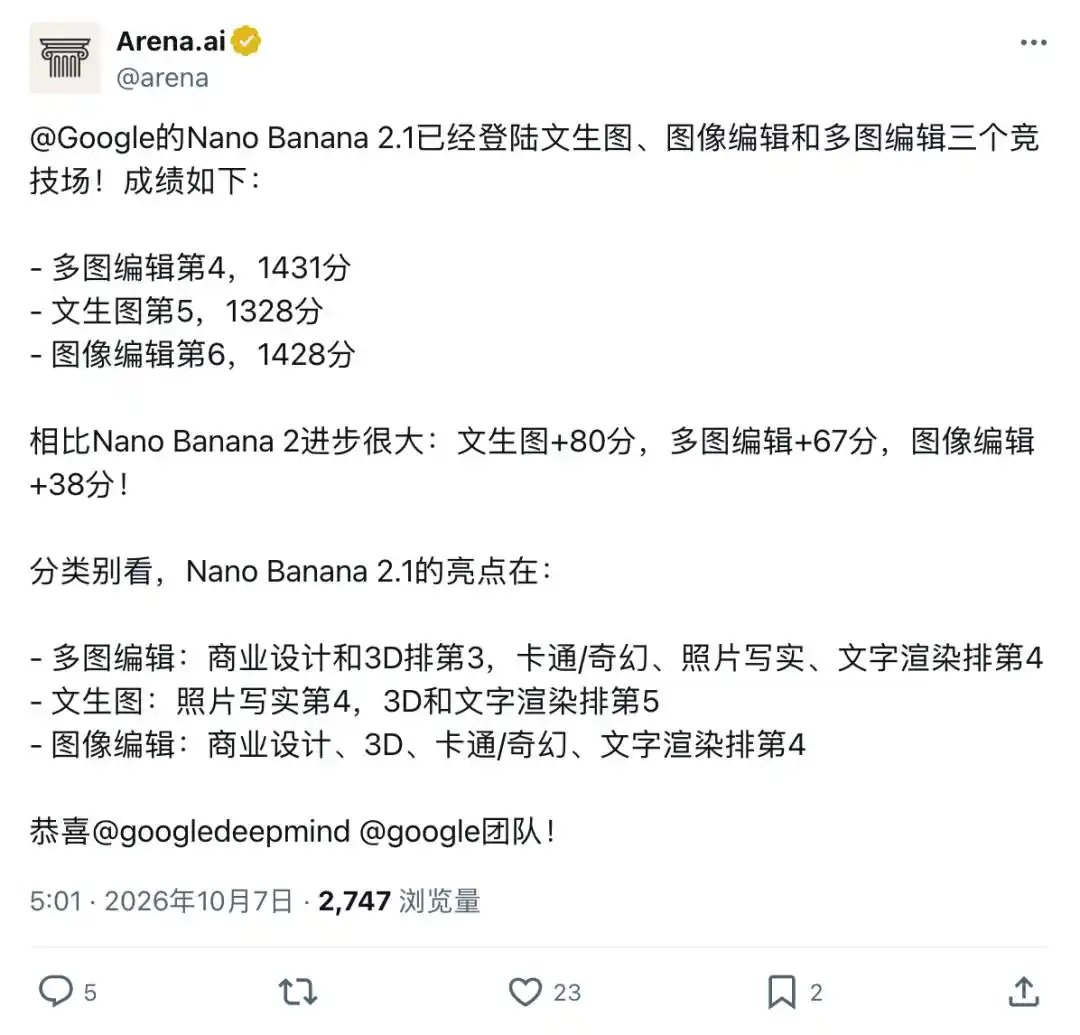
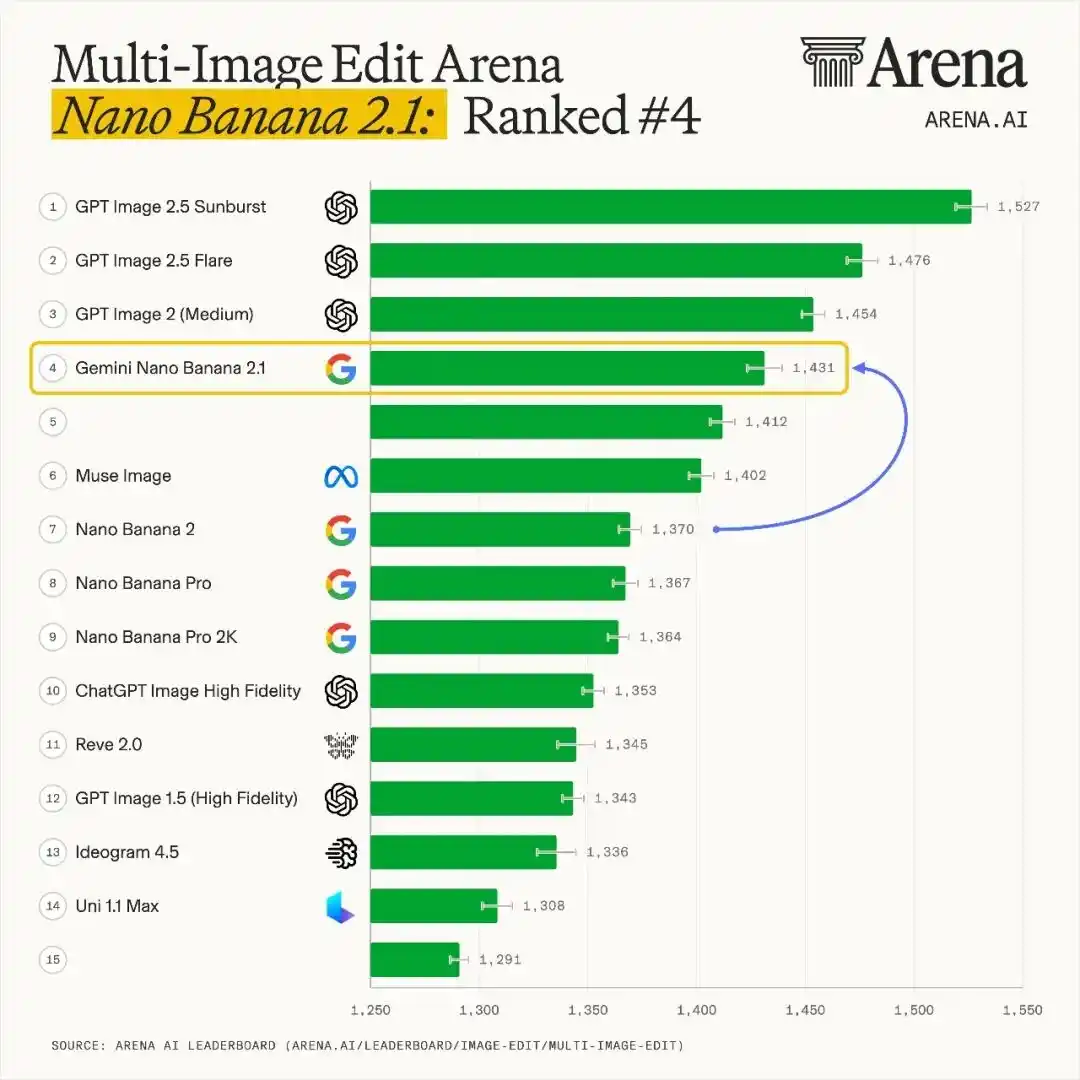
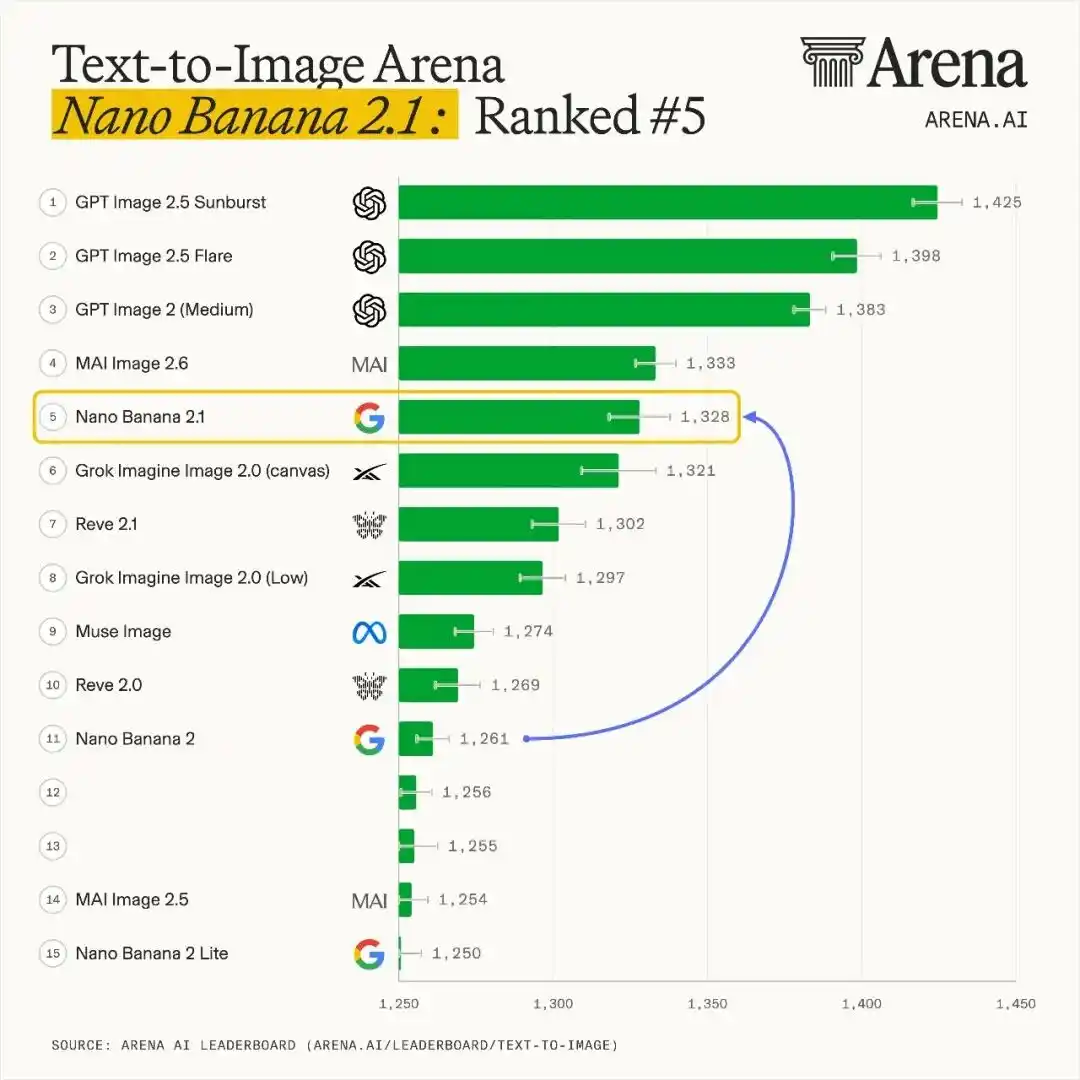
The article says user blind voting on Arena also points in the same direction. Nano Banana 2.1 ranked No. 4 in multi-image editing, No. 5 in text-to-image generation, and No. 6 in single-image editing.
In the multi-image editing ranking, only three OpenAI GPT Image models were ahead of it. The previous Nano Banana 2, by comparison, ranked No. 7, No. 11, and No. 14 in those same three lists.
Set against the lower image-generation price, the source frames the release as a clear push on cost performance.
Mask editing: change only the selected area
One of the main upgrades is mask-based editing. In the source article’s description, users can mark a specific region in an image and change only that part, while leaving the rest untouched.
The article argues that this has long been difficult in AI image generation. In older workflows, a prompt such as changing one cup in the lower-left corner to red often forced the model to regenerate the whole image, with no guarantee that the untouched areas would stay stable. Nano Banana 2.1 is presented as a more direct local-editing tool for tasks such as changing clothes, replacing signage, or removing passersby from the background.
The report cites a three-step test by X user ibexdream. First, the model generated an image of a banknote featuring an elderly philosopher resting his chin on one hand, with his hair extending backward into a maze. In the second step, the image was edited: the serial number changed from 「№ 1098471」 to 「NB-21098471」, the small text on both sides was replaced, a banana used as a telephone was added to the philosopher’s hand, and a ribbon reading 「IN BANANA WE TRUST」 was inserted below. In the third step, the whole banknote was converted into an oil painting. The article says the maze, robe, and beard stayed intact across the revisions.
On the model card, Nano Banana 2.1 scored 1049 in mask editing, 84 points above Nano Banana 2 and 122 points above Pro. The article also says that even without reasoning enabled, 2.1 still outperformed Pro on every metric.
Subject consistency and up to 14 reference images
Another major upgrade is subject consistency, which in practice means people and objects are less likely to drift across multiple generations or repeated edits.
The article says this was the category with the biggest score increase. Multi-person consistency reached 1106, up 128 points from Nano Banana 2. Developers can provide up to 10 object reference images and 4 character reference images, for a total of 14 references.
The source gives an example from X user BG-VC. He supplied one model photo plus reference images for a top, skirt, bag, shoes, and earrings, then asked for six photos in different scenes, all generated in one pass. The article says the six outputs showed different poses—walking, sitting, leaning against a counter—while keeping the face, clothing, bag, and earrings consistent enough to serve as a set of e-commerce images.
More photorealistic output and better infographic accuracy
The article says the images themselves now look closer to real photography. In Google’s sample images, it points to a beetle covered in water droplets and a woman in a green dress standing on stairs outside a pink house, saying both are hard to distinguish from non-AI images at first glance.
Google is also pushing infographic generation. Before drawing an infographic, the model can use Google web search and image search to gather information, according to the source.
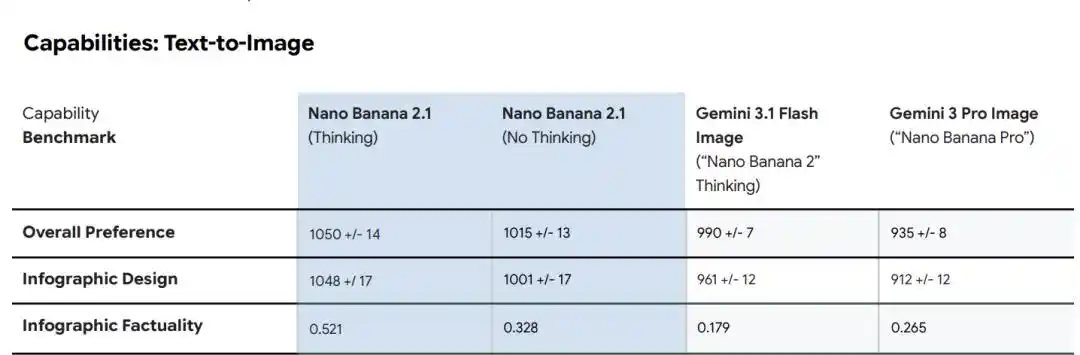
In Google’s automated evaluation, Nano Banana 2.1 scored 0.521 on factual accuracy for infographics, versus 0.179 for Nano Banana 2 and 0.265 for Pro. The article interprets that as fewer factual mistakes when generating science explainers and similar visual material.
Cheaper image generation, higher input and reasoning costs
Pricing is one of the clearest changes in the release. The article says image generation is billed at $30 per million tokens, exactly half the rate of Nano Banana 2.
- A 1K image drops from $0.067 to $0.034.
- A 4K image drops from $0.151 to $0.076.
That puts it at the same image price level as Nano Banana 2 Lite, which the article says was introduced in July as a low-cost option.
Other charges moved in the opposite direction:
- input pricing rose from $0.5 to $1.5 per million tokens;
- text and reasoning output rose from $3 to $7.5.
The source sums that up as Google shifting the bill from “drawing” to “thinking.”
Availability across Google products
Developers can already select the model in AI Studio under the name gemini-nano-banana-2.1.
The previous Nano Banana 2 API will be shut down on Oct. 29, the article says.
For general users, Google is also rolling the model out starting today across:
- Gemini App;
- Search AI Mode;
- Flow;
- the design tool Stitch;
- Google Ads;
- the Gemini enterprise platform.
The source adds that in the Google app, users can tap the banana icon below the search bar to try it.
Early tests against GPT Image 2.5 and GPT Image 2
Less than an hour after launch, users on X had already started posting comparisons.
Mark Kretschmann ran what the article calls a “torture test,” asking for a single image that combined crowds, clutter, readable text, and rainy-day reflections, then checking whether the final result still looked like a real photo.
Luis Catacora asked the model to create a tea shop menu board and write the same item, jasmine green tea, in English, Japanese, Arabic, and Hindi in one image.
Lad wrote a prompt designed to stress common weak points in image models: fine-line tattoos, three necklaces, a row of earrings, bracelets, and tinted sunglasses that still reveal the eyes. He then gave the same prompt to Nano Banana 2.1 and GPT Image 2.5. According to the article, Nano Banana 2.1 placed the tattoos, necklaces, earrings, and bracelets where requested, but failed to tint the sunglasses correctly and left part of the face looking sunburned.
Pankaj Kumar compared Nano Banana 2.1 with GPT Image 2 by asking both models to draw the same scene: a watch on a desk. The article describes Nano Banana 2.1’s result as a natural-light snapshot, while GPT Image 2’s version looked more like a polished ad image lit by a desk lamp, with the watch face changed into a skeleton movement.
Speed and cost differences were also highlighted. The AI/ML API platform prepared five prompts and had Nano Banana 2.1 and GPT Images 2.5 generate one image each for every prompt. The article says Nano Banana 2.1 took 11 seconds and cost $0.044 per image, while GPT Images 2.5 took 50 seconds and cost $0.069.
Hugo Plat created four space-themed prompts—spiral galaxy, supermassive black hole, quasar, and the entire solar system in one image—and sent them to Nano Banana 2.1 and GPT Image 2.5. Across the four images, Nano Banana 2.1 cost $0.178 in total, compared with $0.284 for GPT Image 2.5. On the black hole prompt, the article says Nano Banana 2.1 produced a more restrained image, while GPT Image 2.5 pushed nebula and flame effects much harder.
Chinese text rendering improved, but not flawless
For Chinese output, the article cites blogger 歸藏, who said the text was clearer, typo rates were much lower, and layouts looked cleaner, without the fragmented feel he associated with GPT outputs. He also said one of Nano Banana 2.1’s advantages over GPT was direct 4K output.
Still, the article includes a failure case. In one example, a vertical line of small English text next to the Chinese phrase 「传承与新生」 became unreadable gibberish when zoomed in.
The image race is shifting toward editing
The source article closes by placing the release in a broader product timeline. In April, GPT Image 2 launched and led Nano Banana 2 by 240 points on the same Arena text-to-image ranking. In September, OpenAI released Images 2.5 with a focus on editing only specified regions and staying on track through repeated revisions.
Less than a month later, Google’s Nano Banana 2.1 is also centered on those two areas: local editing and multi-round consistency. The article argues that this lines up with how e-commerce, advertising, and brand design teams actually work, where a single image may go through more than ten rounds of revision and stability in later versions matters more than a striking first draft.
That is also why Google has placed Nano Banana 2.1 directly into Google Ads and its enterprise platform, according to the source. The article cites a post from Google AI Studio on X as reference material. It also notes that the piece was edited by Moses and David, and originally came from the WeChat public account Xinzhiyuan, written by ASI Qishilu.