
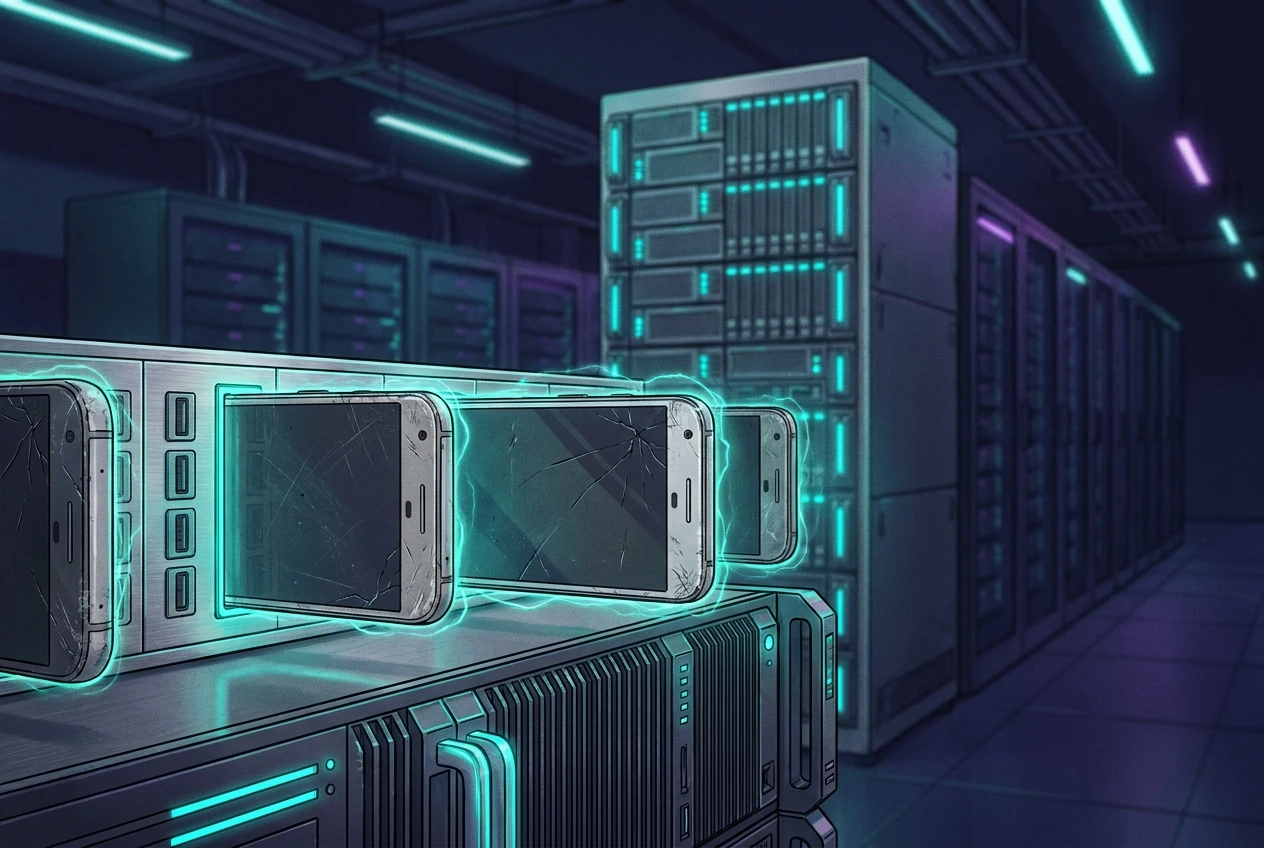
Google Research has floated a counterintuitive proposal: instead of building new server rooms or buying new hardware, turn retired smartphones into computing nodes. In a blog post, the team revealed that clusters of old phones, stripped of screens and batteries and kept only the motherboards, can match a modern data-center server with 25 to 50 units, while emitting far less carbon than new gear.
Pixel Fold's Single-Core Beats a Data-Center Server
The team benchmarked a 2023 Pixel Fold's processor against an ASUS RS720A-E11 data-center server using SPEC CPU2017. Result: the Pixel Fold's performance cores scored higher on most tests in single-core. The reason is straightforward—phone chips are engineered for extreme per-watt performance due to battery constraints, while server chips prioritize multi-core parallelism, large memory, and I/O throughput. Single-core is not a design focus. The generational gap tilts in the phone's favor.
That translates to 25 to 50 old phones offering compute power equivalent to one modern server. The proposal groups phones into self-managing clusters of 25–50, orchestrated via containers and Kubernetes. To upper-layer applications, the cluster behaves like a cloud instance.
Motherboard Only: The Conversion Process
Retrofitting isn't about shoving whole phones into racks. The team removes screens, batteries, cases, cameras—everything but the motherboard. Reason: Google's internal carbon footprint assessment shows the motherboard accounts for 50% of a phone's embodied carbon. Keeping it maximizes carbon savings. Batteries are unsuitable for data centers anyway; cases and screens add no compute value.
Software also needs a major revamp. Android's user space is loaded with consumer-device mechanisms like the 'low memory killer,' which kills background processes when memory is tight. Designed for UI smoothness, it disrupts normal allocation in a server environment. The team swapped the mobile Android userspace for a generic Linux distribution and turned off such consumer-level protections.
UC San Diego's 2,000-Phone Experiment and the Reliability Puzzle
Small-scale tests are already in. A 20-phone cluster delivered lower grading latency than a default AWS backend during peak assignment submissions in a class of 75+ students. Each phone's compute roughly matches an AWS t3.micro instance (2 vCPU, 1GB RAM). For university EdTech, grading, and research workloads, a single phone handles most tasks.
UC San Diego is now building a 2,000-phone compute cluster, aiming to support courses like parallel computing and system programming. Once fully deployed, it can serve hundreds of such courses simultaneously. The system is expected to go live in fall 2026, providing about 50 servers' worth of compute at a fraction of the cost.
The biggest unknown is reliability. Consumer hardware was never designed to run server workloads 24/7. Part lifespan and failure rates need massive long-term data. The 2,000-phone cluster is partly about collecting that data. The real significance may not be cost savings or sustainability—it challenges the default assumption that compute must come from purpose-built hardware. When consumer-grade single-core performance can beat data-center gear in specific scenarios, the very definition of 'compute' starts to shift.