
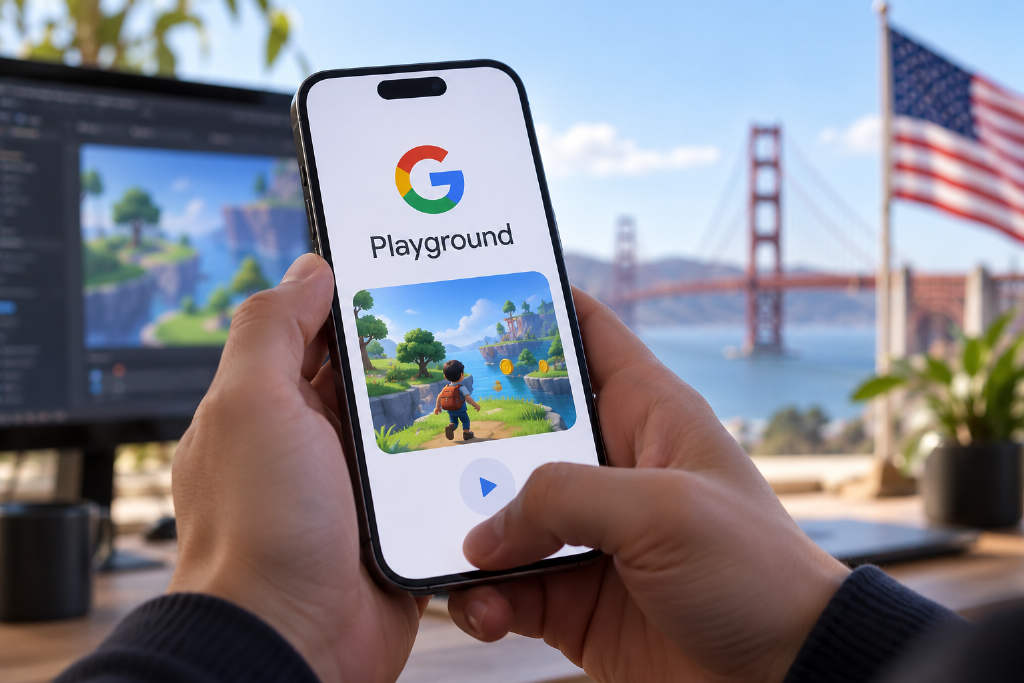
Google launched Playground on Oct. 7 U.S. time, introducing an experimental product that lets users generate playable games from text descriptions. The initial rollout is limited to users in the United States who are 18 or older, and generation allowances are split by subscription tier. A more advanced offering, Unity Spark, is still in the waitlist stage, and Google’s post did not explain how creators would make money from their work.
Text prompts can produce games that users can play right away
In its official blog post, Google described Playground as an experimental service for building, playing and sharing original games. Users interact through a chat-style interface and can begin from a blank canvas, sample prompts or guided suggestions, then test the game as they go.
If they want to change physics rules, rewrite gameplay or swap out characters, they can do that by entering more instructions. Finished projects can stay private, be shared through a link, or be published to the Playground Explore showcase. Google said works featured there are recommended based on player ratings and play activity. Multiplayer is available only for certain types of games.
Google says Playground uses Gemini, Nano Banana and Lyria
Google spokesperson Nia Carter told The Verge that Playground is powered by the company’s existing foundation models, including Gemini, Nano Banana and Lyria, together with a harness tuned through repeated internal game creation and evaluation.
Unity said in a press release that users can sign in with a Google Play Games profile, and that leaderboards, multiplayer matchmaking and community features are available from day one. Unity also said Google will highlight standout projects across its own channels, describing that exposure as a promotional boost for creators. The release did not disclose any partnership value or financial terms.
Free access comes with weekly token limits
Playground is free to use, but game generation is governed by a weekly token quota. Carter said Google One subscribers receive a higher weekly allowance, though the exact amount depends on the plan. Google did not publish the figures for each tier.
Geographic access is also narrow at launch. The service is available only to U.S. users age 18 and older, and Google did not provide a timeline for expansion to other regions.
Unity Spark remains gated and comes with tighter restrictions
Unity Spark carries more conditions than Playground. In demonstrations and explanations provided by Unity to GamesIndustry.biz, the product runs on the Unity engine, works entirely in the browser and requires no download. It is also limited to users 18 and older and is scheduled to enter closed testing later this year, meaning only selected users will get early access. For now, people can only join the waitlist.
The early limitations are more restrictive. Projects cannot be downloaded, cannot be exported to the full desktop Unity engine and cannot be sold. Pricing will use a credit system: users will receive a certain amount of free credits first, then need to buy more after that. Unity did not provide the detailed terms. The company said the focus is on helping more people make games, not on using the service as a way to earn money.
Rules allow homage and parody, but ban impersonation and gambling promotion
Under the platform’s community rules, users are allowed to create works that pay homage to, parody or explore existing gameplay styles, as long as the result is clearly an original creation. At the same time, the rules prohibit imitating existing games through titles or cover images, and they also ban the sale or promotion of regulated services such as gambling.