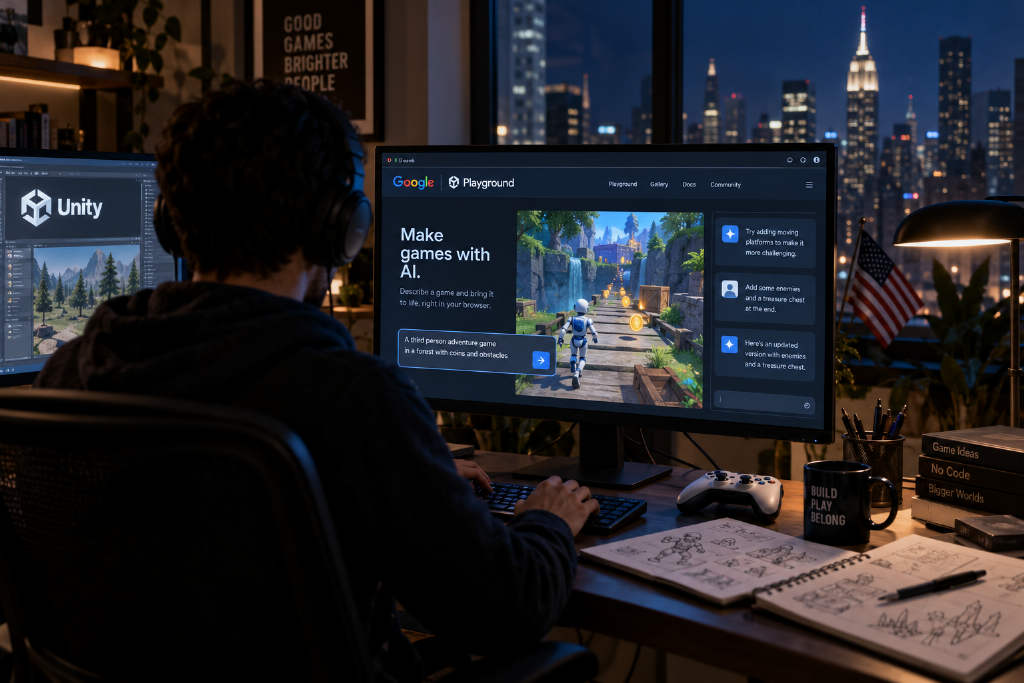
Google on Wednesday launched Playground, a web platform that lets users describe a game in plain language and receive a playable version back without writing code. The company said users can then refine the result through chat, asking for different physics, rules, characters, or settings, and share the game through a link.
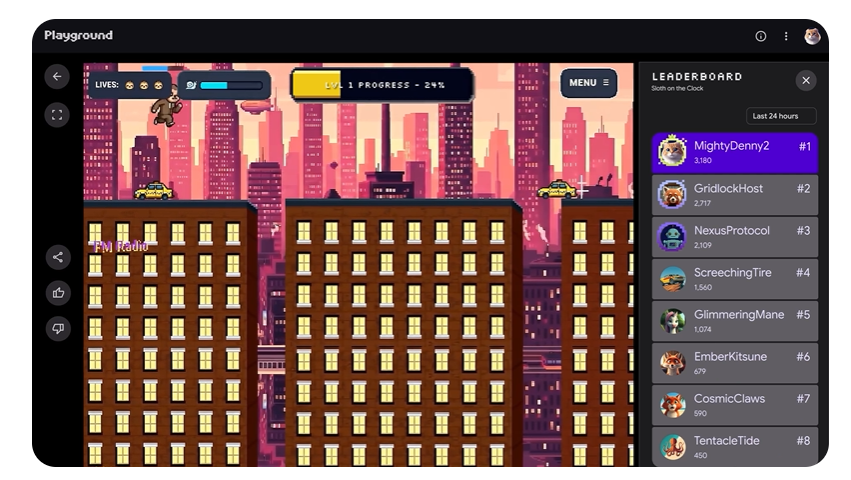
In its announcement, Google wrote: 「Today, we’re introducing Playground, an experimental gaming platform that lets you create, play, and share custom games.」 It added: 「Playground lowers the barriers to creation, so bringing game ideas to life can now be as easy as describing it through a few prompts—no coding experience required.」
Available now to U.S. adults
Playground is live for U.S. users aged 18 and older. Creation access will roll out in tiers based on a user’s Google AI subscription, according to Google. The company’s announcement did not include pricing and did not say which AI models power the tool.
The games run in a web browser on phones and laptops. Creators can keep them private or publish them to a community gallery. Google said every game published there goes through a safety screening, and some genres support leaderboards and multiplayer.
Google frames it as an early experiment
Google describes Playground as 「an early experiment designed to make game creation more approachable.」 The company’s pitch is simple: 「If you can think it, you can play it.」
According to the report, Playground appears to go beyond the simpler kind of vibe coding users might do in a Google Gemini session. It seems capable of drawing on some of the same tools and resources used by experienced game developers in their day-to-day work.
Unity Spark is the next step
Google said Playground will soon integrate with Unity Spark for creators who want professional-level mechanics and high-fidelity 3D. Unity makes a game engine, the software toolkit studios use to build games. Unity’s then-CEO said in 2023 that generative AI could cut the time needed to build game worlds by five to ten times.
Google and Unity said in a joint release that Spark will arrive later this year, and Google said a closed beta is coming soon.
Part of Google’s broader Genie push
DeepMind, Google’s AI research lab, unveiled Genie in 2024. The model was trained on more than 200,000 hours of gameplay video and could turn an image or text prompt into a simple 2D platformer. The report said it had 11 billion parameters, the adjustable values where an AI stores what it learned.
In January, Google opened Project Genie to AI Ultra subscribers in the U.S. The product was built on Genie 3, which Google described as a world model that generates an interactive world in real time as a user moves through it. Sessions were capped at 60 seconds, and Google warned that the generated worlds might not follow prompts or real-world physics.
Game stocks fell after the earlier Genie news
The report said game stocks sank the next day after that earlier announcement. Unity closed down about 24%, while Roblox and others also dropped, as investors worried AI could displace traditional game-development tools. Roblox had told investors in 2023 that it was moving toward letting anyone create avatars and clothing entirely through text prompts.
Still positioned as a prototype-stage tool
For people who have never used a code editor, Playground turns a game idea into a conversation rather than a career change, though only adults in the U.S. can try it for now. The report also noted that anything generated this way is more likely to resemble a prototype before it resembles a hit, and Google itself says the product is experimental.