
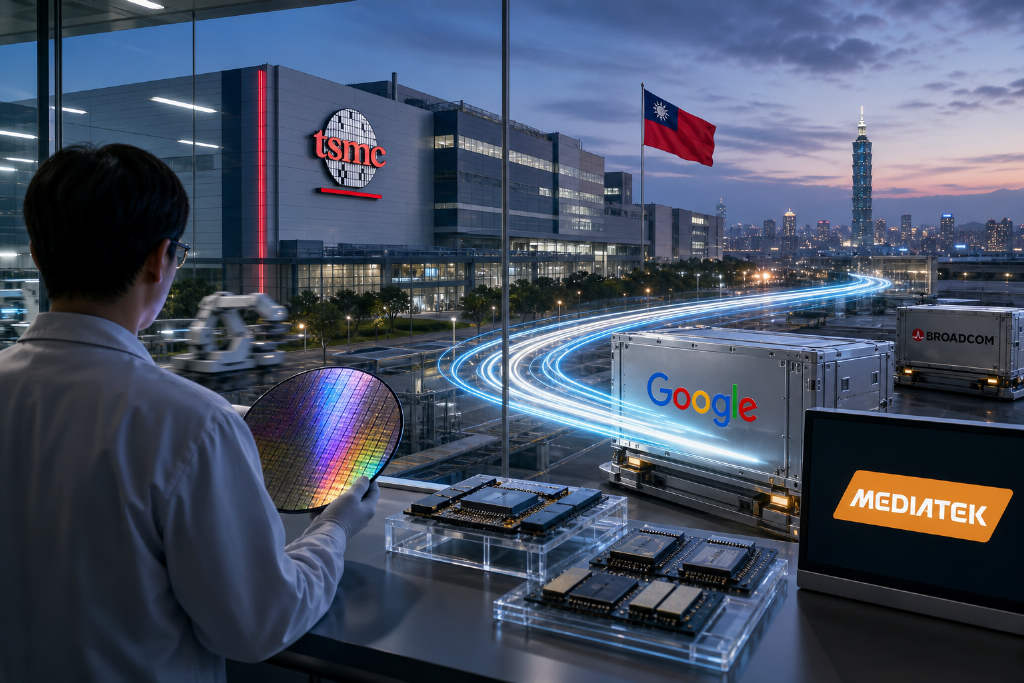
J.P. Morgan said in its latest industry survey that MediaTek is making steady progress with mass production of its TPUv8t Zebrafish AI accelerator, with related revenue projected to exceed $2 billion in 2026. In unit terms, the bank said the product could overtake Broadcom’s competing Sunfish in 2027. It also said Broadcom currently lacks a competitive option for the 2028 TPUv9 generation, as Google’s TPU order mix shifts more heavily toward MediaTek.
Zebrafish enters volume production with TSMC
According to J.P. Morgan’s supply-chain checks, MediaTek’s TPUv8t Zebrafish ASIC is already in mass production with Taiwan Semiconductor Manufacturing Co. using the N3 node and TSMC’s CoWoS advanced packaging technology.
Based on that production pace, J.P. Morgan said MediaTek’s data center ASIC revenue could pass the $2 billion mark in 2026, strengthening the company’s role in Google’s AI infrastructure supply chain.
On the supply side, the report said N3 wafer capacity and CoWoS packaging capacity are currently sufficient, with the main bottleneck sitting at the substrate level. MediaTek is actively qualifying new suppliers to support shipments for both TPUv8 and the next-generation TPUv9, the survey said.
J.P. Morgan sees MediaTek topping Broadcom in 2027 shipments
Looking ahead, J.P. Morgan expects MediaTek’s Zebrafish shipments to exceed Broadcom’s Sunfish in 2027. That, it said, could push full-year data center ASIC revenue to $18 billion, well above MediaTek’s own guidance range of $12 billion to $16 billion.
Zebrafish and Sunfish are both dual-sourced products under Google’s TPUv8 program. They compete for allocation within the same customer account and the same application setting, so higher shipment volume for MediaTek would mean taking share from Broadcom.
43% cost gap could drive more orders to MediaTek
The survey highlighted another figure that weighs on Broadcom’s position: Google could save about 43% per chip if it shifts its purchasing focus from Broadcom’s fully integrated design architecture to MediaTek’s semi-CoT modular packaging approach.
At Google’s scale of computing procurement, J.P. Morgan said, that unit-cost gap translates into savings worth billions of dollars. The bank also said there is currently no sign that Broadcom has a 2028 TPUv9 competitor, codenamed Pumafish.
In J.P. Morgan’s view, if MediaTek moves ahead of Broadcom in the TPUv8 cycle, it could take on an even larger role in Google’s supply chain in the TPUv9 generation.
MediaTek’s $3.9 billion ECB deal draws NVIDIA and Alphabet
MediaTek has also made a major move in the capital markets. On Aug. 31, the company announced a $3.9 billion unsecured overseas exchangeable convertible bond, or ECB, issuance, setting a record for Taiwan’s offshore convertible bond market.
NVIDIA subscribed for $3.5 billion, close to 90% of the total, while Alphabet took the remaining portion. ABMedia said the transaction reflects strong foreign investor confidence in MediaTek’s medium- to long-term growth and lines up with J.P. Morgan’s view that the company’s standing in the AI supply chain is rising quickly.