
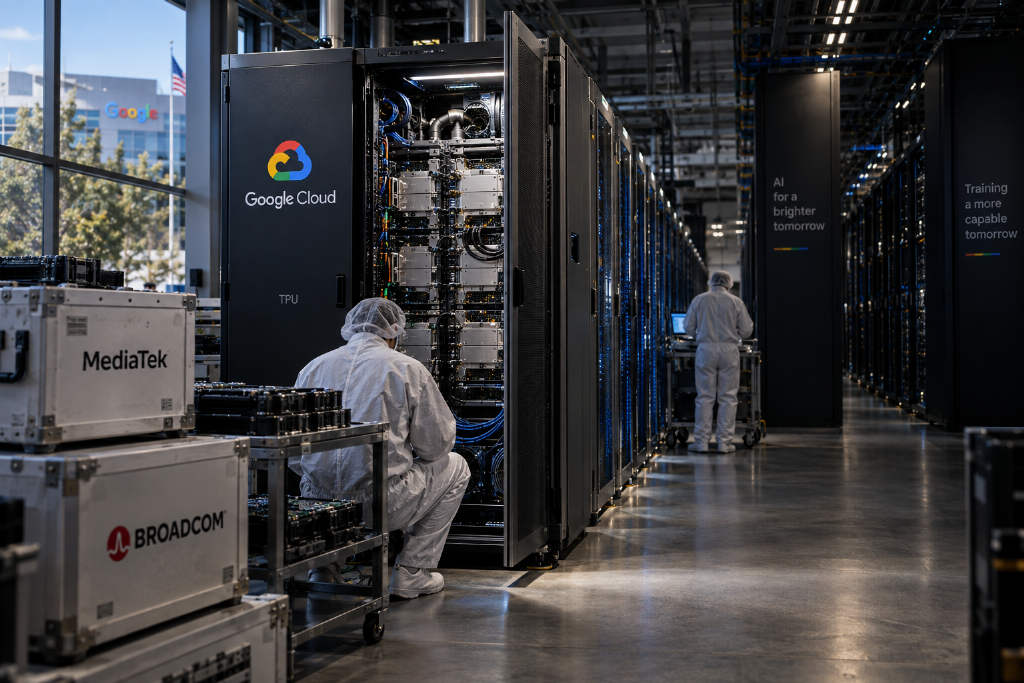
Google Cloud CEO Thomas Kurian said Google’s in-house TPU chips can recover their investment in about one year, while the overall payback period for Google AI servers is less than two years. The disclosure has shifted market attention to the supply chain. Industry sources said Google TPU order momentum continues to build, with MediaTek expanding its supply share and Broadcom still holding major orders for training-side chips. Demand is also spreading beyond AI labs into finance, biotech and the public sector.
TPU demand is widening from AI labs to finance and government programs
According to DIGITIMES, Kurian said at Goldman Sachs’ Communacopia + Technology forum that Google AI servers have an overall investment payback period of under two years, while the payback period for the company’s self-developed TPU is only one year. He said TPU deployment demand is no longer limited to AI laboratories.
Google Cloud’s AI infrastructure customers now include financial services, capital markets, high-performance computing, public-sector entities and research institutions. The examples cited in the report include hedge funds, Deutsche Börse and the U.S. government’s Genesis Mission project for the energy sector. As use cases broaden, Google needs to launch more TPU projects tailored to different computing patterns, which the report said could become a driver of new orders for Taiwanese suppliers.
SemiAnalysis finds lower inference cost for TPU v7 Ironwood in some FP8 tests
Research firm SemiAnalysis compared Google’s seventh-generation in-house AI accelerator, TPU v7 Ironwood, with Nvidia’s B200 and B300 for FP8 inference. Under a setting of 100 tokens per second per user, Ironwood’s cost was about $0.181 per million tokens, compared with $0.222 for the B200 and $0.276 for the B300, or roughly 19% and 34% lower, respectively.
Under a lower-throughput condition of 20 tokens per second per user, Ironwood’s token output per dollar was 50.4% higher than the B200 and 96% higher than the B300.
SemiAnalysis also cautioned that the results can vary significantly depending on development maturity and latency requirements. It added that the B200 still outperforms Ironwood on some compute curve ranges. Ironwood also lacks native FP4 capability, leaving Nvidia ahead in FP4 comparisons.
MediaTek raises supply weight while Broadcom keeps training-side TPU business
Supply chain sources said MediaTek (2454) has raised its ASIC business target across several recent earnings calls, while Broadcom’s rapid revenue growth also points to stronger Google TPU order momentum. From the supply chain’s perspective, Google has been rolling out more chip variants in response to changes in AI technology. TPU is now the largest cloud AI chip product by demand outside Nvidia, according to the report.
In terms of division of labor, MediaTek is continuing to expand its supply role, with related revenue estimates also moving higher. Broadcom, for its part, has said demand for TPU training-side chip orders remains strong, and some customers’ TPU procurement programs are still in Broadcom’s hands. Google has already indicated that its next-generation TPU will split into the training-focused 8t and the inference-focused 8i. The design requirements for the two are materially different, creating more entry points for ASIC design service providers.
Industry view: the market is growing fast enough for more suppliers to expand
A person familiar with the IC design industry said MediaTek and Broadcom are still likely to compete head-on for market share, and more peers may join the field. Even so, that person said the Google TPU market is expanding at a pace where it remains “big enough for everyone to keep growing.” In that view, near-term market share shifts could benefit a broader group of ASIC companies, while the supplier base becomes more diversified.