

OpenAI’s GPT-5.6 Sol Max is facing fresh scrutiny from Codex users who say the model became less willing to think through hard problems, even though it started answering faster.
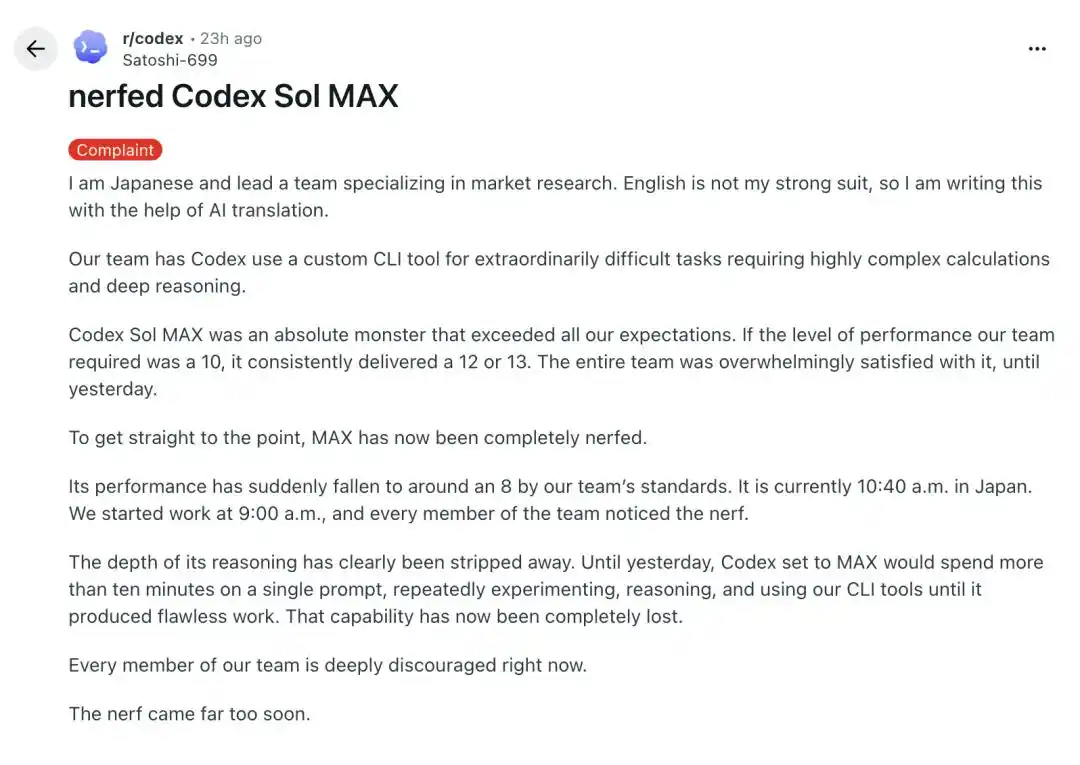
The discussion gained traction after a Japanese market research team posted on Reddit’s r/codex, saying the behavior of Codex Sol MAX changed during the morning of July 15. The team said it runs the model through an in-house CLI tool for jobs that require complex calculation and deep reasoning. Under normal conditions, according to the post, the model would spend more than 10 minutes iterating on a prompt, repeatedly testing ideas, calling tools, and refining the result until the output was hard to fault.
That behavior, the team said, dropped away that morning. Work started at 9 a.m., and by 10:40 a.m. every member had noticed the same pattern: the model was quicker, but it no longer pushed as deeply into the task. The post described a system that had previously outperformed expectations and then suddenly delivered shallower work.
Community complaints centered on a hidden reasoning parameter
The Reddit post was only one example. The original report said similar complaints had spread across the Codex community in recent days, with users giving almost the same description: responses arrived faster, but the model seemed less inclined to dig, reconsider, or challenge its own first pass.
For users, proving that kind of change is difficult. They cannot directly inspect model weights or see how much server-side compute is being allocated. What they can observe are indirect signals: reply speed, how long the model appears to think, whether it revisits its own answer, and whether it spins up other agents to help with a task.
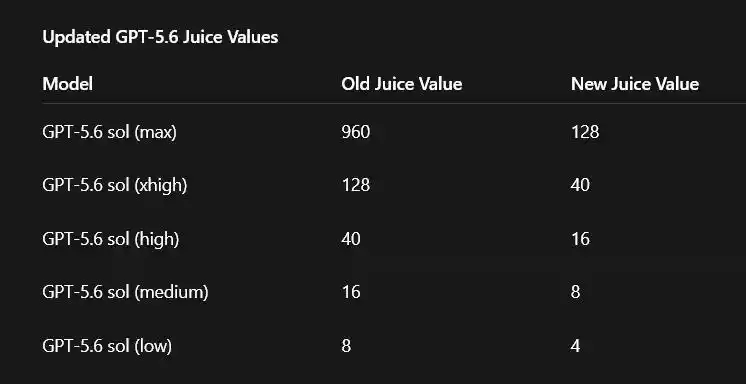
That led some community members to inspect system prompts and hidden configuration fields. One user, identified in the report as ns123abc, used what the community calls a “model fingerprint” hidden prompt to surface a value in the system configuration labeled “juice.”
OpenAI has not publicly documented that parameter. Community observations had previously placed Sol Max at a juice value of 960. This time, screenshots showed 128 instead, a drop of nearly 87%.

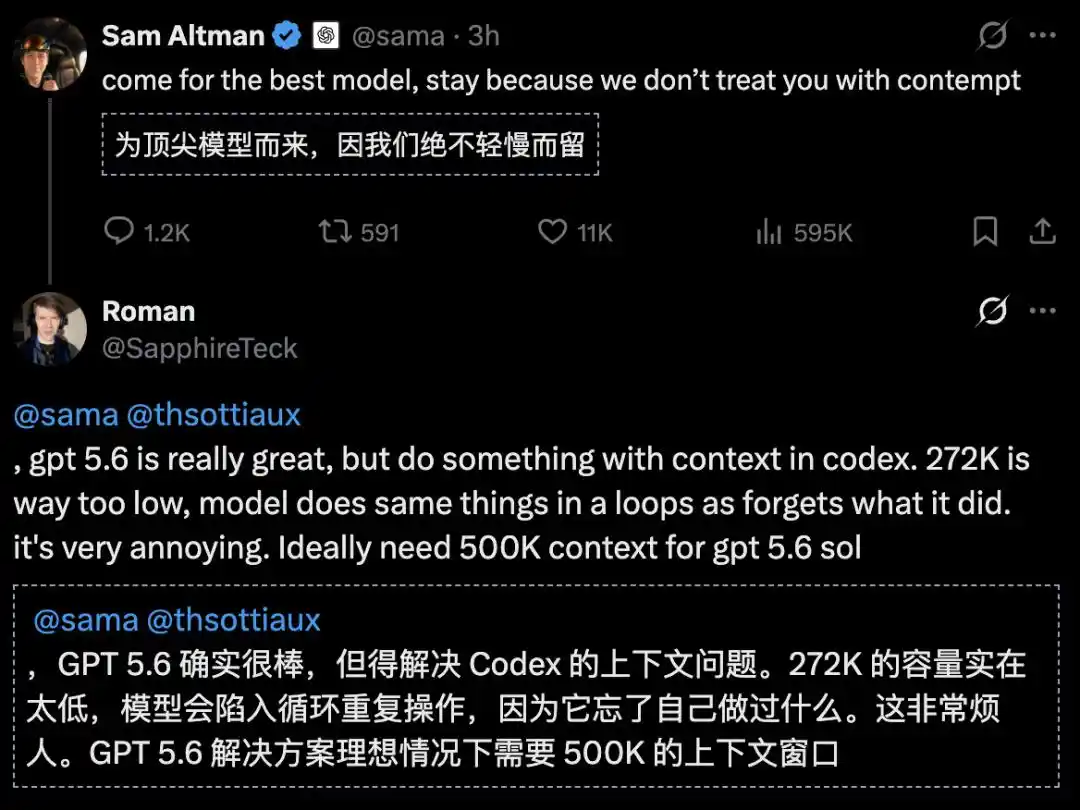
At roughly the same time, another set of screenshots began circulating that appeared to show usable context in the Codex client falling from about 372k back to 272k. Together, those two numbers became the focus of the backlash.
OpenAI says there was no nerf, only an experiment
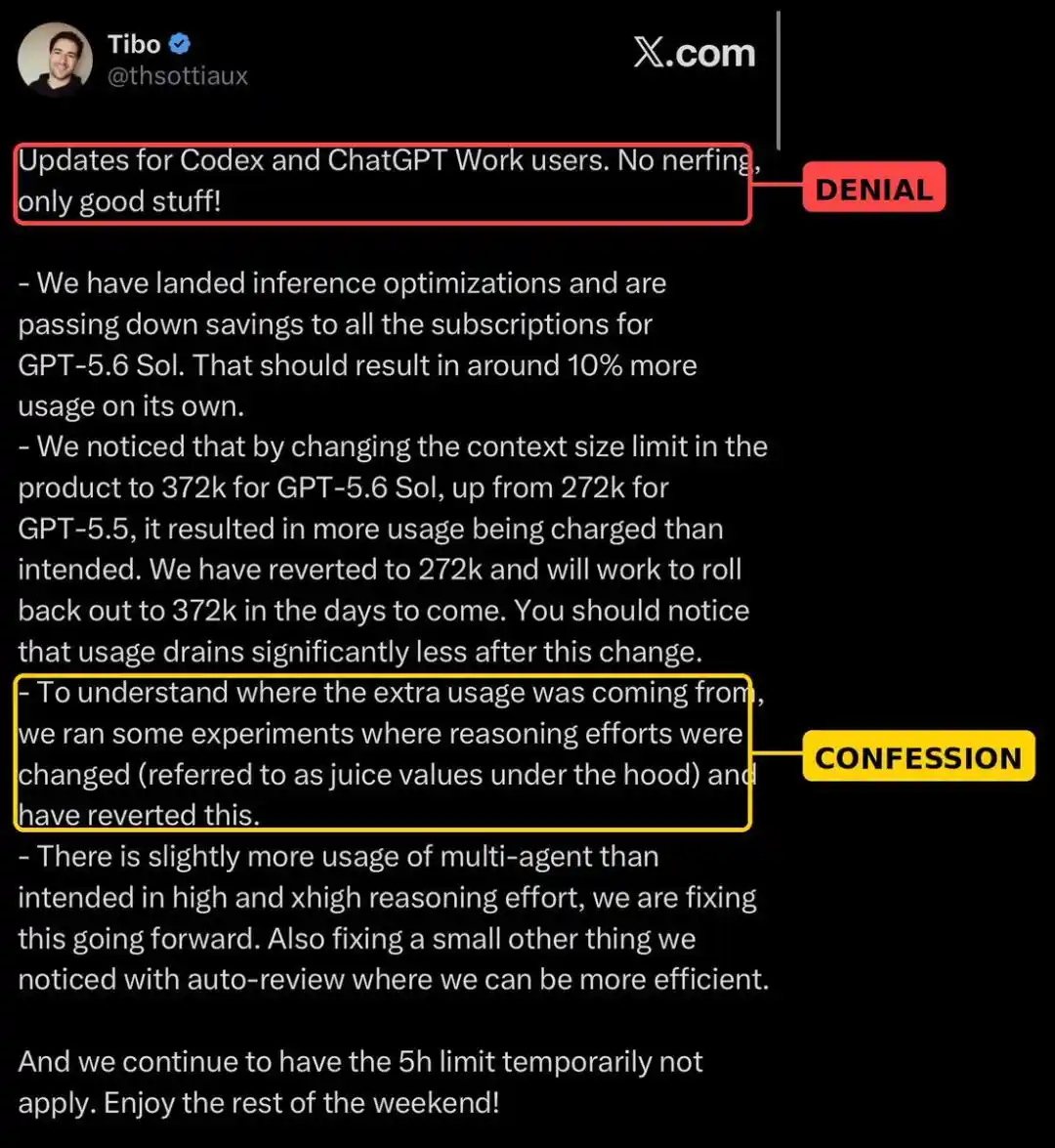
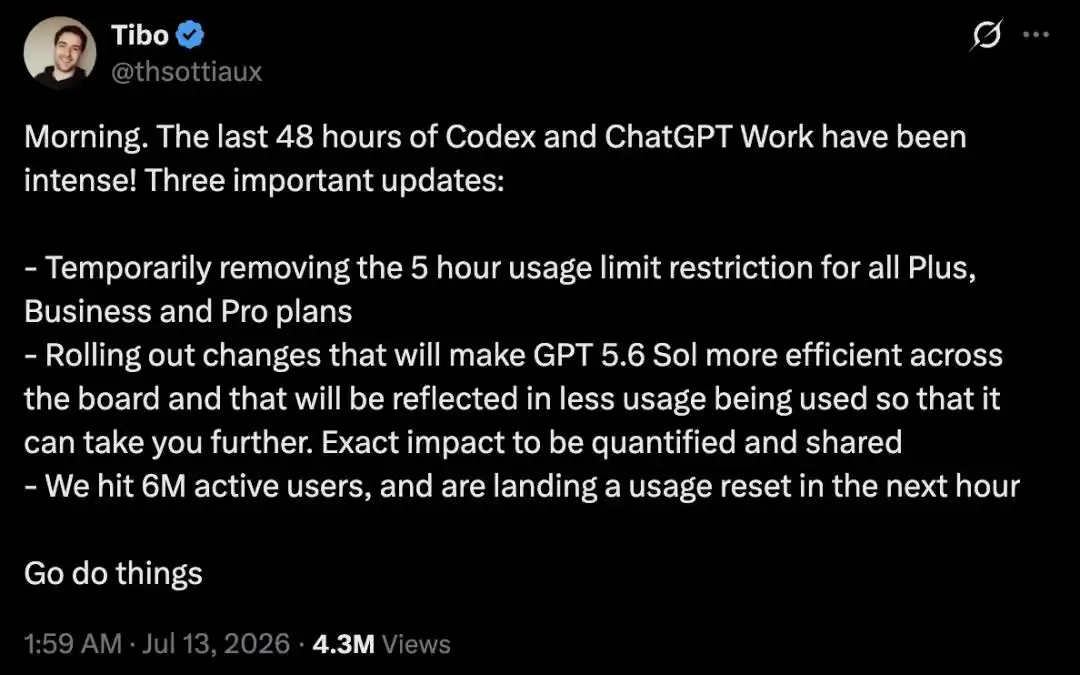
Thibault Sottiaux, the OpenAI executive responsible for Codex and ChatGPT Work, responded on X later that day. His opening line was direct: there was no “nerf.”
According to Sottiaux, four things were happening at once.
- First, reasoning efficiency improvements had already shipped, and the compute saved there would be returned to subscribers, adding roughly 10% more usage.
- Second, Sol’s context limit had been lifted from GPT-5.5’s 272k to 372k, but that change consumed more than expected, so the limit had temporarily been moved back to 272k, with 372k set to return in the coming days.
- Third, the team ran experiments to understand where the extra usage was coming from, and those experiments changed “reasoning effort,” which he said is internally referred to as “juice values.” He added that the setting had already been changed back.
- Fourth, multi-agent calls in the high and xhigh tiers were higher than expected, and auto-review was also wasting resources, both of which were being fixed.
His statement did not address whether the underlying model weights had changed. It did, however, acknowledge that the configuration users actually received had been altered during the experiment.
What “juice” appears to represent
OpenAI’s public product language focuses on reasoning tiers. When GPT-5.6 was released on July 9, the company said it introduced max reasoning intensity for the first time, giving Sol the most time for deep reasoning. Above that sat an ultra mode, which by default launched four agents in parallel.
Inside ChatGPT, those settings appear as options such as Medium, High, and Extra High. The report said they all run on Sol, while the Pro tier runs on Sol Pro.
“Juice,” based on the information cited in the report, seems to sit underneath those visible options as an internal reasoning resource budget. Users do not normally see it, and OpenAI has not published official values.
A lower reasoning budget does not automatically prove that a model is weaker. Even so, it could affect several parts of task performance: how many routes a long job explores, how many rounds of comparison happen between candidate solutions, whether generated code is tested proactively, how many rollback attempts occur after failure, and whether difficult edge-case tasks get enough extra work to succeed.
That is one reason the dispute remains unresolved. The report argued that settling the question would require a controlled comparison using the same model snapshot, the same tasks, and the same tooling environment, while changing only the juice variable. Only then could users measure the effect on complex coding, long-horizon agents, math reasoning, and error recovery. For now, that evidence is missing.
Usage pressure appears to be the immediate backdrop
The report tied the experiment to a sharp demand surge after GPT-5.6 launched. OpenAI at one point temporarily relaxed a five-hour usage window to absorb rising call volume.
The same features that made GPT-5.6 attractive were also expensive in token terms: longer thinking time in Max mode, four-agent parallel execution in Ultra, and a larger context window. Those were the places where usage climbed.
Seen from that angle, the experiment described by Sottiaux follows an engineering logic. If usage overshoots expectations, one way to isolate the source is to lower the budget variable and observe what changes. But that same adjustment is also something users can feel. On their side of the product, it can register as a model that simply does not want to think as hard.
A broader question about what a model tier guarantees
The dispute reaches beyond GPT-5.6 Sol Max itself. The report framed it as part of a larger shift in how advanced AI systems are delivered: away from laboratory systems that occasionally produce astonishing results and toward infrastructure that must run continuously inside ordinary workflows.
That change weakens the assumption that a model name alone defines a stable level of intelligence. Even if the model label stays the same, a platform can still alter the service users actually receive through resource budgets, context limits, and multi-agent orchestration rules.
The original article compared that relationship to buying a light bulb with a fixed product name while the brightness dial remains in the platform’s hands. For enterprise buyers, the report argued, a model name may not be enough. Vendors may need to explain what a paid Max tier actually guarantees, which parameters can shift dynamically, and how those changes may affect output on demanding tasks.
As of publication, the debate remained active. What is publicly established from the cited material is narrower: community users reported seeing a juice value move from 960 to 128 and a context change from about 372k to 272k, while OpenAI said those changes came from a temporary experiment aimed at understanding unexpectedly high usage and that the relevant settings had already been restored.