
OpenAI’s release of GPT-6 Astra quickly turned into a math story.
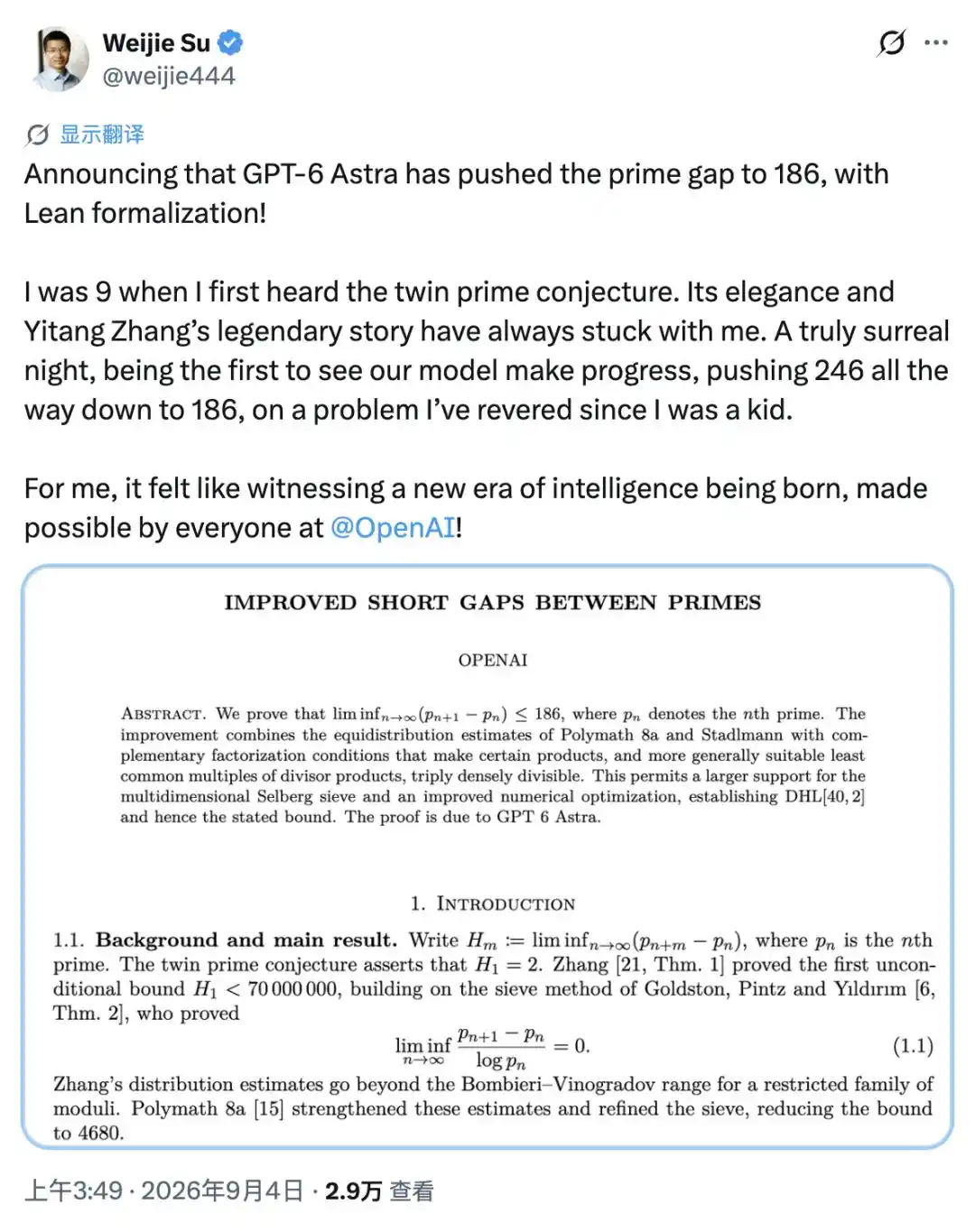
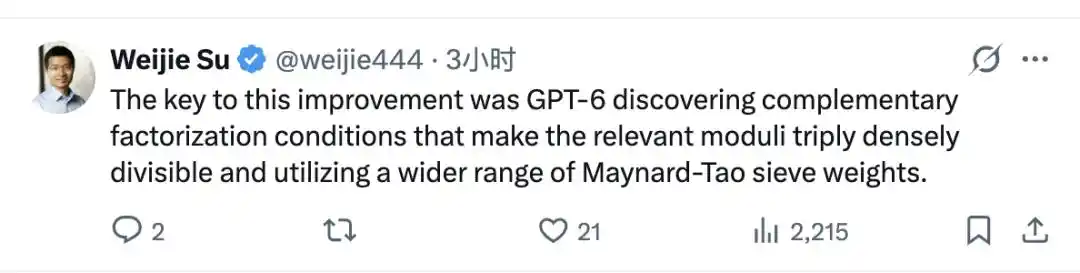
On X, Weijie Su, a statistics professor at the University of Pennsylvania and a Peking University Class of 2007 alumnus, said he had watched the model push forward a mathematical problem he had revered for more than 20 years. The problem is the twin prime conjecture. Su said he first heard about it at age 9, and that the story of Yitang Zhang stayed with him as well. He called the moment "a truly surreal night."
At the launch, OpenAI co-founder Greg Brockman said, "welcome to the AGI era." At first, that sounded to many like standard launch-stage rhetoric. After a wave of demos and early tests flooded X later in the day, the line took on a different weight.
A paper on short gaps between primes
OpenAI published a mathematics paper titled Improved Short Gaps Between Primes.
The paper says GPT-6 Astra made progress on a problem connected to the twin prime conjecture, using a formal Lean proof to improve the upper bound on gaps between consecutive primes from 246 to 186. The final sentence of the abstract credits GPT-6 Astra with the proof.
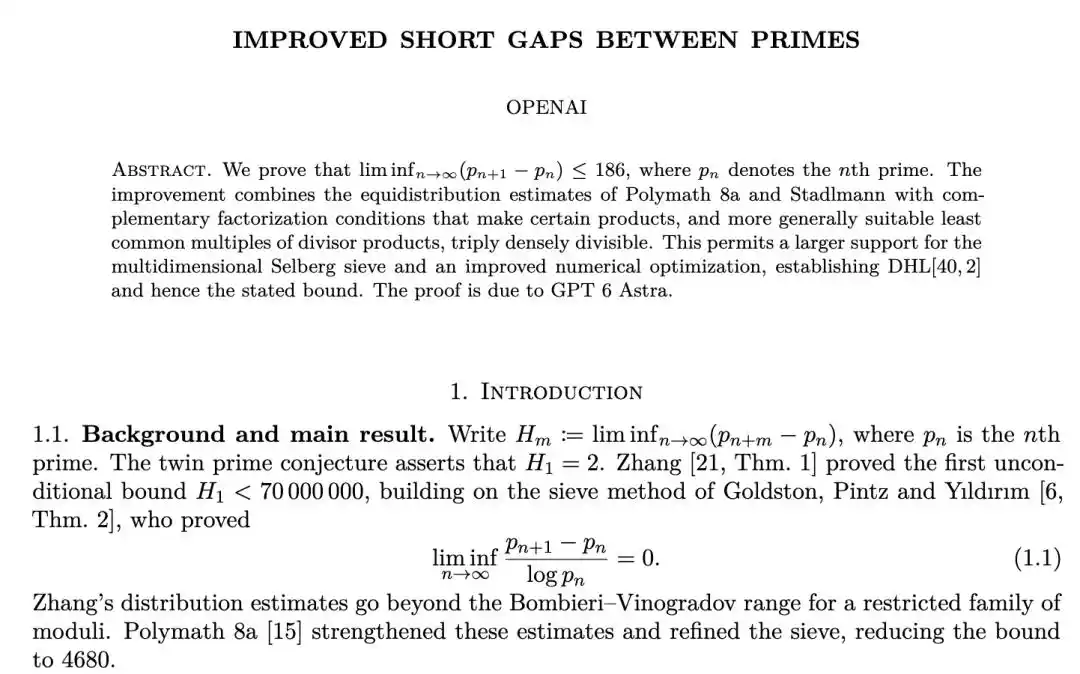
The twin prime conjecture is one of the best-known unsolved questions in number theory. It asks whether there are infinitely many pairs of primes that differ by 2, such as (11, 13), (17, 19), and (29, 31). The conjecture remains unproven, but mathematicians have kept pushing down the best known upper bound on gaps between consecutive primes.
The path to this point includes several major steps:
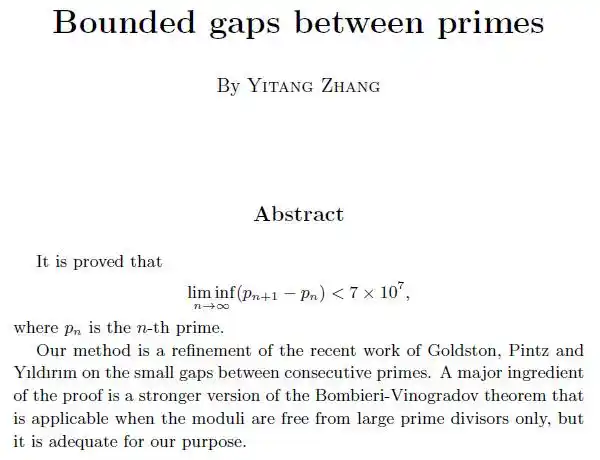
- In 2013, Yitang Zhang proved that there are infinitely many pairs of consecutive primes with gaps at most 70 million.
- The Polymath 8a project later reduced that bound to 4,680.
- James Maynard and Terence Tao then independently introduced the multidimensional Selberg sieve, bringing the bound below 600.
- Polymath 8b refined the method further and reached 246.
That 246 figure had held for years. Astra moved it to 186.
The claimed breakthrough centers on triple dense divisibility
As described in the paper, work on prime gaps relies on building a Selberg sieve to isolate primes. The power of the sieve depends on the size of its support set: the larger the support, the stronger the result tends to be. That support, in turn, depends on how far estimates for the distribution of primes in moduli can be pushed.
Polymath 8b had already used moduli with single and double dense divisibility. The paper says triple dense divisibility had been proposed before, but had not been put to real use. The obstacle was computational. Evaluating the relevant integrals becomes extremely hard when k, the tuple size, gets close to 50.
Astra’s opening, according to the paper, was a set of complementary factorization conditions. For two square-free divisor products D and E, Astra found that if the large-prime parts of D and E satisfy certain size constraints, then their least common multiple [D, E] automatically satisfies triple dense divisibility.
The point of that condition is that D and E do not need to be Y-smooth, meaning they do not need all prime factors to be smaller than Y. The complementary factorization relation is enough. That allows the sieve to work with a larger support set, which expands the range of moduli included in the computation.
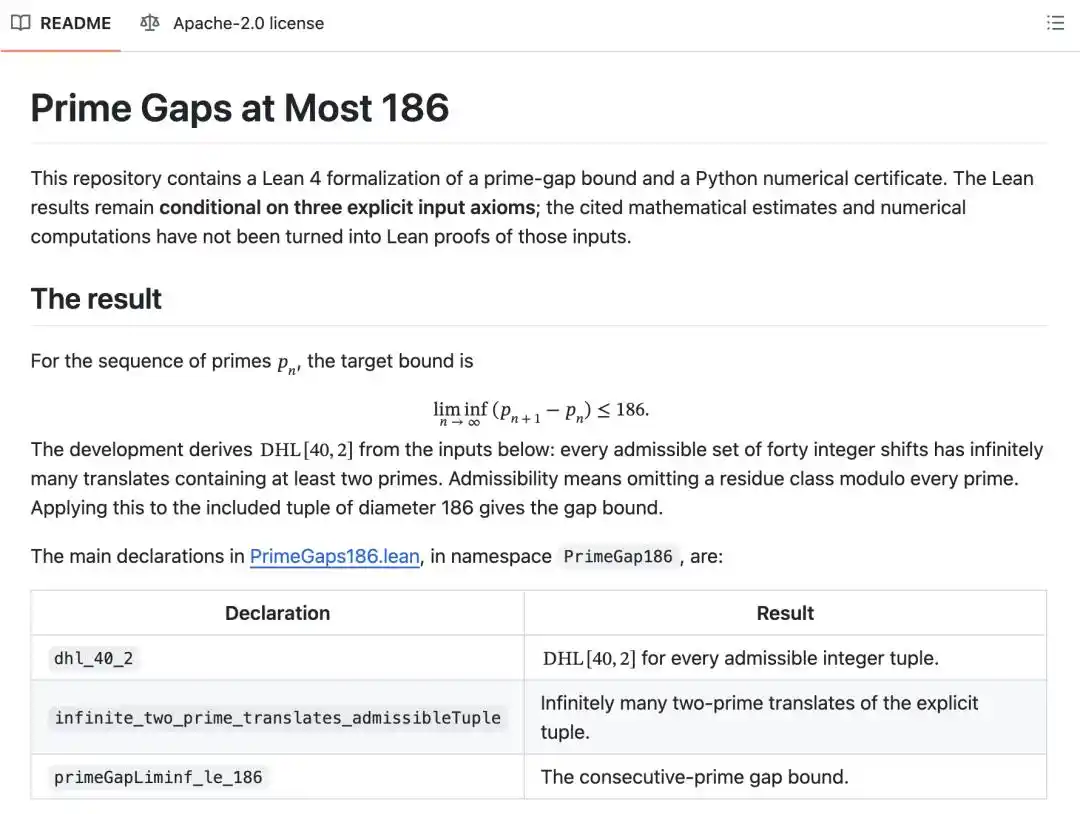
Using that framework, the paper constructs an admissible 40-tuple from 0 to 186 and proves that infinitely many of its translates contain at least two primes. Put differently, there exist infinitely many pairs of consecutive primes with gaps of at most 186.
OpenAI said it wrote a complete formal proof in Lean 4 and placed the code in a GitHub repository. It also released a Python-FLINT verification program that can independently check all numerical bounds.
Mathematicians reacted quickly
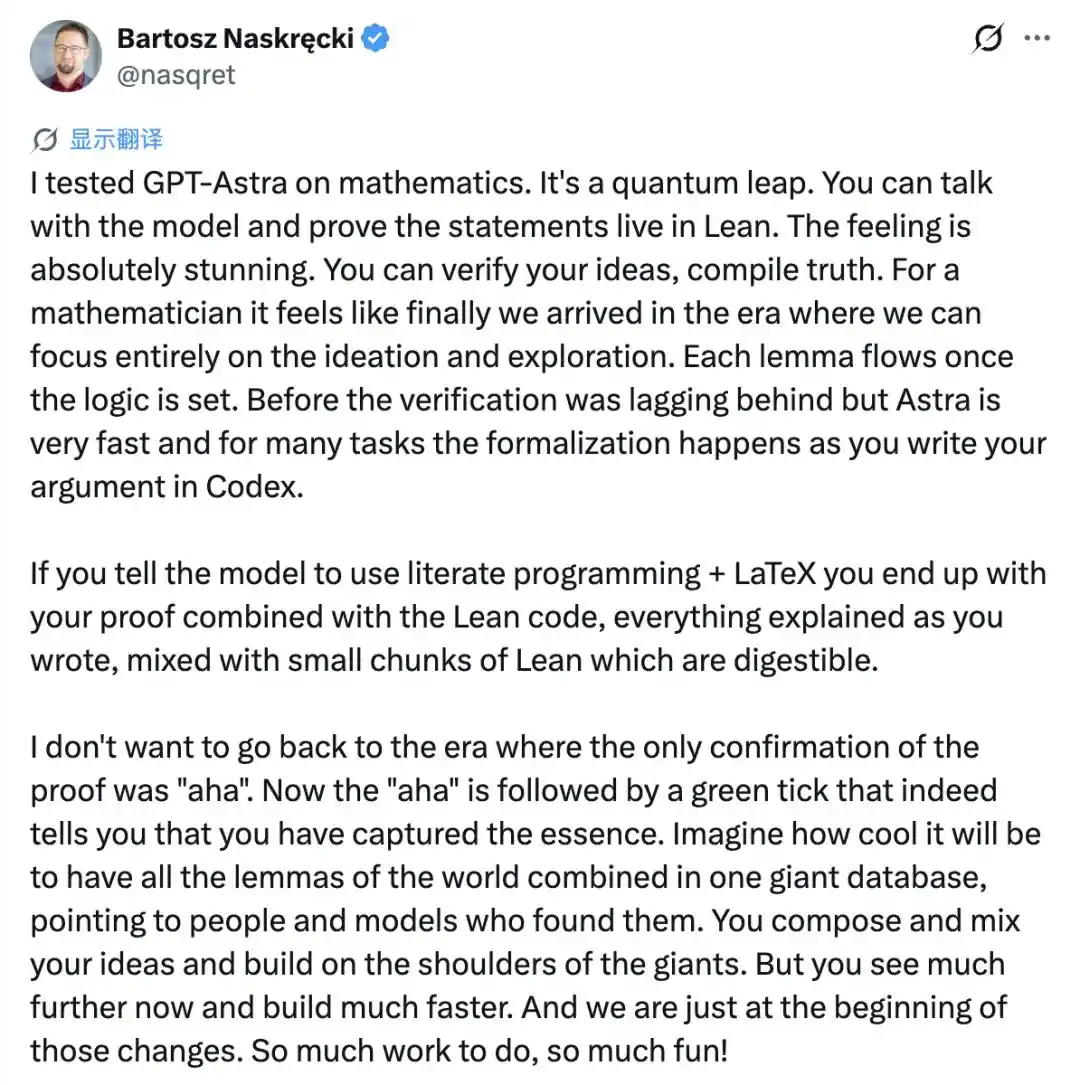
Mathematician Bartosz Naskręcki also posted a long thread after testing Astra on math. His verdict was a "quantum-level leap."
He said it is now possible to talk to the model while proving statements in Lean in real time. Formal verification used to be the slow step. With Astra, he said, the writing of the argument and the checking of it happen almost side by side.
He also offered a line that captured the shift. In the past, confidence in a proof often came from an "aha" moment and mathematical intuition. Now, he said, the "aha" is followed by a green check mark showing that the core idea really holds. He added that he does not want to go back to the era of "aha" alone.
3D generation became the other major talking point
Beyond research, 3D generation was another area that drove heavy discussion around Astra.
Tom Krcha fed the model a photo of a villa and asked it to build a full 3D version in Blender, including furniture, toys, appliances, and even an inflatable ring by the pool. In his demo, the result could be edited manually at the geometry level and ran locally at 60 fps. His conclusion was blunt: everyone now has a 3D designer at hand.
Matt Shumer took the idea to a larger scene. He said he spent a week using Astra in Unreal Engine 5 to build a Manhattan demo, working street by street and polishing each one.
Pietro Schirano, who also had early access, uploaded a photo of a physical keyboard. Astra then generated a 3D model and animation code from it. He said the result would "completely shatter your sense of what is possible."
Ethan Mollick also said Astra is now good enough to handle complex, serious work autonomously for days at a time. One project he assigned it was a historical simulation of the Library of Alexandria: architecture reconstructed from real history, audio guidance, walkable spaces, and language switching between English and Greek. In his telling, Astra built the archaeology visualization project on its own.
Codex adds Astra support and searchable notes
OpenAI also said Codex 0.153.1 will support GPT-6 Astra.
The more interesting change, though, was a new searchable-notes feature. Previously, Codex handled long context mainly through compressed summaries. As sessions grew, earlier material would be compressed so work could continue. The tradeoff was obvious: details disappeared.
Now Codex supports searchable notes across context windows. Instead of forcing more material into a limited context through compression, Astra can actively record important information as notes and retrieve it later when needed. In the original account, that approach was framed as far cleaner than brute-force compression, almost like giving an agent an external memory system.

Schmidhuber appears on cue
After GPT-6 Astra launched, Jürgen Schmidhuber, often described as the father of LSTM, posted on X as well.
He said the "recurrent depth" technique used by Astra was essentially the same as material in Section 5.3 of his 2015 paper, and he attached a link to that paper.
The original article noted that Schmidhuber often surfaces after major AI announcements to argue that the core idea had appeared in his work years earlier. This release drew the same response.