
GPT-6 rollout and Fed minutes hit markets on the same day
Two market-moving events landed on Oct. 7, and they pointed in different directions. OpenAI pushed GPT-6 to all ChatGPT users worldwide. Paying users on Plus, Pro, Business and Enterprise were switched that day to GPT-6 Sol, while Free and Go users were scheduled to move to GPT-6 Luna on Oct. 8. OpenAI also introduced a new feature called Intelligent UI, allowing answers to assemble text, charts and interactive components in real time depending on the query.
OpenAI said ChatGPT now has more than 1.2 billion weekly active users.
The same day, the Federal Reserve released minutes from its September meeting. All 19 participants backed the September rate increase. Most officials said another hike could still be needed before the end of the year, and participants broadly stressed that inflation remained elevated, the labor market was close to full employment, and inflation risks were tilted to the upside.
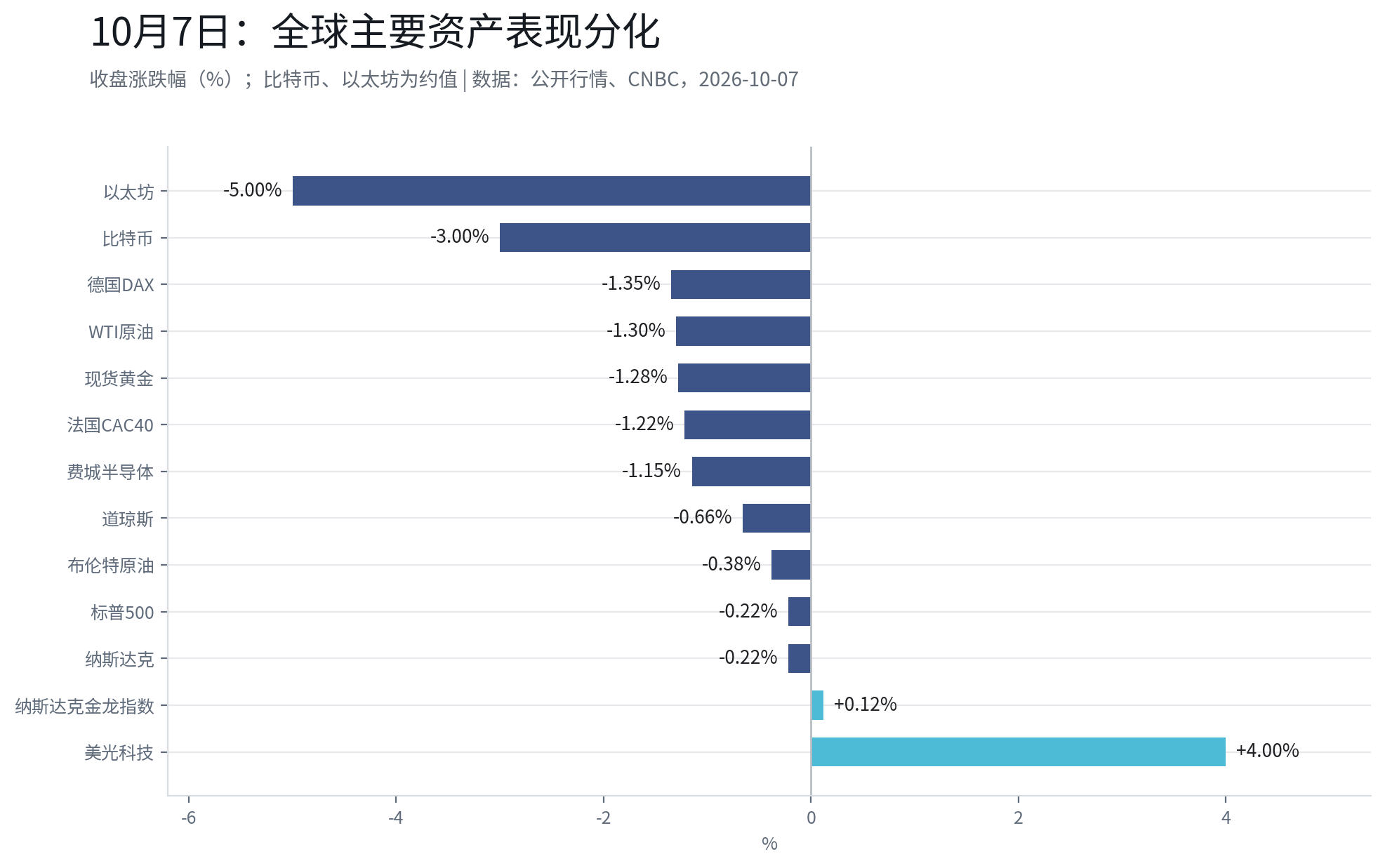
That set up a direct clash between what markets frame as an AI-driven “AGI moment” and the central bank’s “higher for longer” message. U.S. equities retreated from the prior session’s record highs: the Dow Jones Industrial Average fell 341.41 points to 51,179.87, down 0.66%; the S&P 500 slipped 0.22% to 7,801.77; and the Nasdaq declined 0.22% to 27,538.69. European shares fell harder, with Germany’s DAX down 1.35% and France’s CAC 40 off 1.22%. Public reports also pointed to French fiscal concerns and high oil prices as part of the pressure on Europe, alongside rising bond yields.
A line in the minutes put AI inside the inflation debate
Most coverage focused on one point: most officials still support one more rate hike this year. But the minutes contained another passage that received less attention in public reporting. Some participants said the development of artificial intelligence could cause aggregate demand to exceed supply over the medium term, adding upward pressure to inflation.
That matters because AI capital spending is now appearing inside the Fed’s inflation framework rather than sitting outside it as a neutral story about productivity or innovation. Based on the minutes, one market interpretation is that if AI commercialization and compute expansion keep accelerating, policymakers could have an added reason to justify a higher-for-longer rate path. The source text itself also notes that this directional reading remains uncertain.
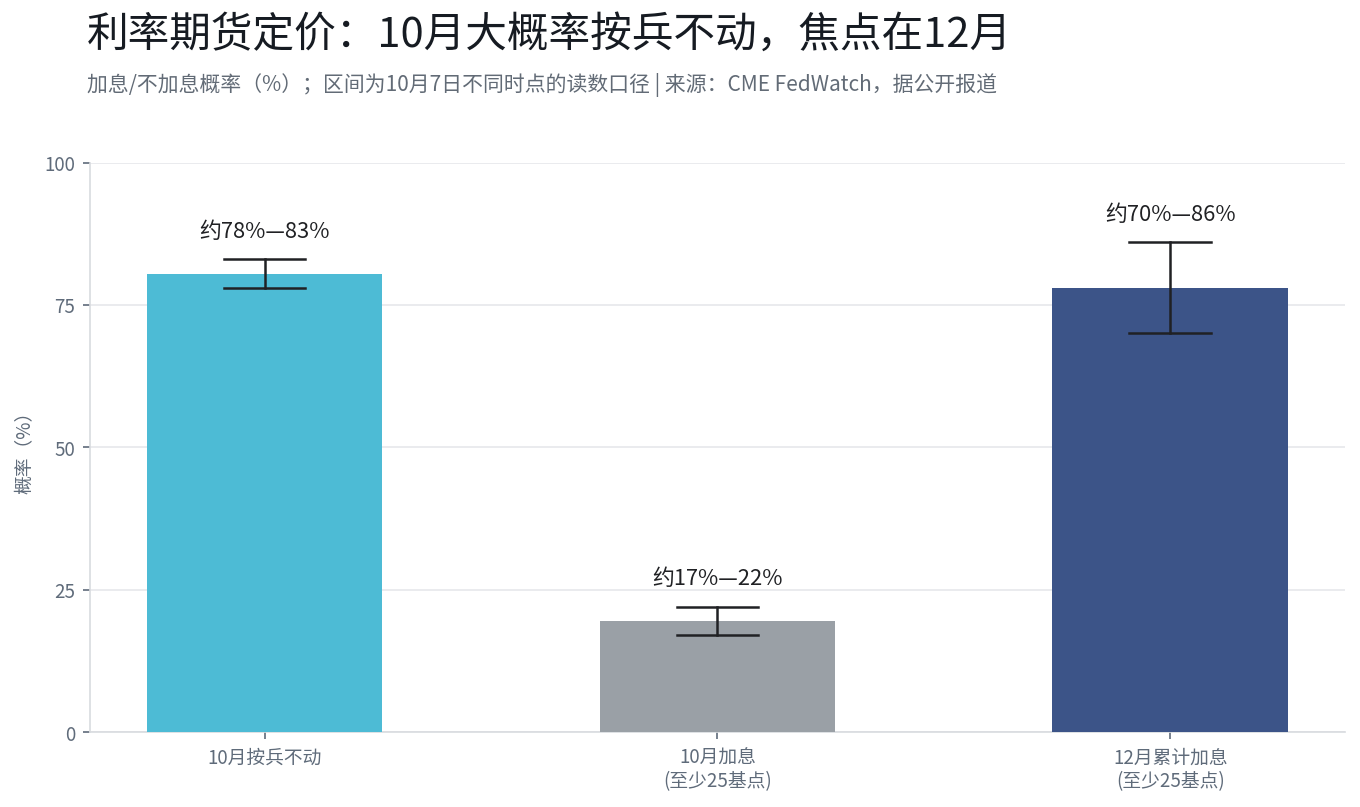
Current pricing sits between those two narratives. CME FedWatch data cited for different points on Oct. 7 showed the probability of at least a 25 basis point hike in October had dropped to roughly 17%-22%, while the probability of cumulative tightening of at least 25 basis points by December stood in a range of about 70%-86%. The signal from pricing was straightforward: October looked more likely to be a pause, while December was shaping up as the more important checkpoint.
A strong 10-year auction brought buyers back into Treasuries
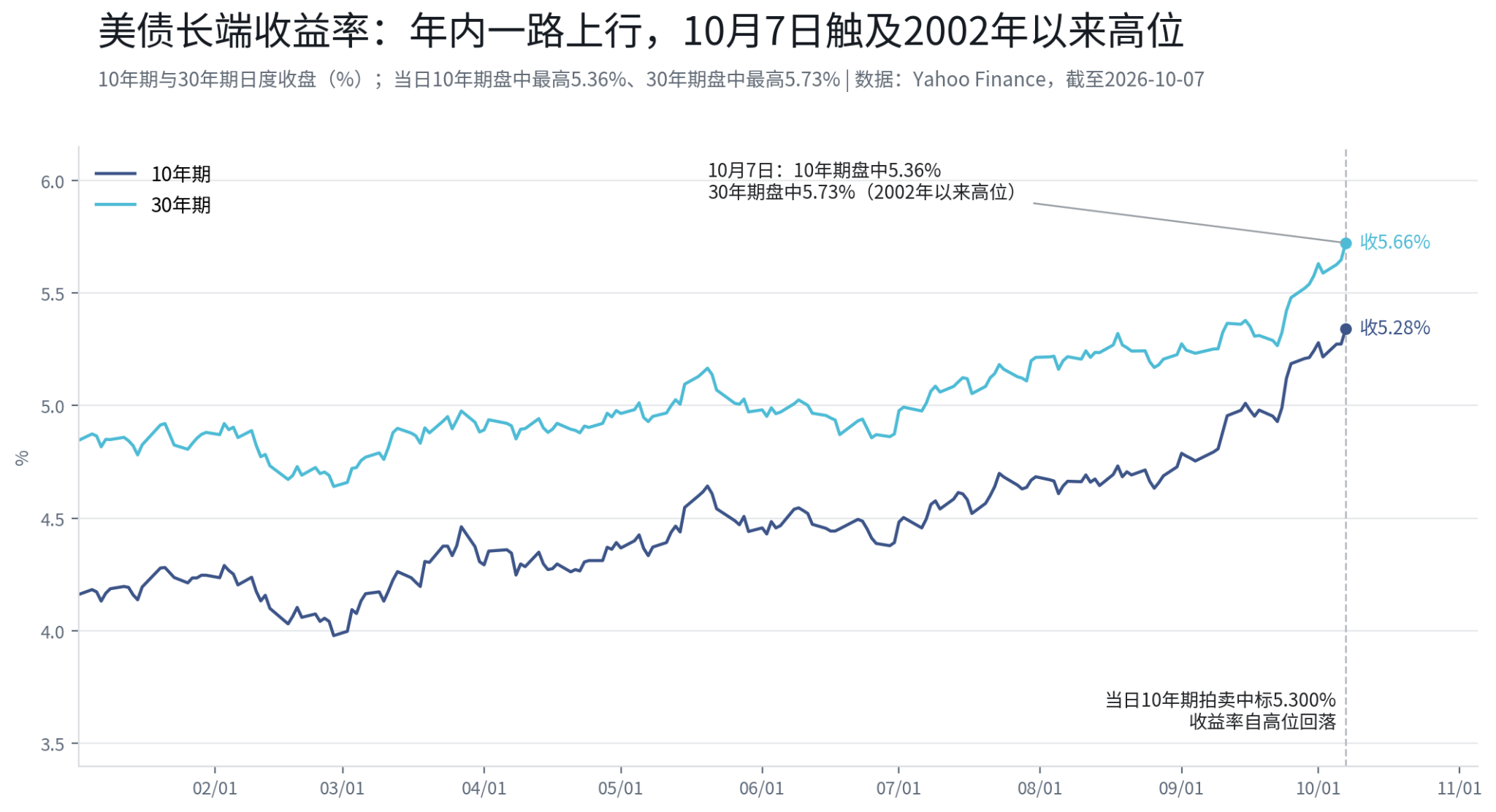
One of the day’s biggest moves came in bonds. The U.S. 10-year Treasury yield climbed as high as 5.364% intraday, which Reuters described as the highest level since April 2002. The 30-year yield touched 5.70%-5.73%, the highest since May 2002. By the close, those yields had eased to around 5.28% and 5.66%.
According to public reports, a U.S. Treasury official said the selloff was a “global phenomenon.” Long-end yields in the U.S., Europe and Japan were moving up together, driven by inflation expectations after oil moved above $100 and by the higher compensation investors demanded to absorb large sovereign debt supply.
Still, Oct. 7 also delivered an important counterpoint. The U.S. sold $39 billion of 10-year Treasuries, and the auction was stronger than expected. The bid-to-cover ratio came in at 2.77, clearly above the average of 2.54 seen over the prior six auctions. Primary dealers took only about 2.5%, a post-financial-crisis low, implying roughly 97.5% of the issue was absorbed directly by non-dealers. Indirect bidders, a category that includes foreign central banks and other institutions, were awarded 80.3%, above the average of 72.4% over the last 10 auctions.
That suggests some longer-term allocators may have shifted from avoiding the long end to buying it in a disciplined way once yields moved above 5.3%. The article’s own framing is careful here: one auction is not enough to confirm a trend, and the evidence applies to 10-year demand, not the whole curve.
After the auction results, the 10-year yield retreated from its intraday peak to roughly 5.28%-5.30%. The key marginal change in bonds was not a fresh macro release. It was the appearance of buyers.
Why the 30-year may matter more than the 10-year now
If the 10-year was the day’s pricing anchor, the 30-year may have been the most stressed point on the curve.
In absolute terms, both parts of the curve were stretched. The 10-year’s 5.364% intraday high was the highest since April 2002, while the 30-year’s 5.70%-5.73% range marked the highest level since May 2002. Quoted market interface data in the article said both were sitting near the 98th percentile of their 52-week ranges. Looking only at the rise since early September, the 10-year moved from about 4.79% to 5.28%, while the 30-year rose from about 5.27% to 5.66%, so the long bond was not uniquely steep on that measure alone.
The 30-year stands out for three structural reasons.
- First, it is the part of the curve least controlled by the central bank. Policy rates directly shape the short end. The 30-year is priced more by the market through inflation expectations and term premium. Public reporting cited in the article said long maturities were under more pressure than the short end in the latest selloff, with the spread between 10-year and 30-year yields holding a positive steepening shape of about 35-40 basis points. That is not a classic recession inversion. It looks more like pricing tied to inflation and supply premium.
- Second, duration magnifies the move. The duration of a 30-year Treasury is more than double that of a 10-year note. A similar rise in yield translates into a larger price decline. For pensions and insurers holding long-duration bonds, the 30-year is where valuation pressure concentrates. For the U.S. Treasury as issuer, it is also the most expensive part of the curve to fund through.
- Third, a strong 10-year auction does not answer the question for the ultra-long end. The Oct. 7 auction showed buyers were willing to take 10-year paper at yields around 5.3%. But the liability duration of pensions and life insurers sits mainly in the 20-30 year range. Whether the same appetite exists further out the curve depends on the 30-year auction scheduled for Oct. 8.
If that 30-year sale also proves strong, evidence that long-end yields are nearing a top would build. If it is weak, it would suggest allocation buyers are willing to extend only to the 10-year sector, leaving the 30-year under pressure.
With oil still above $100, inflation expectations can feed into the ultra-long end more directly. In that setup, the 30-year auction and the next inflation prints may say more about how far this rate move can run than the 10-year alone.
GPT-6 day did not bring a broad AI rally in equities
The full GPT-6 rollout did not trigger a broad-based rush into AI stocks. The tape split instead.
The Philadelphia Semiconductor Index fell 1.15%. Moves inside semiconductors and memory were uneven. Public market data cited in the article showed Micron rose more than 4% against the broader decline, and Super Micro Computer gained more than 3%. Qualcomm and Arm dropped more than 2%, TSMC fell 2.09%, and Western Digital plus SK Hynix ADRs weakened.
The article linked Micron’s relative strength to supply-demand dynamics in memory. On Oct. 7, an overseas institutional analyst reportedly raised Micron’s target price from $2,100 to $3,000, with one core argument centered on AI data center demand for HBM, or high-bandwidth memory. The source text explicitly notes that the target reflects only that institution’s own view.
One market reading is that the heavier the inference load from models such as GPT-6, the more direct the demand pull for high-bandwidth memory becomes. That could explain the valuation gap opening inside memory between “core AI memory” names and more traditional storage exposures. Whether that split lasts will depend on later earnings and order data.
Among megacaps, the picture was mixed: Amazon rose 1.42%, Apple gained 0.91%, Google added 0.81%, and Microsoft edged higher. Meta fell 2.38%, while Nvidia and Tesla posted modest declines. The market was not buying “AI” as a single block. It was starting to sort through who actually benefits from inference demand.
Gold fell as yields and the dollar rose, then recovered off the lows
Gold was one of the weaker major assets on the day. Spot gold settled around $4,110 per ounce, with quoted sources in a range of $4,110.68-$4,110.75, down 1.28%. It touched an intraday low near $4,066, the weakest level since Aug. 5. Spot silver closed near $59.75 per ounce. December COMEX gold fell $46.40 to $4,140.70 per ounce.
The article points to two main drivers. One was the real-rate backdrop: with the 30-year Treasury yield trading above 5.7% intraday, the opportunity cost of holding a non-yielding asset rose sharply. The other was dollar strength: the U.S. dollar index climbed above 102.3, weighing on gold priced in dollars. Public coverage also cited a precious metals research source saying the market’s message was that rates could stay high for longer, which supported both yields and the dollar.
Timing matters, though. Gold’s intraday drop came before the 10-year auction results were released. After the auction, yields pulled back and gold rebounded from the low. That makes any one-factor explanation incomplete. Rates, the dollar and positioning likely all mattered during the session.
Oil settled lower even as geopolitical tensions stayed elevated
Public market data showed WTI crude futures fell 1.30% to $88.28 a barrel, while Brent crude slipped 0.38% to $100.20 a barrel.
Price action did not follow geopolitics in a simple way. Public reports said Iran stated that the Strait of Hormuz was in a “closed state” and under the control of its armed forces. Conflict between Saudi Arabia and Yemen’s Houthi movement was also continuing. Even so, crude did not move higher on the day.
Supply-side offsets appear to have mattered more. The G-7 had agreed to coordinate the release of about 100 million barrels of crude oil and fuel over the next four months through the International Energy Agency. On Oct. 7, IEA member states also agreed to speed up the release of already announced reserves. According to a maritime data provider cited in the article, Middle East crude exports excluding Iran had recently risen above pre-conflict levels, with some cargoes rerouted. Separate reports also said Saudi Aramco was studying additional export channels to deal with short-term disruption.
That combination likely offset part of the geopolitical risk premium. The article still notes that if supply disruptions intensify, the cushioning effect of reserve releases has limits and the balance may not hold.
Crypto sold off as leveraged longs took the hit
Crypto assets moved lower alongside broader risk appetite. Bitcoin briefly dropped below $83,000 and closed around $83,100, down more than 3%. Ether fell nearly 5%, SOL lost about 3%, HYPE and XRP dropped more than 4%, and DOGE fell more than 7%.
CoinGlass data showed liquidations across the crypto market reached about $700 million over the past 24 hours, with more than 90% of that tied to long positions. The article attributes the pullback to several factors: higher Treasury yields and a stronger dollar weighed on the valuation of non-yielding or low-yielding assets, while forced unwinds of leveraged longs amplified the move lower. Early-session geopolitical developments that pushed oil higher also pressured risk sentiment.
Chinese ADRs moved somewhat independently
Even as the broader U.S. market closed lower, the Nasdaq Golden Dragon China Index turned positive late in the session and ended modestly higher. Public market data cited in the article showed gains of roughly 0.1%-0.3%, depending on the source, with some individual Chinese ADRs posting stronger moves.
The article lists two possible reasons. One is valuation: the sector had already gone through a deeper correction and was trading from relatively low levels. The other came from a foreign investment bank’s statistical analysis of nearly 2,800 global funds, which said active long-only global funds had lifted their average China allocation from underweight to benchmark neutral since June, ending a four-year underweight stance. Those funds were said to manage about $562 billion in Chinese equity assets.
The source text makes clear that this view belongs to the institution cited, and that historical fund behavior and historical performance do not guarantee future outcomes.
What markets may watch next
Four follow-through points stand out from the day’s trading.
- The 30-year Treasury auction. This is the most direct test of whether allocation demand extends into the ultra-long end. A strong 10-year and a strong 30-year would suggest pressure on long-end yields may be nearing a temporary release. A strong 10-year but weak 30-year would leave the 30-year sector as the vulnerable point, with expensive assets and gold still facing a headwind.
- Whether the 10-year yield can move back below 5.3% and stay there. If yields remain above that level, valuation pressure on high-multiple assets is likely to continue. If allocation buying proves persistent, the top in long-end rates may be closer than current pricing implies, though the article treats that as uncertain.
- How GPT-6 feeds through the supply chain. The first signal is already visible in the split inside memory and semiconductors, where some AI-linked storage names outperformed while traditional storage and parts of the chip complex lagged. If that valuation gap widens, the market may move from buying “AI” broadly to identifying the links in the chain that gain most from inference demand. Orders and earnings will have to confirm that.
- The marginal shift in December hike odds. CME FedWatch readings at different points of the day put the probability of cumulative tightening of at least 25 basis points by December at roughly 70%-86%. If later inflation data keep showing stickiness, that probability may rise. If inflation cools, the pressure on growth stocks and long-duration bonds could ease together.
A day of repricing, not a single-theme verdict
Reading Oct. 7 simply as a failure of the AI narrative, or as a panic day, misses too much. What actually happened looks more like a repricing across several linked markets. Fed minutes pulled AI into the inflation discussion, which helped keep pressure on long-end yields. A stronger-than-expected 10-year Treasury auction then pushed yields back down from the highs. GPT-6 did not spark a market-wide AI surge; it triggered a more selective ranking of likely beneficiaries. Gold and crypto weakened largely under the weight of higher carry costs and a firmer dollar.
Underneath all of that sits the same unresolved point: the 30-year yield traded above 5.7%, and it had not yet faced a demand test of the same kind as the 10-year. For the next several trading sessions, that may be the clearest market gauge to watch.