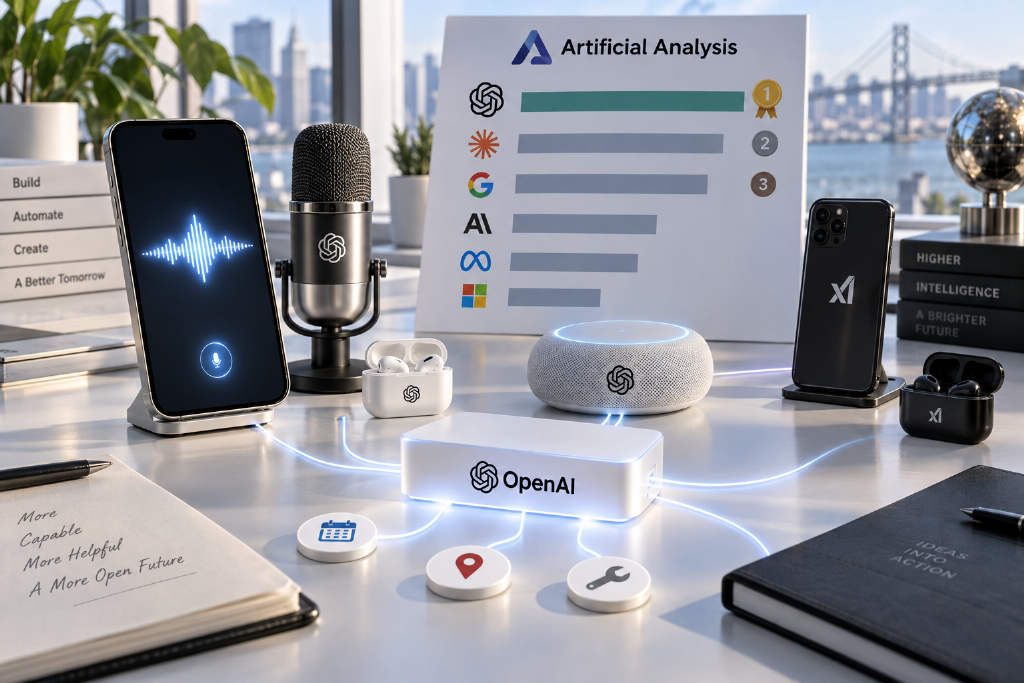
Artificial Analysis’ latest benchmark shows that OpenAI’s GPT-Live-1 moved to the top of the Speech to Speech Index after connecting GPT-6 Astra as its backend model. The system scored 81.5, slightly above Grok Voice Think Fast 2.0 High at 81.3. According to the benchmark description, GPT-Live-1 handles real-time listening and speaking, while more complex reasoning and tool-use tasks are handed off to Astra. The combined setup did not take first place in speech reasoning alone. Still, it ranked No. 1 in an agent evaluation focused more on practical task execution, posting 67.9%. That result lifted its overall score to the top of the leaderboard. The ranking highlights how model orchestration, rather than a single-model design, can improve end-to-end performance in voice agent testing.
OpenAI’s GPT-Live-1 climbed to the top of Artificial Analysis’ Speech to Speech Index after adding GPT-6 Astra as its backend model, scoring 81.5 and narrowly beating Grok Voice Think Fast 2.0 High at 81.3.
How the system is split
According to the benchmark summary, GPT-Live-1 is responsible for real-time listening and speaking. When a task requires more complex reasoning or tool use, it passes that work to Astra.
Agent test result pushed the combined score higher
The GPT-Live-1 plus Astra setup was not ranked first in speech reasoning by itself. In the agent evaluation, which leaned more toward practical task execution, it placed first with 67.9%. That result was enough to pull its overall score to the top of the ranking.
This article was originally published by Bit.Fan. For more cryptocurrency news and market insights, visit www.bit.fan. Disclaimer:
The market information, project data, and third-party content displayed on this platform are for industry information sharing only and do not constitute any form of investment advice or return commitment.
Cryptocurrency trading carries high risks. Users should fully assess their risk tolerance and make independent decisions. All profits, losses, and legal responsibilities are borne by the users themselves.