A signed article by m&WDAO initiator Jerry, published by Foresight, says OpenAI’s formal release of GPT-6 Astra in early September 2026 marks what the company internally defined as a generational leap into the 「AGI era」. The article focuses less on stronger understanding and reasoning than on execution in complex environments: operating computers, calling tools, browsing the web, orchestrating software, completing multi-step professional work, and changing course as new requirements appear during execution.
That shift, the author argues, moves AI from a model that answers questions into an actionable agent that can be authorized to carry out tasks over time. The article then raises a broader question: if AI can work, research, create, and trade on behalf of humans, what form of presence will humans retain in the digital world?
From AI Agent to Digital Twin
The article says AI gives machines the capacity to act, while a Digital Twin gives human intent the capacity to act. In that framing, m&W is the piece that allows those digital subjects to cooperate in a trusted way.
Jerry describes the Builder as the anchor point of the Digital Twin, and the AI agent as its execution layer. When a Builder begins to own, dispatch, and manage multiple agents, those agents are no longer just separate tools. Together, they form a Digital Twin that can keep acting on behalf of the Builder.
The relationship is summarized in the article as: Builder + Agent Network = Digital Twin. Under that structure, the Builder sets goals, makes value judgments, and carries final responsibility, while agents handle execution. The piece draws a sharp line between the two concepts. An AI agent answers the question of what can be done; it is presented as a discrete tool with no subjecthood or ownership. A Digital Twin answers who it acts for, why it acts, what boundaries define that action, and where the value created by that action ultimately belongs. Anchored to a human Builder, it combines identity, authorization, experience, and values into a digital subject with continuity and an economic track record.
The article says any agent entering real production has to face five basic questions of order: who it is, whom it represents, what it is authorized to do, what it has done before, and who bears responsibility if something goes wrong. It also points to GPT-6 Astra’s official safety evaluation, which the article says emphasized task execution within authorization boundaries and even maintained a zero boundary-crossing rate on difficult tasks. From that, the author argues that agent capability is moving from simply finishing tasks to acting within precise authorization.
How a Digital Twin Network changes coordination
The article says one Builder controlling a group of agents can multiply personal output, but the larger structural change begins when one person’s Digital Twin starts interacting frequently with another person’s Digital Twin. It describes that progression as a shift from human-to-human collaboration, to human-to-AI collaboration, and then to Digital Twin-to-Digital Twin collaboration.
In the author’s view, the real change in production relations appears at the level of the Digital Twin Network. The article says that when research agents, development agents, data agents, trading agents, and service agents begin to discover one another, verify one another, negotiate tasks, and exchange value on their own, the production model shifts from people finding people to digital subjects finding digital subjects.
But the article says that as agent capability grows at an exponential rate, the biggest bottleneck is no longer intelligence. It is trust and coordination. In fully automated digital collaboration, identities can be forged at scale, and code and track records can be packaged by AI. Because of that, a network can no longer stop at asking who someone is. It also has to ask what that entity has actually done.
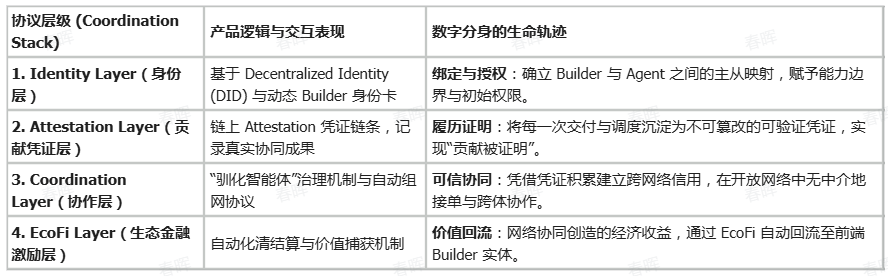
That idea leads to what the article calls the core protocol philosophy of m&W: identity can be declared, but contribution has to be proven. It breaks the stack into four parts. Identity tells the network who you are. Attestation tells the network what you have done. Reputation shows how well you have done in the past. Coordination determines whether the network should work with you now.
m&W’s strategic position
The article defines m&W’s role in direct terms: building a trusted order of coordination for Digital Twins. It says AI handles intelligence, agents handle action, blockchain handles value and settlement, and m&W handles trusted coordination between digital subjects.
According to the piece, that structure is integrated across m&W’s product system and documentation into a full m&W Coordination Stack. The article does not list the individual modules in the stack in the provided text, but says its purpose is to turn Builder intent into a verifiable digital record so that trust can rest on hard facts. In that setup, the stack is meant to answer how agents in open networks are identified, authorized, verified, trusted, and settled.
From asset sovereignty to digital subject sovereignty
The article then moves to what it calls the extension of subject sovereignty and the meaning of life in the digital era. Its central claim is that as machines begin to act for humans, execution becomes extremely cheap, while defining direction and assigning meaning become scarce.
In that telling, human value in the AGI era no longer lies in having more compute than AI or being better at execution. It lies in becoming the Builder who defines goals, creates meaning, and bears responsibility. The article offers two paths to explain the shift. One is a technical path: AI → Agent → Digital Twin → Digital Twin Network. The other is a control logic: Builder → Digital Twin → Digital Twin Network → AI Agents.
The article says this leads to a deeper change in personal sovereignty. In the Web2 era, platforms owned the account. In the Web3 era, wallets gave users sovereignty over assets. In the AGI era, the article says, m&W is pushing toward digital subject sovereignty, a framework built around the question: Who owns the digital actor. In that model, a person owns not only assets, but also a network of Digital Twins that can accumulate credit, keep creating value, and route returns back to that person.
The article’s closing argument
The piece ends by saying GPT-6 Astra has opened the curtain on the age of agents. What belongs to humans in that future, it argues, is not simply a smarter AI, but a Digital Twin Network that can keep acting, building credit, creating value, and cooperating with other digital subjects in a trusted way.
The article adds that the human body is constrained by time and physical space, but under the trusted coordination framework built by m&W, each Builder can bring their own Digital Twin into networks, accumulate contribution, and continue growing. It describes that change as a new kind of extension: for the first time, humans can bring their Digital Twins with them, break through the limits set by physical bodies, and allow thought, creation, and contribution to continue entering an expanding digital civilization.
The original article also includes a disclaimer stating that markets involve risk, investment should be approached with caution, and the piece does not constitute investment advice. It says readers should decide whether any opinions, views, or conclusions fit their own circumstances and bear responsibility for any investment decisions made on that basis.