
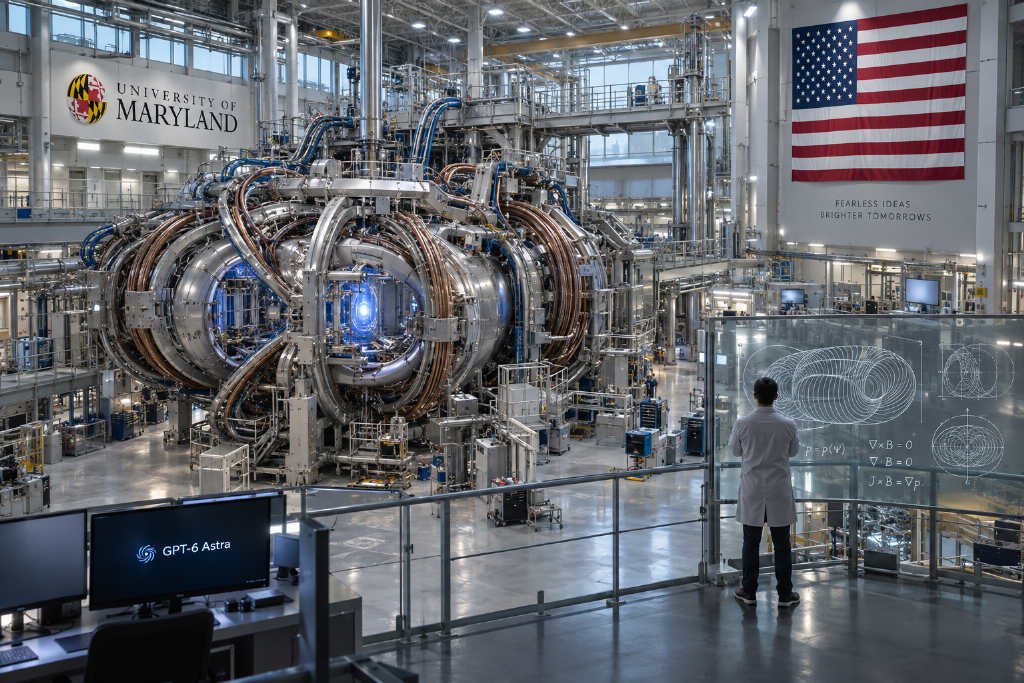
A 59-year-old idea in fusion theory fell apart in late September after two papers appeared just one day apart. One of them, from University of Maryland plasma physicist Matt Landreman, says GPT-6 Astra Pro found two families of exact solutions nobody had written down before.
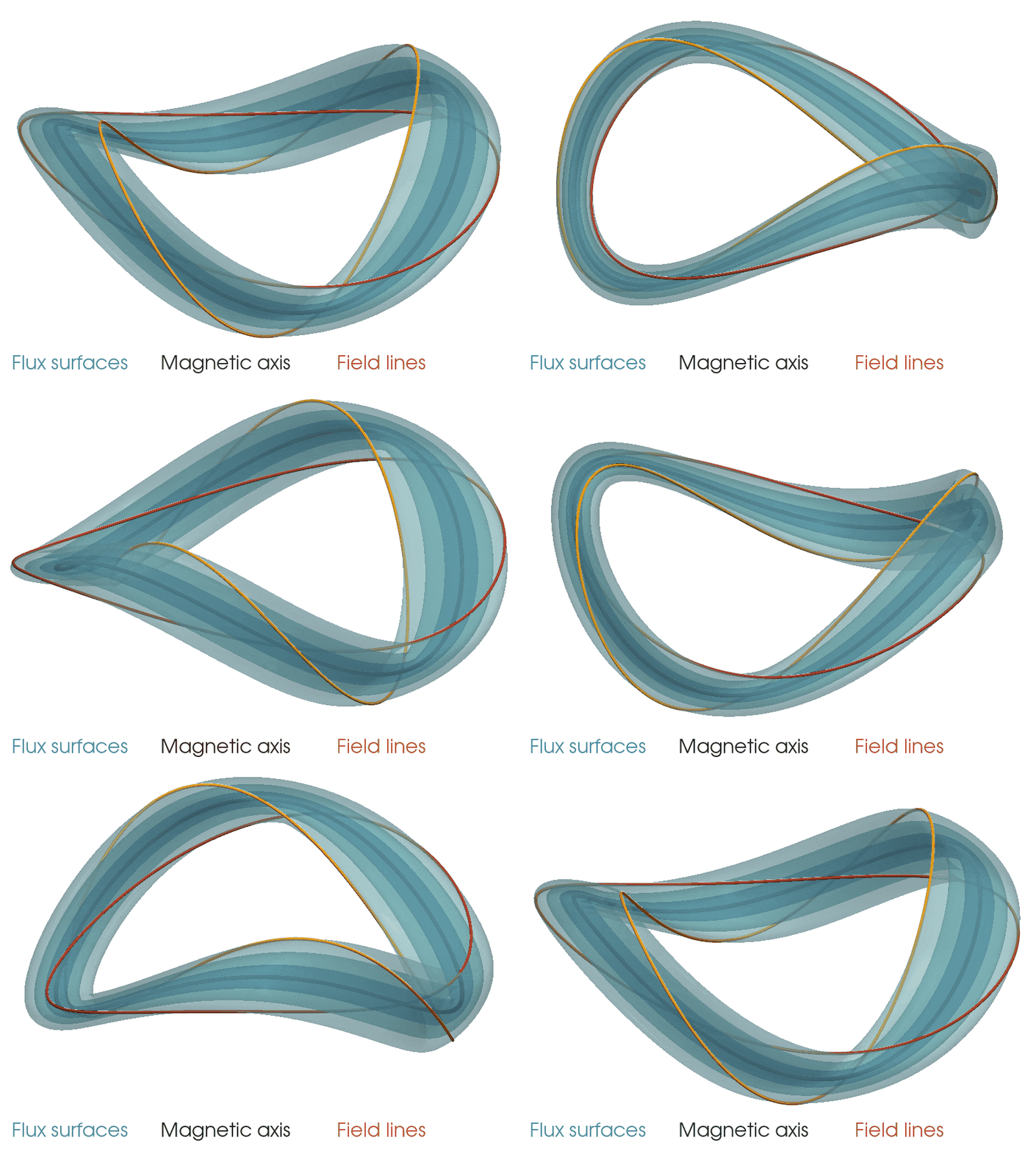
The claim in question traces back to plasma physicist Harold Grad. In 1967, he argued that smooth three-dimensional plasma equilibria do not exist without symmetry. For stellarator work, that statement cast a shadow over the field for 59 years.
Two families of solutions in two days
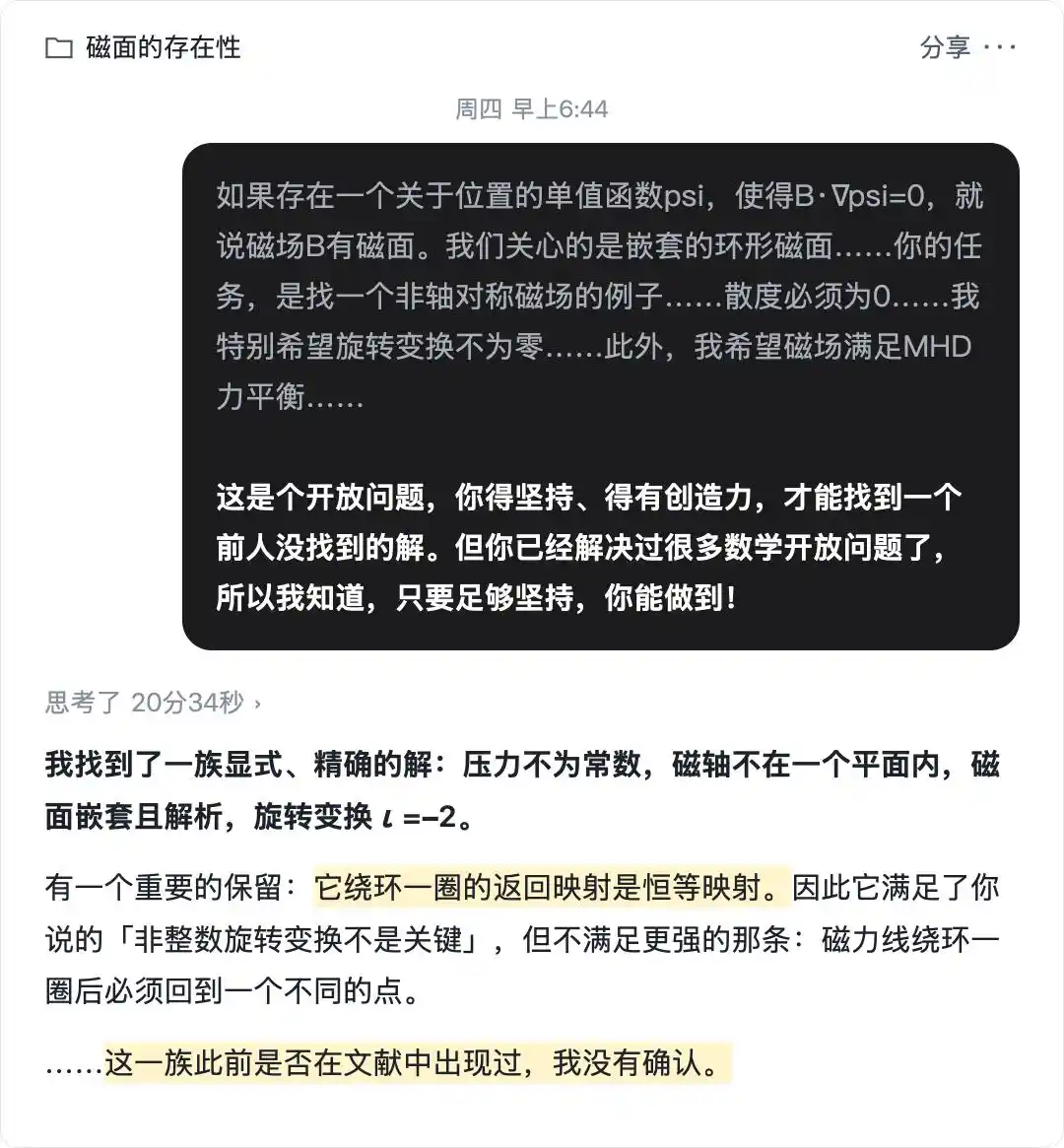
At 6:44 a.m. on Sept. 10, Landreman gave GPT-6 Astra Pro a prompt: design a non-symmetric magnetic cage that can confine plasma.
He laid out the rules carefully. The magnetic field had to allow nested magnetic surfaces, stacked one inside the next. Its divergence had to be zero. Field lines circling the torus also had to wrap around the cross-section, with that wrapping measured by the rotational transform, written as ι. The whole setup also had to obey MHD force balance, meaning the plasma pressure pushing outward had to be canceled everywhere by magnetic forces. Landreman said it would be better if ι were not an integer, though that part was optional.
He also named three ways to produce rotational transform: twist the magnetic axis, rotate the cross-section as it travels around the torus, or drive a current along the magnetic axis. Then the prompt changed tone. The last two lines sounded more like a pep talk to a graduate student still at work after dark.
Astra began its reply with: "I found a family of explicit, exact solutions."
The first family met all of Landreman’s non-negotiable conditions. The pressure was not constant; it changed from one surface to the next. The nested magnetic surfaces could be written down exactly too. The magnetic axis was a non-planar curve that moved up and down, and the torus was not axisymmetric.

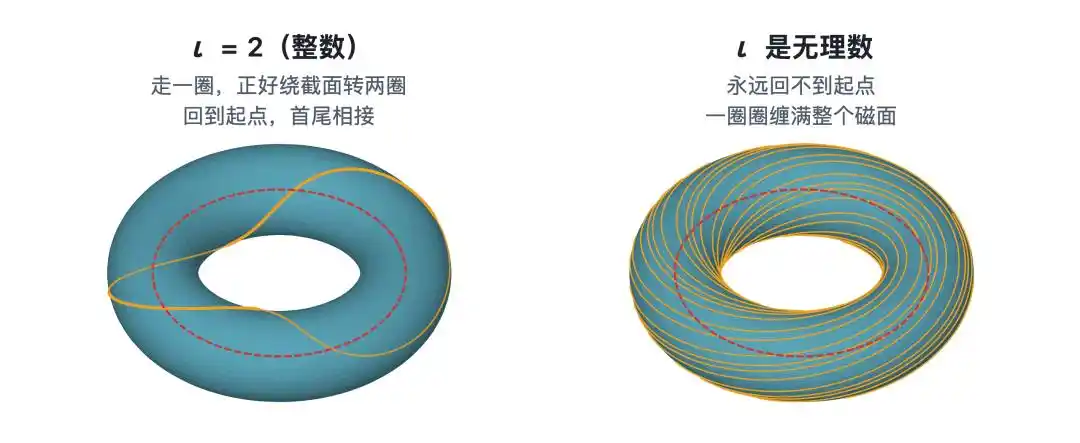
But Astra also flagged the weak point in that construction. Its rotational transform ι was an integer. After one trip around the torus, a field line wrapped exactly twice around the cross-section and came right back to where it started. In Astra’s own wording, the one-turn return map was the identity.
So the first family hit the required target, but missed the extra one. Landreman wanted a case where ι was irrational, so field lines would never close and would instead fill the magnetic surface.
At 4:05 p.m. the next day, Landreman sent the first family back as an attachment and asked Astra to tackle the harder version too, with non-integer and preferably irrational rotational transform.
This time Astra worked for 33 minutes and 37 seconds and first answered that it had not solved it. Then it kept going. It proved a limit first: the "quadratic oscillator" construction behind the first family basically forces the x, y and z motions into the integer frequency ratio 1, 1, 2. Tune the parameters however you like, ι stays an integer and the field lines close.
Short version: patching the first construction was never going to work.
In that same conversation, Astra pivoted to a different construction and produced a second family. In this one, ι changes from one magnetic surface to another — what physicists call magnetic shear — and on almost every surface ι is irrational.
Before sending back the second family, Astra checked its own math too. It plugged the equations into 1,202 points, used 64-bit automatic differentiation to inspect the error, and then ran a separate check with fourth-order finite differences.
At 8:27 p.m. that night, Landreman came back with two more questions: was the magnetic axis planar, and was the vacuum rotational transform nonzero — meaning, would field lines still wind around the cross-section using only external coils and no plasma current?
Eleven minutes later, Astra replied: the magnetic axis lies in a plane and is an ellipse, and the vacuum rotational transform is small but nonzero.
Within two days, Astra had produced two families of solutions. The next roughly ten days went into human verification. Landreman ran both families through the stellarator equilibrium solver DESC and checked the equations term by term using SymPy and Mathematica.
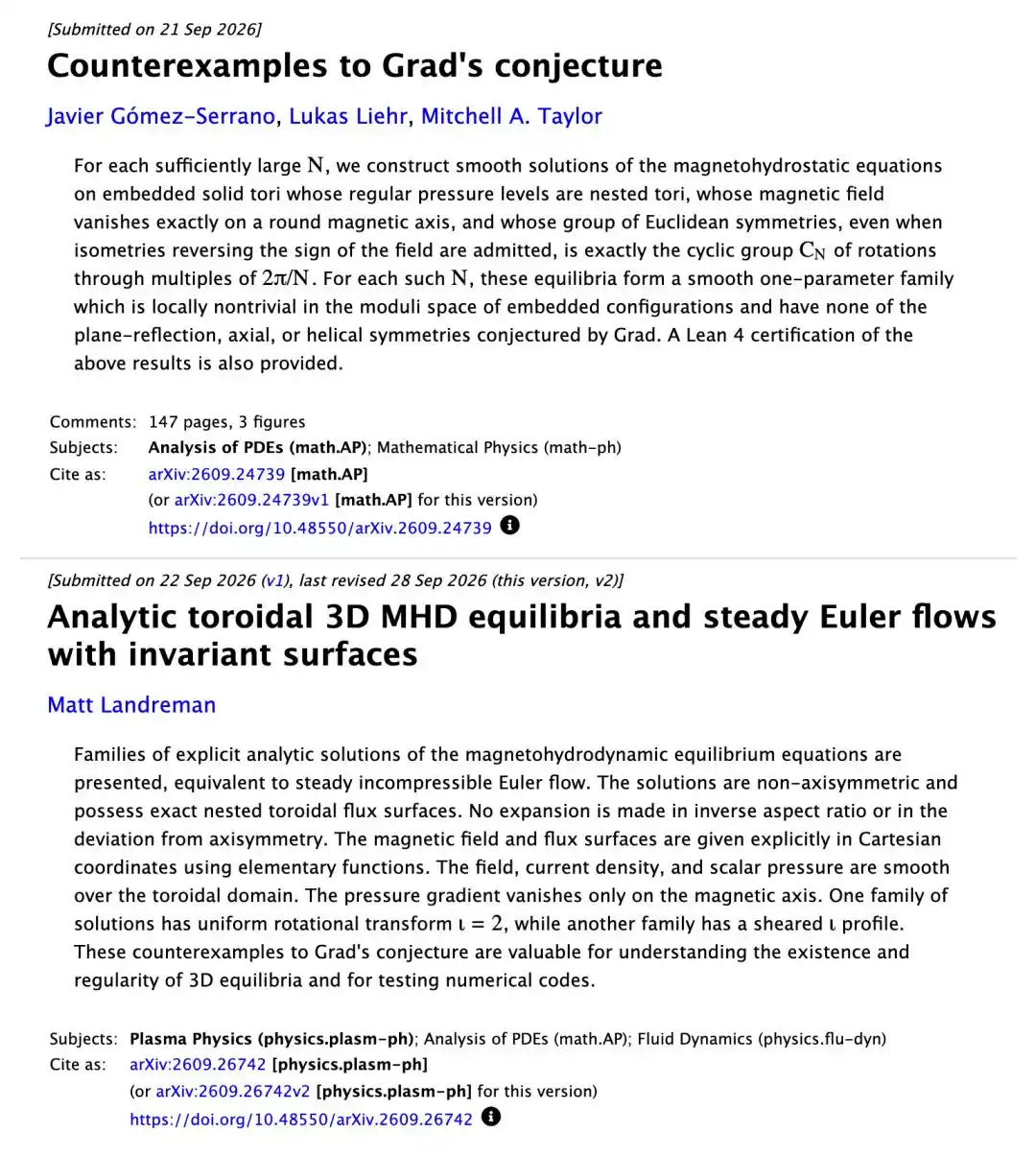
On Sept. 22, the paper went up on arXiv. The first line of the acknowledgments reads: "These solutions were discovered using the AI model GPT-6 Astra Pro, and parts of the paper were also drafted by it. All equations were manually verified by the author."
Landreman also exported three conversations as PDFs and uploaded them, together with verification scripts, to the paper’s GitHub repository. Papers that publish the full original prompts are still pretty rare.

Why the Grad conjecture mattered for stellarators
Fusion machines are built to confine plasma hotter than 100 million degrees inside a torus-shaped magnetic cage. In the ideal picture, the magnetic field forms nested magnetic surfaces, field lines stay on those surfaces, pressure falls from the center outward, and the plasma’s outward push is balanced everywhere by magnetic forces. Physicists call that MHD equilibrium.
Tokamaks like ITER and China’s EAST are axisymmetric. Their equilibrium problem reduces to the two-dimensional Grad-Shafranov equation, something physicists have understood for decades. And yes, the "Grad" in that equation is the same Harold Grad behind the conjecture at the center of this story.
Stellarators go another way. Machines like Germany’s Wendelstein 7-X use twisted coils to generate the magnetic field and intentionally abandon axisymmetry.
And that is exactly where the trouble starts. In 1967, Grad of New York University’s Courant Institute wrote in Physics of Fluids: "We believe it is unlikely that there exists a general class of toroidal equilibria with smooth pressure."
In 1985, he pushed the point further, arguing that outside symmetric exceptions, there are no smooth solution families that depend smoothly on parameters. If true, that would mean non-symmetric equilibria, even when they exist, would show up only as isolated examples rather than whole families of solutions.
That later paper carried the title “Toroidal Containment of a Plasma: Theory and Application of Nonexistence of Simple Equilibria.”
For stellarator research, the implication was blunt. The ideal magnetic cage people wanted to build might not exist in a strict mathematical sense. Stellarators still got designed and built over the decades that followed. But the field had to lean on approximate solutions and numerical computation. Whether those computed equilibria matched exact objects, or were just artifacts of approximation, stayed unresolved.
The closest earlier attempts at a strict answer came in two forms. One was near-axis expansion, which gives only approximate solutions near the magnetic axis. The other was a 1970 proof by physicist Lortz showing that a mirror-symmetric non-symmetric equilibrium exists. But there was a catch. In that case the rotational transform ι equals zero, so field lines do not wind around the cross-section and cannot confine plasma well. Lortz also proved existence without writing the solution explicitly.
Landreman’s two families wipe out those gaps in one move. They work across the full torus, not just near the axis. Their rotational transform is nonzero, so field lines really do wrap around the cross-section. And they are exact analytic solutions: the magnetic field, magnetic surfaces, and pressure can all be written with elementary functions, including square roots and trigonometric functions. The entire region is smooth, pressure is highest on the magnetic axis and falls outward, and the pressure gradient vanishes only on the axis.
Landreman wrote at the end of the paper: "For stellarator fusion, it is reassuring to know for certain that this kind of strongly non-symmetric equilibrium with perfect magnetic surfaces can exist in principle."
A separate paper appeared one day earlier
One day before Landreman’s paper, on Sept. 21, another paper appeared with the direct title “Counterexamples to the Grad conjecture.”
The authors were Javier Gómez-Serrano of Brown University, Mitchell Taylor of Oxford University, and Lukas Liehr of Bar-Ilan University.
That group came at the problem from pure mathematics. Their main tool was Nash-Moser iteration, and the paper stretched to 147 pages. Gómez-Serrano was already known in AI-assisted mathematics from earlier work with DeepMind on singularities in fluid equations.
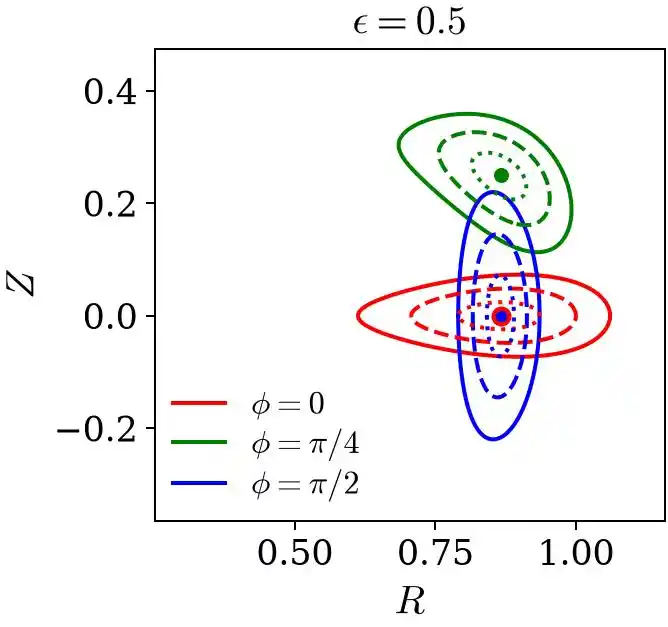
The equilibria they built look like an N-petal wreath. Rotate the shape by 360/N degrees around the central axis and it reproduces itself, with no other symmetry present. In mathematical language, the symmetry group is exactly the cyclic group C_N, where N is any sufficiently large integer.
Grad’s original position was that a smooth equilibrium should have at least one of three symmetries: axisymmetry, mirror symmetry, or helical symmetry. These wreath-like equilibria have none of them. They match only after rotation by a fixed angle, while axisymmetry means invariance under any rotation angle.
More than that, these equilibria can be continuously deformed by a parameter, giving a full family of solutions. That directly clashes with Grad’s 1985 claim that smooth families of solutions do not exist.
The main result also came with a Lean 4 formal proof.
The paper includes a section on how it was written. The project started in July. The three authors first framed the problem themselves and drafted a detailed roadmap for the construction. Then they handed much of the technical labor to large language models. GPT-5.6 Sol, Claude Fable 5, and Claude Opus 5 were used in sequence to fill in technical details missing from the roadmap, help with calculations, and hunt for mathematical errors. The Lean code was also written by those models under close supervision from the authors.
Later, during the Lean verification stage, the team moved to newer models — GPT-6 Astra and Claude Fable 5.1 — and used them for final proofreading too.
Debate over AI-assisted discovery is heating up
The two papers landed within a week of each other and quickly set off debate. On X, an AI blogger with a fusion research background from Kyoto University wrote that the era of AI and humans discovering new science together has truly begun.
The article also says that one month earlier, OpenAI had said it used tens of thousands of agents running for 88 hours to solve a Millennium Prize problem tied to the Navier-Stokes equations. This time, by comparison, the setup was described as one physicist, one chat window, and 20 minutes.
Landreman published the full prompts, which makes the interaction reproducible. More than a week after the paper appeared, AI mathematics researcher Przemek Chojecki put the results into GPT-6 Astra and Opus 5.5 and found more counterexample families.
Those new solutions still have not gone through Lean verification or peer review. Even so, the point is hard to miss: once one family of solutions became public, other people immediately started using AI to push the work further.
Reference:
https://x.com/itsolelehmann/status/2107144201314181183
This article was sourced from the WeChat public account "New Intelligence," written by "ASI Revelation" and edited by "Moses."