
GRAM has risen against a broadly weaker crypto market, prompting Telegram CEO Pavel Durov to say the token’s market capitalization is “severely undervalued.” Durov said GRAM should eventually rank among the top three crypto assets by market value.
The market data, however, presents a mixed picture. GRAM has shown relative strength during a broad sell-off, while TON’s user activity, liquidity and token supply dynamics still leave open questions about whether the ecosystem can support the valuation Durov described.
GRAM holds up as crypto assets decline
Crypto markets have recently come under pressure as hawkish macro expectations strengthened, technology stocks faced selling, ETF funds continued to flow out and geopolitical risks intensified. Market sentiment has moved into fear.
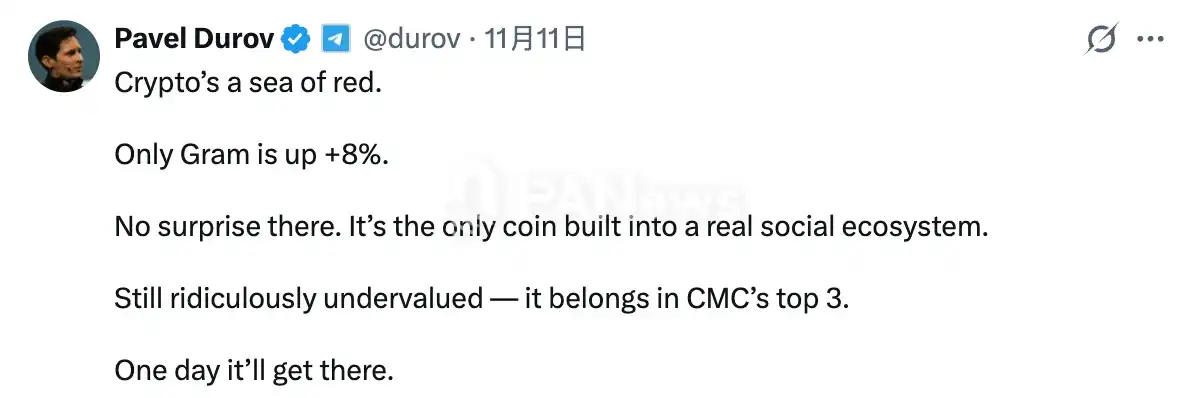
GRAM has not followed the broader decline. Instead, it has traded independently and moved higher. CoinGecko data identified GRAM as one of the more closely watched tokens over the cited 24-hour period and the second-biggest gainer among the top 100 tokens by market capitalization. Its gain was 5.3%, a relatively strong showing in a market where many assets were falling.
Durov then made his bullish view public. He said GRAM is the only cryptocurrency genuinely integrated into a large social ecosystem and that its market capitalization remains severely undervalued. In his view, the token should be among the three largest crypto assets by market value, and he said he believed that goal could be achieved in the future.
Durov also changed his profile on X, adding the label “Founder of the TON Blockchain (2019).” The update offered another public indication that he was backing the TON ecosystem again.
As Telegram’s founder, Durov’s comments quickly brought more attention to GRAM and helped lift market sentiment around the token.
From TON to GRAM
TON, originally known as Telegram Open Network, was first launched under Telegram’s leadership. Its native token was called GRAM. Telegram was later forced to leave the project because of a regulatory lawsuit in the United States. Independent developers and the TON Foundation then took over, and the native token was renamed Toncoin, or TON. For a considerable period afterward, Durov publicly stressed that he had no direct relationship with the project.
In May this year, Durov announced that he had taken control of Ton again and changed the token’s name back to GRAM. He became the network’s main driving force and largest validator. To integrate TON more deeply into Telegram and turn it into native payment and application infrastructure, Durov also introduced a seven-step strategy called “Make TON Great Again,” or MTGA.
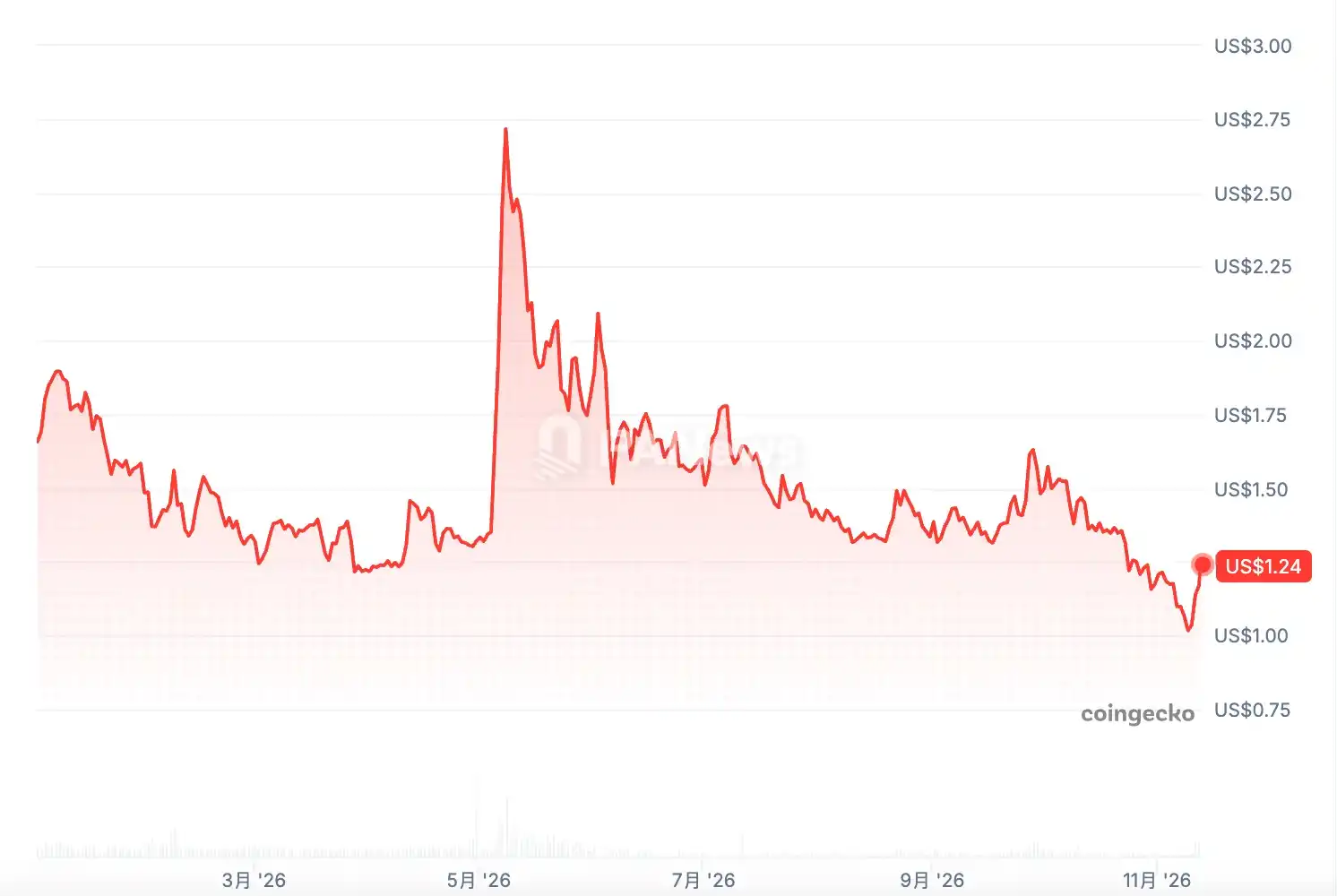
GRAM’s price has not continued to rise with the rollout of that strategy. After a short-term rebound, the token entered another downward trend. CoinGecko data shows that GRAM has fallen about 55.1% from its $2.7 peak in May. Compared with its all-time high, the decline has reached 85.3%.
Wallet activations rise faster than actual activity
Durov has also released new ecosystem data in an effort to demonstrate GRAM’s growth potential. According to his disclosure, Telegram’s self-custodial Gram Wallet has seen a large increase in activations. The figure was viewed by the market as a positive sign for ecosystem adoption and supported a more bullish view of GRAM.
Telegram launched Gram Wallet in July 2026 as a native self-custodial crypto wallet. Because it is embedded directly in Telegram, a platform with more than 1 billion users, the wallet was viewed as one of the largest self-custodial wallet distribution efforts in the crypto industry. It first opened to a group of invited users and began a gradual global rollout to Telegram users on Oct. 9.

Traditional crypto wallets generally require users to download an application, create an account and set up a seed phrase. Gram Wallet uses automatic activation instead. Users do not have to register or complete a complex setup process. If a Telegram account receives GRAM from another user, even as little as 0.1 GRAM, the wallet is activated automatically and appears in the Telegram settings interface. The transfer itself becomes the entry point for wallet activation.
As access expanded and the activation process remained simple, the number of Gram Wallets grew rapidly. GRAM Explorer data shows that Telegram’s self-custodial Gram Wallets had exceeded 3.53 million as of Nov. 12. Nearly 650,000 wallets were added in the previous 48 hours.
A rapid increase in activations does not necessarily indicate a matching increase in genuine usage. GRAM Explorer data shows that about 53,000 Gram Wallet addresses were active on Nov. 12, with roughly 66,000 transactions recorded. Active addresses represented only about 1.5% of the total wallet count, leaving most wallets inactive.
Only about 188,000 wallet addresses held a GRAM balance. Together, they held approximately 1.683 million GRAM, worth about $2.053 million at the current price. The number of actual holders and the size of their combined holdings remained limited.
TON remains heavily dependent on Telegram
Telegram’s large user base gives GRAM a distribution channel that few other blockchains can replicate. Whether that reach can turn into sustained on-chain activity, long-term demand for the token and lasting economic value remains unverified.
TON’s own ecosystem also faces development challenges. Telegram currently carries almost all of TON’s main user access and application distribution. That close connection can bring users in quickly and reduce the cost of acquiring application users, but it also leaves TON heavily dependent on Telegram. The network has yet to build a diversified ecosystem independently.
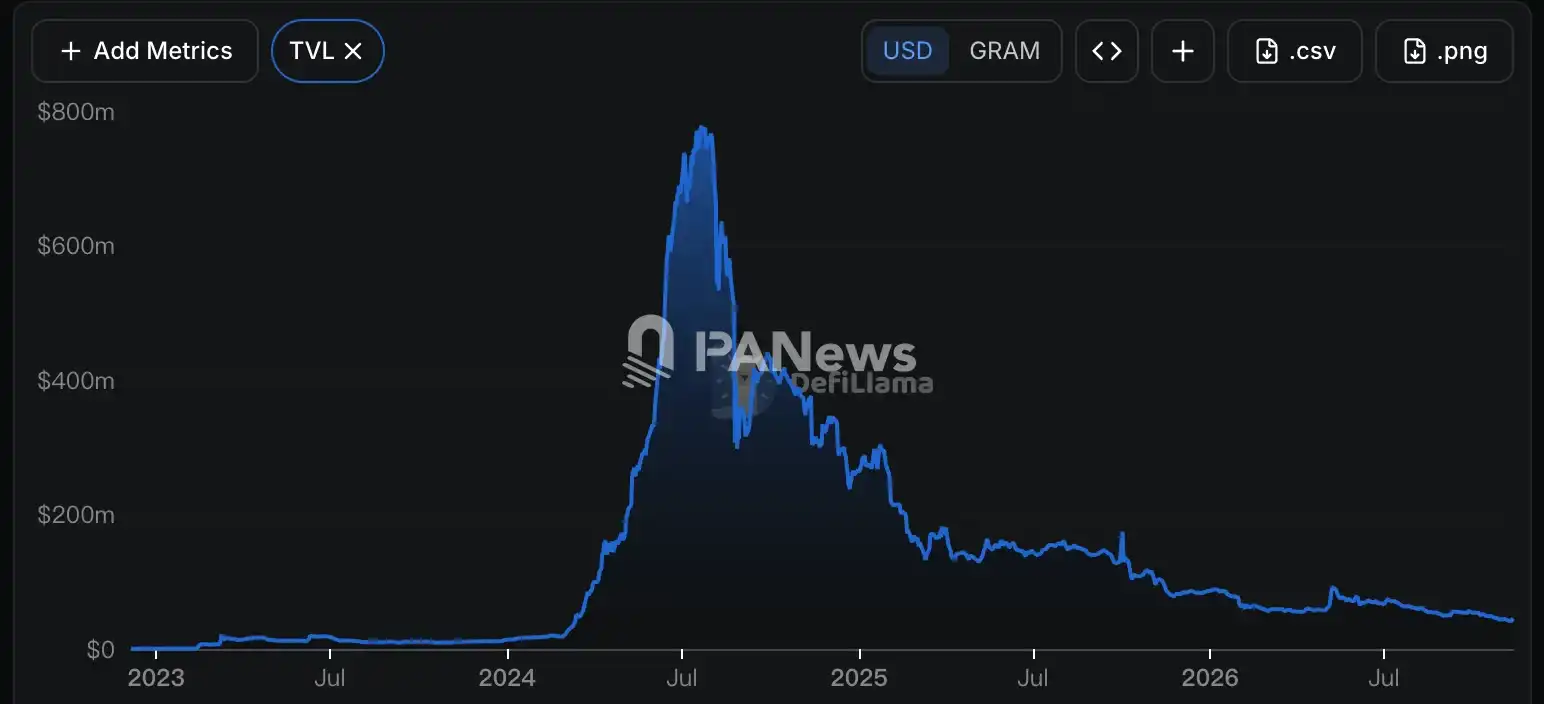
DeFillama data shows that TON’s total value locked stood at about $45.74 million as of Nov. 12, far below its historical peak of roughly $780 million. Liquidity was concentrated mainly in two applications, Tonstakers and Stakee.
TON still lacks a sufficiently broad range of applications and a sustained inflow of capital to form a large-scale, durable on-chain economy. A relatively high development threshold has also limited the entry of developers, making it harder for the ecosystem to diversify its applications.
Accelerated block production raises inflation pressure
GRAM also faces a tokenomics issue. In April, the TON team implemented an upgrade that accelerated block production. New blocks began to be generated at five to six times the previous rate, and block rewards were issued faster as a result.
Annual token inflation rose from about 0.6% to approximately 4%. As newly issued tokens from validator rewards continue to enter the market, GRAM faces greater supply pressure.
Telegram gives TON a distribution channel that other public blockchains struggle to match, while Durov’s return has supplied the ecosystem with fresh momentum. The remaining test is whether that reach can become genuine adoption and whether ecosystem expansion can translate into value capture. Durov has laid out his vision; ecosystem data and market performance still have to validate it.



