
Delphi Digital interviewed Wyn Labs co-founder and CEO Andrej Radonjic, the lead behind Grass, in an October 2026 podcast episode that focused on the project’s role in AI data infrastructure. Radonjic said Grass has grown from a small bandwidth-sharing project into a network serving frontier AI labs including OpenAI and Anthropic. He said the network now has millions of nodes and has delivered web data on the order of 1 billion GB to AI labs.
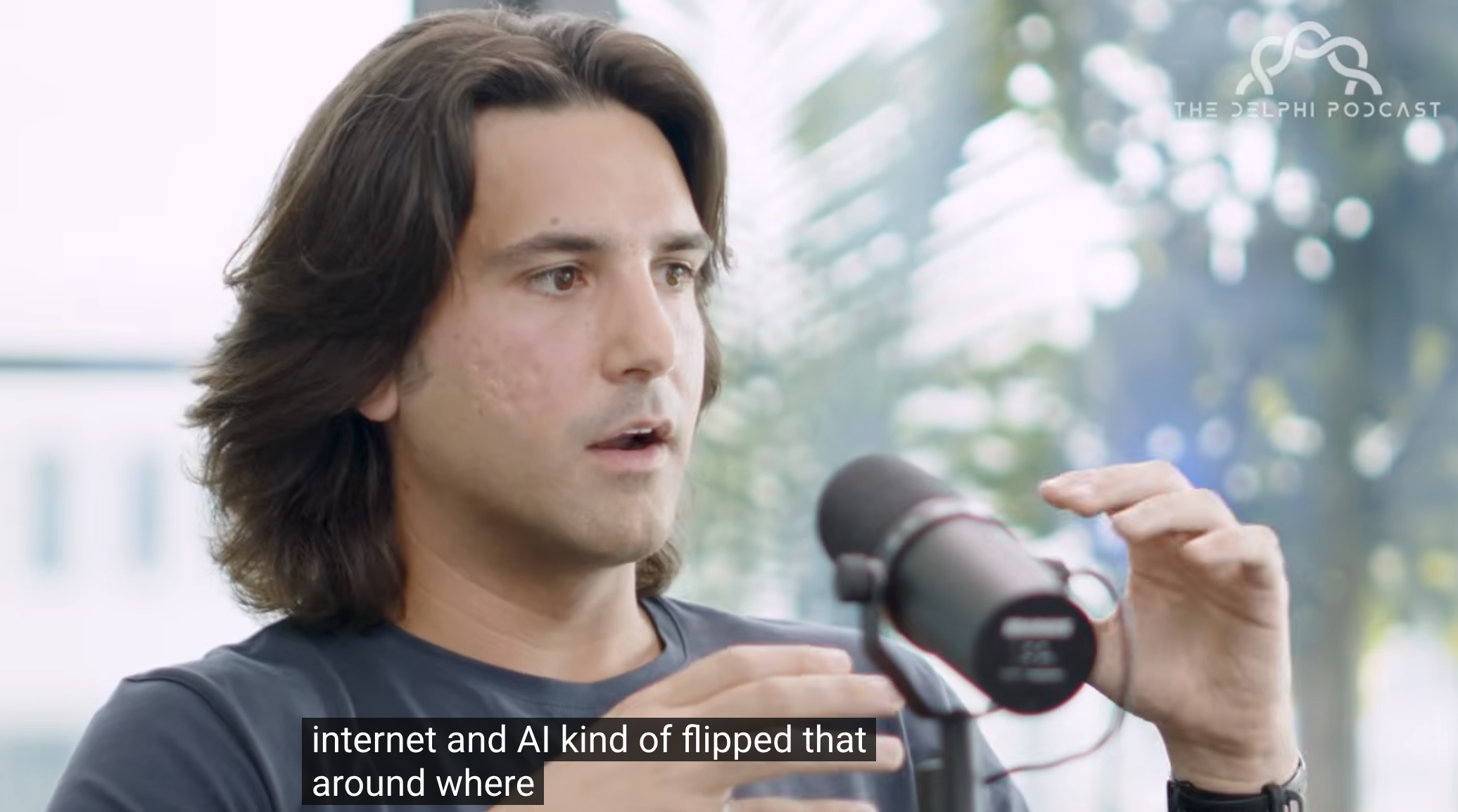
The conversation covered Grass’s business structure, the split between training data and inference data, demand for robotics video datasets, and the newly released Live Context Retrieval product suite.
Grass says it turns shared bandwidth into web data access at scale
Asked to explain what Grass is, Radonjic said the network is made up of millions of nodes whose users opt in to share bandwidth in exchange for rewards. On the other side, data infrastructure operators use that bandwidth to access web data at scale.
He described the system as something that can look like ordinary internet use from the outside while functioning as a large data infrastructure layer underneath.
Radonjic also walked through his background. He said he studied engineering physics in Canada, with a focus on nuclear engineering and photonics. After graduation, he chose not to move to the more remote areas where many nuclear engineering jobs were located, worked in finance for several years, and later returned to academia for a PhD in computational physics. When the pandemic began, he was pursuing a PhD in applied mathematics and modeling complex physical equations. During that period, he started building side projects, including arbitrage bots that searched for price differences across websites. Those tools required heavy web scraping, which pulled him into the field. He later met his two co-founders, compared experiences, and decided the opportunity was too obvious to ignore.
Why AI agents struggle to access the human web
When asked what signal convinced him to build in this area, Radonjic pointed to the pandemic. He said many businesses moved online during that period, and so did the way companies gathered intelligence. He used price intelligence as an example, adding that even government CPI collection had previously involved people physically recording prices from store shelves. Once stores shut down, spending shifted online.
In his view, web infrastructure kept getting more sophisticated at the same time demand for web intelligence surged. Many websites wanted information to remain public so consumers could discover products and make purchases, but they also wanted a walled garden that allowed consumer access while blocking all data center IPs.
That, he said, is when demand for automated web data infrastructure took off. He added that he did not expect the trend to stop, arguing that stronger machine learning systems would push the need across the broader internet.
On what AI agents cannot do today, Radonjic said most of the internet built for humans is still hard for agents to access, and he expects that to remain true for a long time.
He said many websites block AI crawlers for different reasons, whether to keep competitors from scraping data or to stop AI training on their content. But because sites often cannot reliably distinguish one automated visitor from another, the default policy becomes a blanket block on data center IPs.
He used AWS as an example. If an agent runs on AWS, websites can often identify the IP range as AWS infrastructure. From the site’s perspective, that agent may look no different from a competitor’s price scraper, so it gets blocked. Radonjic said the pattern is becoming more common.
He added that the issue extends beyond agents. It also affects standard large-model use cases and the training process itself, because model builders still need to crawl the web to gather training data. To get the best training data, he said, teams need to access as much information as possible, then filter and select what belongs in model weights.
Training data and inference data are separate markets for now
Delphi asked how Grass thinks about training data and inference data as two parts of its business. Radonjic said current AI training cycles are long, with much of the time spent converting raw data into formats suitable for training. After that, models generate more data from their outputs, which he grouped under reinforcement learning, and teams use those results to adjust the model.
Once a model is trained and deployed, though, its knowledge effectively cuts off within seconds and it cannot keep learning from the world in real time. Continuous learning is still being researched, he said, but has not been solved yet.
That leaves two distinct workflows today:
- Training: crawl large volumes of internet content and build useful pretraining datasets, sometimes with targeted collection for specific languages, file types or content categories.
- Inference: after deployment, models need to go online and retrieve information. A model running in a data center may not be able to see content that is only available from certain countries or user environments. At scale, Radonjic said, that requires routing traffic through a network such as Grass.
He said Grass is especially excited about inference data as an emerging category. The core idea, in his telling, is that models need live contextual information while they are being used, or while one model is calling another, if they are going to remain useful.
He also said the split may not last forever. Over the next few years, if continuous learning frameworks become mature enough to run at scale, training data and inference data could merge. Models, he said, would then take in real-time information from across the internet continuously, "like a firehose."
Robotics companies want web-scale video
The discussion then turned to robotics. Delphi noted that Grass had indexed more than 10 billion public web videos and asked how robotics companies use that data.
Radonjic replied that the figure was probably already outdated and said Grass has now indexed more than 100 billion videos. He stressed that "indexed" does not mean blindly downloading every video. Video is too dense and too expensive to store and process that way, so the company uses targeted collection.
He called robotics and robotics data one of the most interesting areas in machine learning right now. His explanation was straightforward: if the optimization target is clear and the data format is suitable, established machine learning methods can learn quickly from large datasets.
According to Radonjic, the ideal setup for robotics researchers is to let a model watch millions of videos, or more precisely billions of videos, listen to millions of podcasts, and read trillions of words from the internet, then learn how to act and generalize from that information. If a model has seen someone use a lawn mower, walk, move an arm, or pick up a tool enough times, he said, the right algorithm and setup may allow it to learn those behaviors.
He pointed to Generalist AI as an example of why the field has drawn attention. Radonjic said the company’s model may have been the first to show that a system could learn practical actions from watching large amounts of video alone, such as picking up a ball of a specific color and placing it into a cup. He also referred to a live demonstration in which a person performed the action, the model watched it, and a robot reproduced the same movement.
He added that Skild AI later published a paper showing that this kind of behavior can be scaled with web video, which in his view is driving fast growth in demand for web video datasets.
Live Context Retrieval starts with a Contents API
Delphi also asked about Live Context Retrieval, or LCR, the new product suite Grass recently released.
Radonjic said the first product is the Contents API. Search will follow, and the suite will later add multimodal capabilities such as audio listening, image reading and semantic understanding.
He said the Contents API began as an internal tool. Grass needed to collect training data across different modalities at scale, and residential IP routing alone was not always enough. The team also had to deal with TLS fingerprints, efficient browser rendering on servers, and changing request patterns often enough to avoid being blocked. To make internal data collection more efficient, engineers built a web content API that the team could call directly instead of writing a new crawler from scratch each time.
Radonjic said the company later concluded that the product had reached a top-tier level relative to the broader market, which led Grass to release it externally as the first component of LCR.
He described the product as a way to compress the full workflow of global residential proxy management, browser loading and anti-bot configuration into a single API call. A user provides a URL and receives the site content quickly. The caller can also specify the country perspective for access and choose output in Markdown or plain text.
The next release will be Search. Radonjic said Search should accelerate adoption of the broader LCR suite because a typical agent may need to visit 5 to 50 webpages for a single task, and even more for complex reasoning. The current Contents API is better suited to customers who already know which sites they want to monitor. Once Search is live, he said, a model will not need to know where to look first. It can call the Search API and then use the Contents API to extract the content.
Working with frontier AI labs means strict secrecy
Asked what it is like to work with frontier AI labs, Radonjic said the experience is exciting. He said AI may eventually be seen as a defining technology for this generation, or even for a period in human history, and that watching models improve step by step while expanding what people can do is deeply motivating for his team.
He also said those labs are highly concentrated environments with very smart people, making each conversation intellectually demanding and often revealing.
The hardest part, he said, is not being able to share much of what the team sees. Grass may help on a project launch and know for months that it is coming because it contributed to the work, but cannot talk about it publicly.
Radonjic said he had made a similar point a few months earlier on Handsome’s podcast, where he compared the situation to defense technology. A company helping a government track terrorists would not publicly detail what it does, because others could infer the methods and build countermeasures. He said the AI sector now has a similar dynamic: companies are racing for capability, and if rivals know what data a model company is prioritizing, they may infer what it is building and ship a competing product first.
Because of that, he said, Grass often has a view into where the AI industry may be heading over the next 6 to 12 months, but cannot say more.
Grass Foundation faces customers, Wyn Labs provides services
Delphi also brought up Grass’s recently released proof of revenue and asked Radonjic to explain the project’s structure.
He said the setup is unusual and may look odd to some customers, but was designed that way for incentive alignment.
According to Radonjic, the audit report was prepared by an accounting firm that checked all purchase orders between Grass and major AI labs as well as other customers, then reconciled those records with cash received. He noted that there can be timing differences, such as invoices that are paid 60 days after issuance, but said the figures broadly match.
He stressed that the audited entity is the Grass Foundation, not an equity company. The Grass Foundation, he said, is an ownerless foundation. All customers, whether they buy pretraining data, fine-tuning data or inference data products, ultimately contract with the foundation. It has no owners, is managed by independent directors, and any movement of funds requires board approval.
Radonjic said he works at Wyn Labs, which serves as a service provider to the Grass Foundation. Wyn Labs exists because a real-world operating entity is still needed to hire employees, handle payroll-related obligations and buy insurance.
At the same time, he said Wyn Labs does not own any intellectual property. All IP has been transferred to the Grass Foundation. Wyn Labs does not face customers directly, and any cooperation between Wyn Labs and the foundation requires approval from the foundation’s directors, who have no economic interest in Wyn Labs. He added that members of the Wyn Labs team are themselves token holders.
The long-term goal is to become AI’s access layer for information
At the end of the interview, Delphi asked what Grass could look like in 5 to 10 years if things develop according to plan.
Radonjic said no one can say with confidence what the world will look like in five years given the current pace of exponential progress, but Grass’s mission is clear: to become the way AI accesses information.
Whether that means agents going online or more complex future AI systems retrieving information in a better and less biased way, he said Grass wants to be the medium. He did not offer a fixed prediction for what the company will look like in five years, but said that perhaps one day the system could involve satellites collecting information rather than relying on millions of IPs around the world acting like digital satellites with their own views of the world.
His core point did not change. Whatever form future systems take, AI will need access to information for training, for generating new data, or for a larger continuous learning process. Grass, he said, wants to be the pipe through which that access happens.