
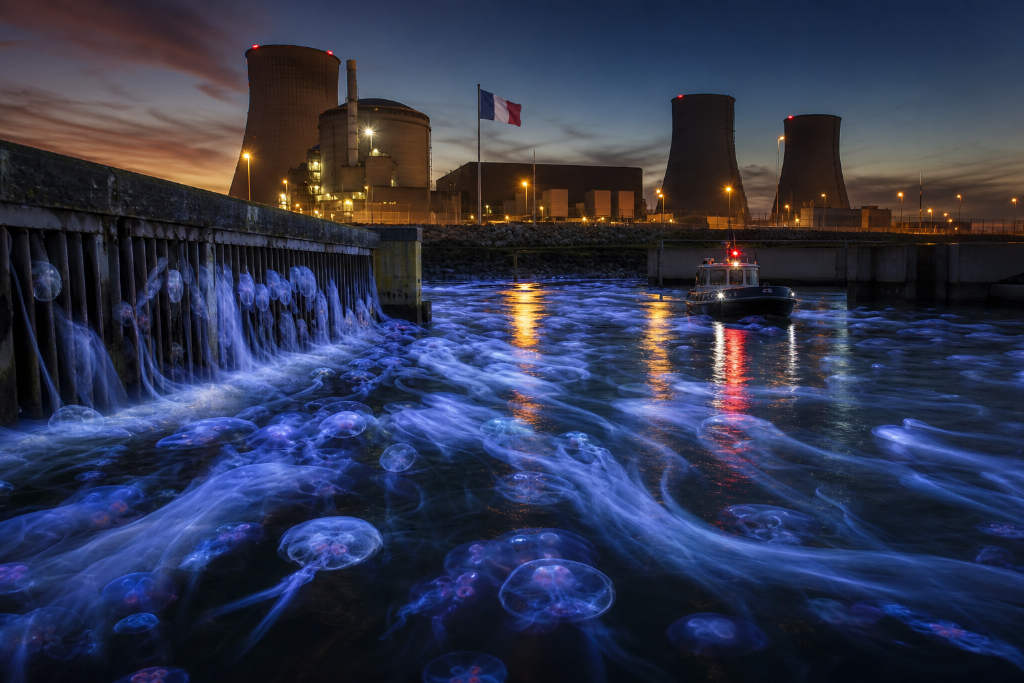
Electricite de France (EDF) said a surge of jellyfish at the Gravelines nuclear power plant near Dunkirk forced three reactor units to shut down and cut a fourth to 50% output, removing 3.2 GW of installed capacity from the French power grid in one day.
EDF said units 2, 3 and 4 at Gravelines were taken offline, while unit 1 was reduced to half power. Of the site’s six reactors, only unit 6 was still running at full output. Unit 5 was already in a scheduled maintenance outage, leaving as many as five units either offline or operating at reduced capacity at the same time.
Gravelines is the largest commercial nuclear power plant in Western Europe. Each of its six units has net capacity of 910 MW, making the disruption significant for the French grid.
Cooling water intake blocked by jellyfish
The immediate cause was a large influx of jellyfish into the intake pumping station, where they clogged the filter drums used in the seawater cooling system. In an official statement, EDF said: 「This situation does not affect facility safety, personnel safety, or the environment.」
The report said this was not EDF’s first run-in with jellyfish, and the company had already put defensive measures in place. NucNet reported that since June 2026, EDF had installed surveillance cameras on filter drums and intake channels, deployed three fishing boats on 24-hour rotating patrols, used preventive trawling to move jellyfish swarms away, and added thermal imaging equipment to anticipate their movement. It also worked with the French sustainable fisheries group France Pêche Durable et Responsable and a national sea rescue body to observe and quantify jellyfish numbers each day.
EDF has also earmarked 8.7 billion euros through 2040 for climate adaptation across its nuclear and hydropower fleet. Even so, those measures did not prevent this latest disruption. EDF officials said the jellyfish bloom expanded too quickly for monitoring boats to keep pace.
Climate and overfishing pressure seen worsening the problem
A marine invertebrate research organization had warned: 「Jellyfish and power generation disruptions remain a global challenge. Overfishing, climate change, and rising coastal development are making jellyfish blooms more frequent and more widespread.」
The report also said climate stress on France’s nuclear fleet is rising. Agence France-Presse, using EDF data, calculated that climate-related unavailable nuclear capacity in France reached 15.6% on Aug. 9, 2026, the highest level on record.
The same data showed French nuclear output fell by about 3% in June and by about 6% in July. One estimate cited in the report said climate factors could cut annual nuclear output by 1.4% by 2035, well above the 0.3% average recorded since 2000.
Heat wave adds strain across Europe
Europe is also dealing with a heat wave, with temperatures nearing 40 degrees Celsius. At the same time, other EDF nuclear plants located along inland rivers have also had to reduce output because river water temperatures were too high, in order to limit the ecological impact of discharged cooling water.