

Grayscale said in a new research report that Bitcoin’s bear market may already be over if the Federal Reserve does not raise interest rates again.
Zach Pandl, the digital asset manager’s head of research, laid out two competing frameworks for the current Bitcoin market. One is the long-used four-year cycle theory. The other is a macro-driven pricing model. Pandl said he leans toward the second view, arguing that Bitcoin is increasingly trading in response to interest rates and the broader economic backdrop, while the old cycle pattern may no longer hold.
Two models, two very different bottom calls
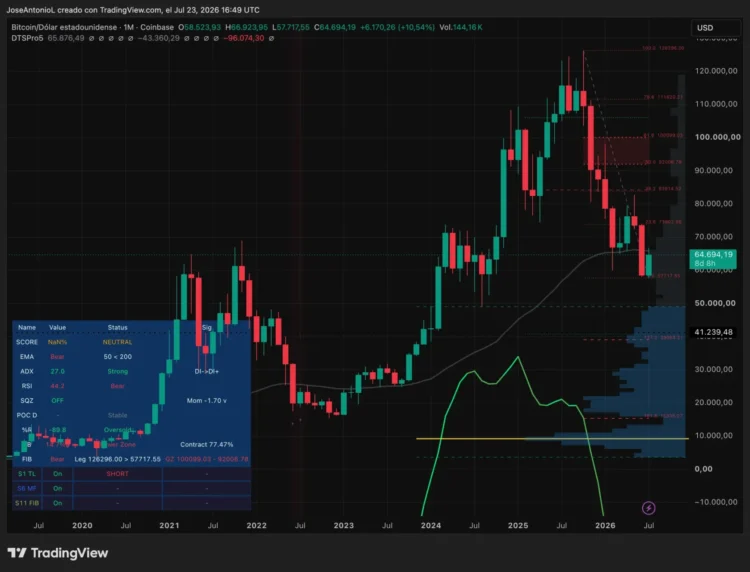
According to Pandl, the four-year cycle model suggests Bitcoin could still fall further and may not bottom until September or October this year. From the current level of about $65,000, that would imply roughly 15% more downside.
Recent market flows, though, point in another direction. Bitcoin has rebounded more than 10% from its early July low of $57,717. Spot ETFs have also recorded net inflows for seven consecutive trading days, with total net inflows approaching $1 billion.
Even so, on a monthly chart basis the market still appears weak, and the report said Bitcoin could remain in a bearish structure and drift lower for months.
The old script points to a deeper decline
Pandl said the traditional four-year cycle model shows Bitcoin usually bottoms about one year after reaching a bull-market peak, or roughly two and a half years after a halving event. Historically, the average drawdown has been as large as 80%. If that pattern repeats, Bitcoin could fall to $50,000 in the coming months before the next major upward leg begins.
He pushed back on that framework. In his view, Bitcoin has matured and is no longer simply a retail-driven speculative asset. Instead, it now behaves more like gold, or like tech stocks that are highly sensitive to interest rates.
Grayscale ties this bear market to macro conditions
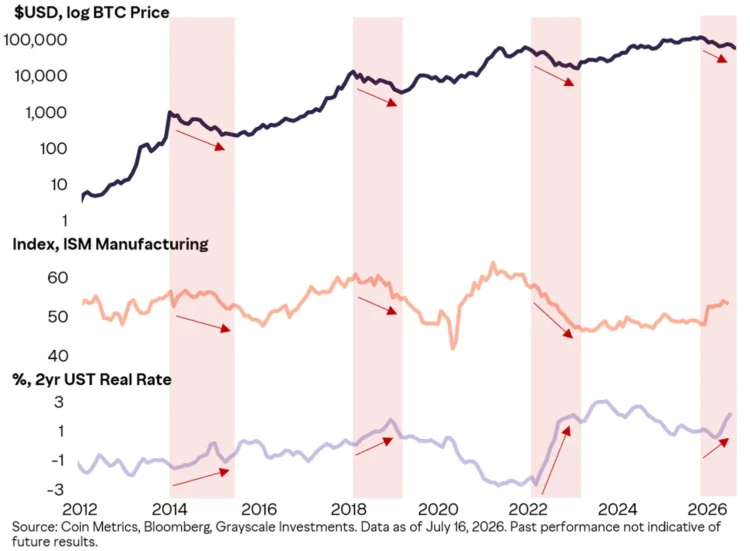
The report said past bear markets have often coincided with slowing economic growth and rising real interest rates, defined as bond yields adjusted for inflation.
Pandl wrote, “This bear market likewise reflects a major shift in expectations for Fed monetary policy, as well as higher real interest rates. If macroeconomic factors are now driving the market, then a reversal in those macro headwinds would mark Bitcoin’s true bottom.”
The report also looked back at Bitcoin’s move to an all-time high of $126,000 in October 2025, noting that the asset is now down about 49% from that peak. It said an earlier sharp sell-off was driven in large part by the nomination of Kevin Warsh as Fed chair, which weakened expectations for monetary easing and a weaker U.S. dollar. That, in turn, ended a key narrative that had supported Bitcoin’s rally. Bitcoin briefly fell below $58,000 in early July before rebounding.
Fed policy remains the key variable
Pandl said the market could also rebound quickly if macro conditions improve. “If the Fed holds off further rate hikes and economic growth remains solid, Bitcoin may already have bottomed,” he wrote.
On that basis, Grayscale said the four-year cycle still points to a lower trough, but the macro view suggests the worst may already be over.
Investors are also watching the CLARITY Act
The report added that the market is following progress on the U.S. Digital Asset Market Clarity Act. It said the market broadly believes that if the bill passes the Senate and becomes law, it could improve regulatory clarity, lift investor confidence in Bitcoin and the wider crypto market, and help trigger a strong rebound.