

Grayscale’s latest research argues that for Bitcoin, the bigger investment risk may not be volatility or drawdowns alone. It may be missing the handful of days that drive most of the asset’s long-term return.
In traditional finance, risk is usually measured through volatility and maximum drawdown. That framework has shaped a familiar investor response during market transitions: sell when conditions look unclear, wait for the pullback to stabilize, then try to buy back in once the trend appears safer.
The report says that approach can be especially costly in Bitcoin, where returns are distributed in a far more extreme way than in many traditional assets.
A small number of days carried most of Bitcoin’s gains
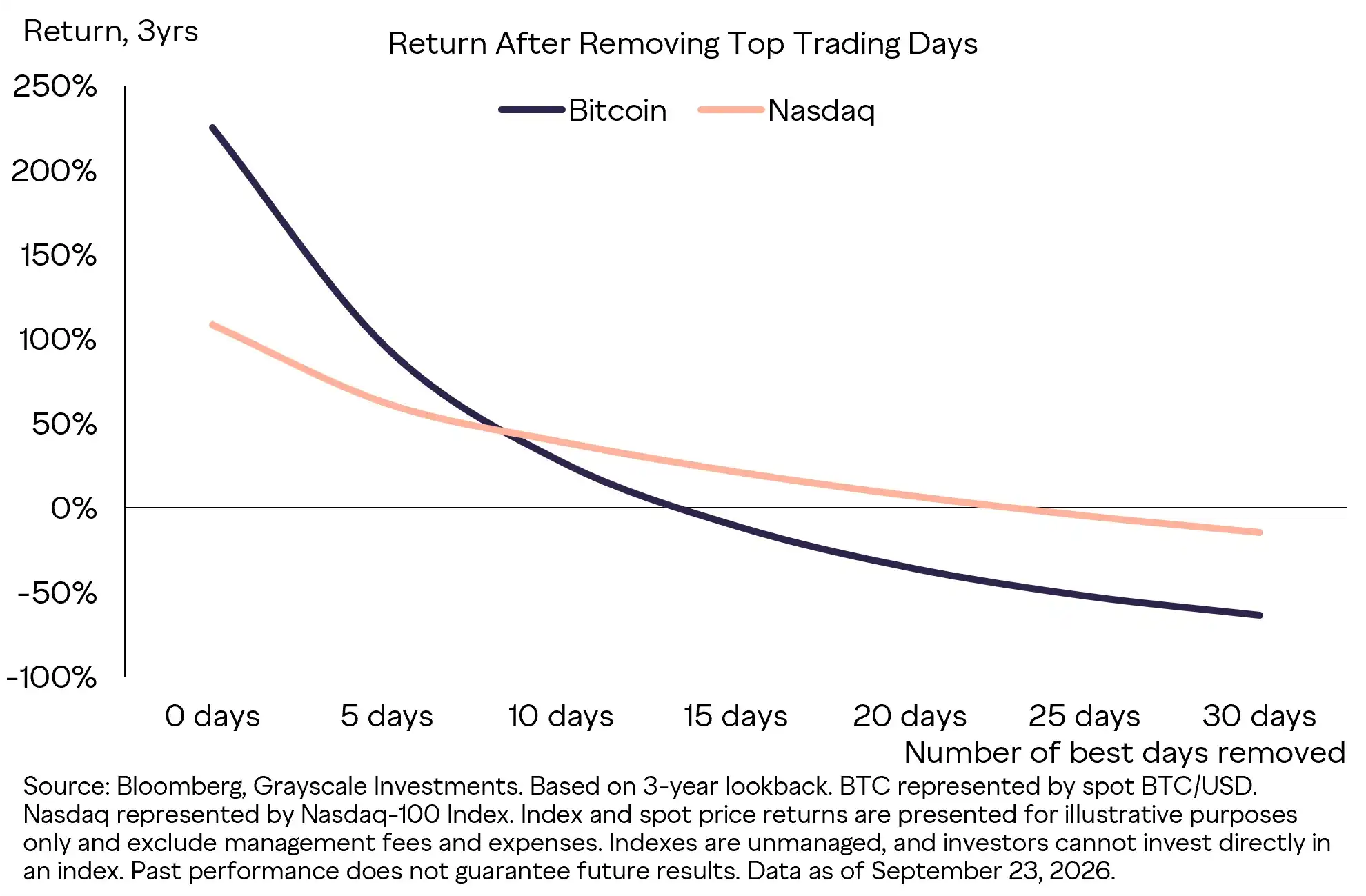
Over the past three years, Bitcoin posted a cumulative return of about 225%, according to the report. Over the same period, the Nasdaq-100 returned 109%.
But once Grayscale broke down BTC’s daily returns across roughly 1,095 calendar days, the concentration became stark:
- Remove the five best trading days, and Bitcoin’s three-year cumulative return falls from 225% to 95%.
- Remove the 10 best trading days, and the return shrinks to 27%.
- Remove the 15 best trading days, and the cumulative return turns negative, dropping to -11%.
That means most of the alpha that allowed Bitcoin to outperform inflation and mainstream assets over the past three years was compressed into less than 1.4% of trading days. Miss that short window while sitting in cash or staying on the sidelines, and the experience of holding BTC over three years changes dramatically.
Grayscale contrasted that with the Nasdaq-100, whose return profile was much smoother. Even after excluding its best 15 trading days, the index still retained a positive return of 21%.
Bitcoin’s strongest rebounds often come at the hardest moments to buy
The report says very few investors can consistently buy the day before a major rally. In practice, Bitcoin’s best-performing days often arrive when market psychology is at its weakest.
It points to two common features in sharp single-day rebounds for high-beta assets.
- They often begin after liquidity dries up or panic selling takes hold. The report cites examples such as retaliatory rebounds after regulatory uncertainty clears, or short squeezes triggered by crowded bearish positioning. At those moments, market sentiment is usually deeply pessimistic, on-chain activity is subdued, and holding stablecoins can feel safer than staying exposed.
- The repricing happens fast. Bitcoin’s pulse-like repricing can unfold within hours, with single-day gains often exceeding 10% and sometimes reaching 15%. By the time sidelined capital decides the trend reversal is real and tries to re-enter on the right side, the core move may already be over.
In that sense, waiting for the market to become “fully clear” carries its own cost. When investors feel they finally understand the direction, the repricing may already have happened.
The report frames the issue as absence risk
The article cites a familiar Wall Street line: “Time in the market beats timing the market.” In Grayscale’s framing, that idea matters even more for Bitcoin because the asset’s upside is concentrated in short bursts.
Trying to trade around every 10% pullback may mean missing a 20% surge. In an asymmetric setup like that, the penalty for missing the upside can be harsher than the pain of carrying a temporary paper loss.
The article also notes that whether the approach is dollar-cost averaging used by overseas regulated institutions or accumulation in whale cold wallets, the core idea is not to buy the exact bottom. It is to make sure the position is still there when the small number of days that shape long-term returns finally arrive.
For Bitcoin investors, the report’s message is straightforward: enduring drawdowns may only be the baseline. Staying in the game is what matters most.