
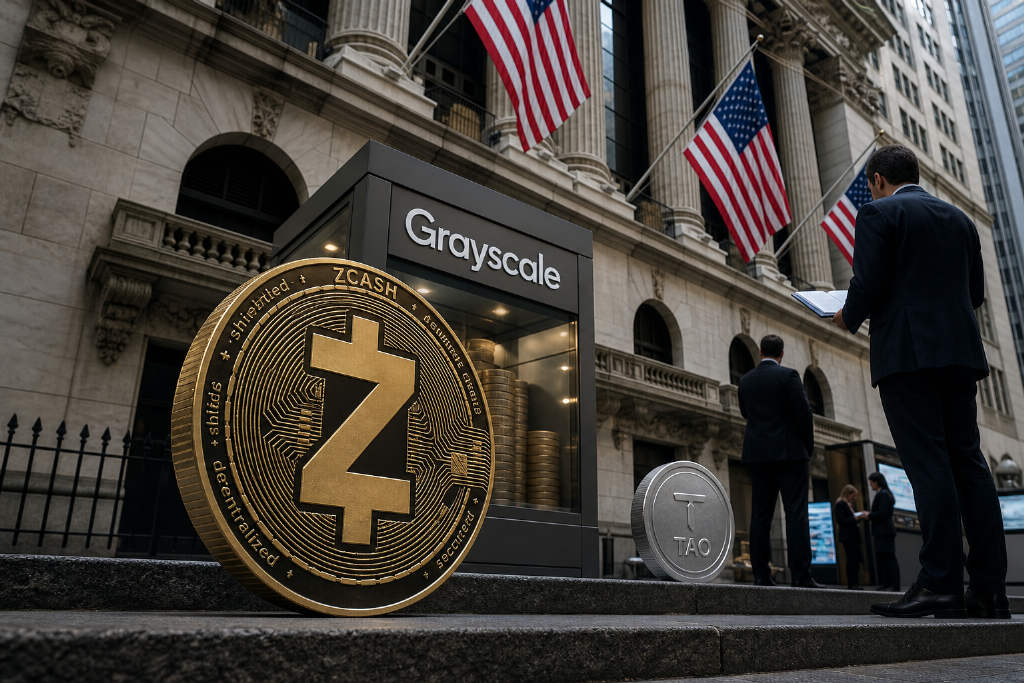
Bitcoin rallied from around $63,000 to above $78,000 this week, posting one of its strongest weekly performances in recent years. Zcash (ZEC) moved with it, but the scale of the move stood out: the token climbed into the $836-$855 range, its highest level since 2018, and lifted its market capitalization to roughly $13.8 billion.

The immediate trigger cited by the market was not just a return of interest in privacy coins. Attention centered on Grayscale’s continued effort to convert Grayscale Zcash Trust into a spot exchange-traded fund, along with a newly disclosed discussion involving a possible injection of about 200,000 ZEC from a Digital Currency Group subsidiary.
Fifth amendment became the key catalyst for ZEC
Cointelegraph and other outlets linked ZEC’s latest jump to Grayscale’s updated filings for the trust conversion.
Grayscale is seeking to turn Grayscale Zcash Trust (ZCSH) into a spot ETF to be listed on NYSE Arca. The proposed product would be renamed The Zcash ETF, with the ticker shown as ZCSH or ZCH. In the second half of August, the firm submitted its fourth and fifth amendments under S-3/A.
The filings specify a 2.5% annual fee. Coinbase Custody and others are named as custodians, while Jane Street and Virtu appear as authorized participants.
The filing detail that drew the most attention involved DCG International Investments, a subsidiary of Digital Currency Group. It disclosed non-binding discussions over a contribution of about 200,000 ZEC to the trust. At the price referenced at the time, that stake was worth about $110 million and could represent roughly 34% of the enlarged fund if completed. The discussions are not binding, and the final amount could be higher, lower, or scrapped altogether.
Some of the documents also mentioned a possible listing window around Aug. 25, though any launch still depends on regulatory approval. At the same time, ZEC futures volume expanded into the multi-billion-dollar range, a sign that leveraged traders were positioning ahead of a product that has not yet gone live.
Why a trust-to-ETF conversion matters
Grayscale has long used OTC trust products to offer indirect exposure to digital assets. If the structure shifts to an ETF, shares can be created and redeemed continuously on an exchange. That changes access, improves liquidity, and can alter how discounts or premiums behave.
For a trust that already holds a large amount of the underlying token, the market often reads the conversion as a dual signal: supply remains locked inside the vehicle, while an institutional access route becomes easier to use. In ZEC’s case, that creates a different setup from a simple Bitcoin-led price move. The repricing is tied more directly to a product structure change.
That reading gained more weight because the trust already holds a meaningful amount of ZEC, and the possible DCG contribution added another layer to the trade.
TAO is on a similar path, but much earlier in the process
Grayscale is running a nearly identical playbook for Bittensor (TAO), though the timeline is clearly behind ZEC.
Public information shows that Grayscale Bittensor Trust has already been established and is quoted on the OTC market under GTAO. On Dec. 30, 2025, the firm filed an S-1 to convert it into a spot ETF under the proposed name Grayscale Bittensor Trust ETF, also with the ticker GTAO. An amended filing followed on April 2, 2026.
Coinbase Custody and BitGo are listed as proposed custodians, and NYSE Arca is the intended exchange.
Unlike ZEC, however, TAO is still at an earlier stage. There has been no similar burst of recent amendments and no near-term listing timetable in view. TAO has still risen with the broader market, moving from around $190 over the past week into the $230-$240 range, but that move has been driven more by broad-market momentum than by ETF paperwork becoming the central narrative.
Filing progress is becoming a signal in itself
The overlap between ZEC’s eight-year high and the pace of the filings suggests that product-structure progress can function as an independent catalyst. TAO is moving along the same route, just on a longer clock, and the market still appears to be paying limited attention to that pattern.
Some observers believe that if the ZEC conversion is completed, or if the path becomes clearer, investors may revisit how they price other assets already inside Grayscale’s product lineup.
For now, TAO’s conversion still needs more regulatory and filing progress. Whether ZEC actually lists, whether the DCG contribution goes through, and how much money ultimately enters the product after conversion will determine how durable this repricing becomes. For assets that remain underwatched, filing progress itself is turning into a trackable leading indicator.
