



Posts on X about Grok Bot often focus on the upside: 0.25 ETH turning into 1.35 ETH in a day, $1,000 becoming five figures overnight, or a setup that starts with no capital and keeps collecting fees. The Odaily article says those examples leave out the harder part. Under what conditions does the bot fail, and how much damage does that failure do?
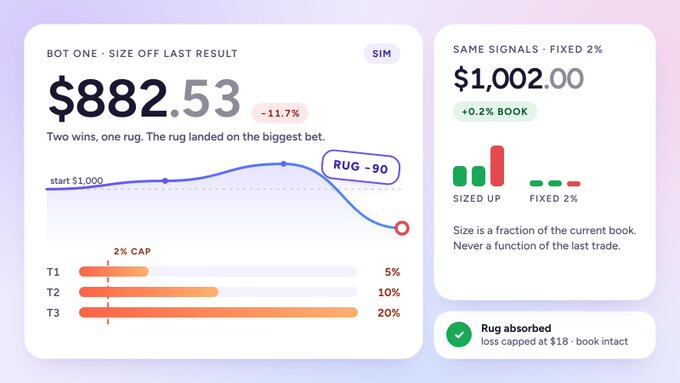
The piece argues that the same three trade signals can produce very different outcomes if the position-sizing rule changes. One account can come through a rug pull roughly flat. Another can lose about 12% and give back all gains from the first two trades. What matters is not only whether a bot catches an opportunity, but how much capital it loses when its judgment is wrong.
Start with failure modes, not profit screenshots
The article frames bot design through failure mode analysis, a method used in aerospace and manufacturing. The process is straightforward: list the ways a system can fail, then score each one by severity, likelihood, and how quickly the problem can be detected. The highest-risk failure modes get addressed first.
It also brings in two engineering ideas:
- A safety factor: a system should not run at its rated limit all the time. If a beam can carry 10 tons, actual use should keep it at 5 tons.
- Failure propagation: when one part breaks, how much of the rest of the system goes down with it.
Applied to memecoin trading, every bot should answer three questions: what edge does it rely on, what breaks that edge, and when it breaks, does the loss stay inside one position or spread across the whole account?
Three common bot types and how they break
According to the article, most Grok Bot-based memecoin trading setups fall into three broad categories: gambler bots, house bots, and follower bots. They make money in different ways, and they fail in different ways too.
Gambler bots: the real danger is position escalation
Gambler bots scan newly issued tokens, check contracts, decide on price direction, and trade. Their edge is supposed to be token selection and directional judgment. Their weak point is that after a few wins, they often increase size. If the next calls are wrong, losses can jump fast.
The article singles out one instruction as especially dangerous: set the next position size based on the result of the previous trade. It describes that as a Martingale-style sizing rule in disguise.
It uses a $1,000 starting account to compare two sizing methods:
- On the first trade, both strategies make 50%. One allocates 5% of account equity, or $50, and the account rises to $1,025. The other allocates a fixed 2%, or $20, and the account rises to $1,010.
- On the second trade, both make another 50%. The first strategy raises size to 10%, puts in about $103, and the account grows to about $1,076. The second still uses 2%, puts in about $20, and the account reaches about $1,020.
- On the third trade, the token gets rugged and both lose 90%. The first strategy raises size again to 20%, puts in about $215, and the account falls to about $883. The second still uses 2%, puts in about $20, and the account is left with about $1,002, roughly preserving principal.
Same signals, very different damage. One account is close to flat after the rug. The other is down about 12% and has lost all prior gains.
The rule the article draws from this is strict: each trade should use a fixed percentage of current account equity, and that percentage should not change based on the previous result. Contract checks, including mint authority, liquidity pool status, and the concentration held by the top 10 wallets, should be hard entry filters that can block an order, not just scoring inputs that trim size.
House bots: fee income can hide both cost risk and a harder boundary
House bots issue tokens, collect fees from each trade, and drop tokens that attract no activity. Their appeal is obvious: if there is volume, there is revenue, and they do not need to predict direction. Their weak point is just as clear. If trading volume dries up, issuance costs can exceed fee income.
The article says the common pitch for these bots is that they “rarely lose money.” That only works if fee income is counted and costs are ignored. Every token launch has costs: deployment, initial liquidity, gas, and the money spent on tokens that never get a single trade after launch.
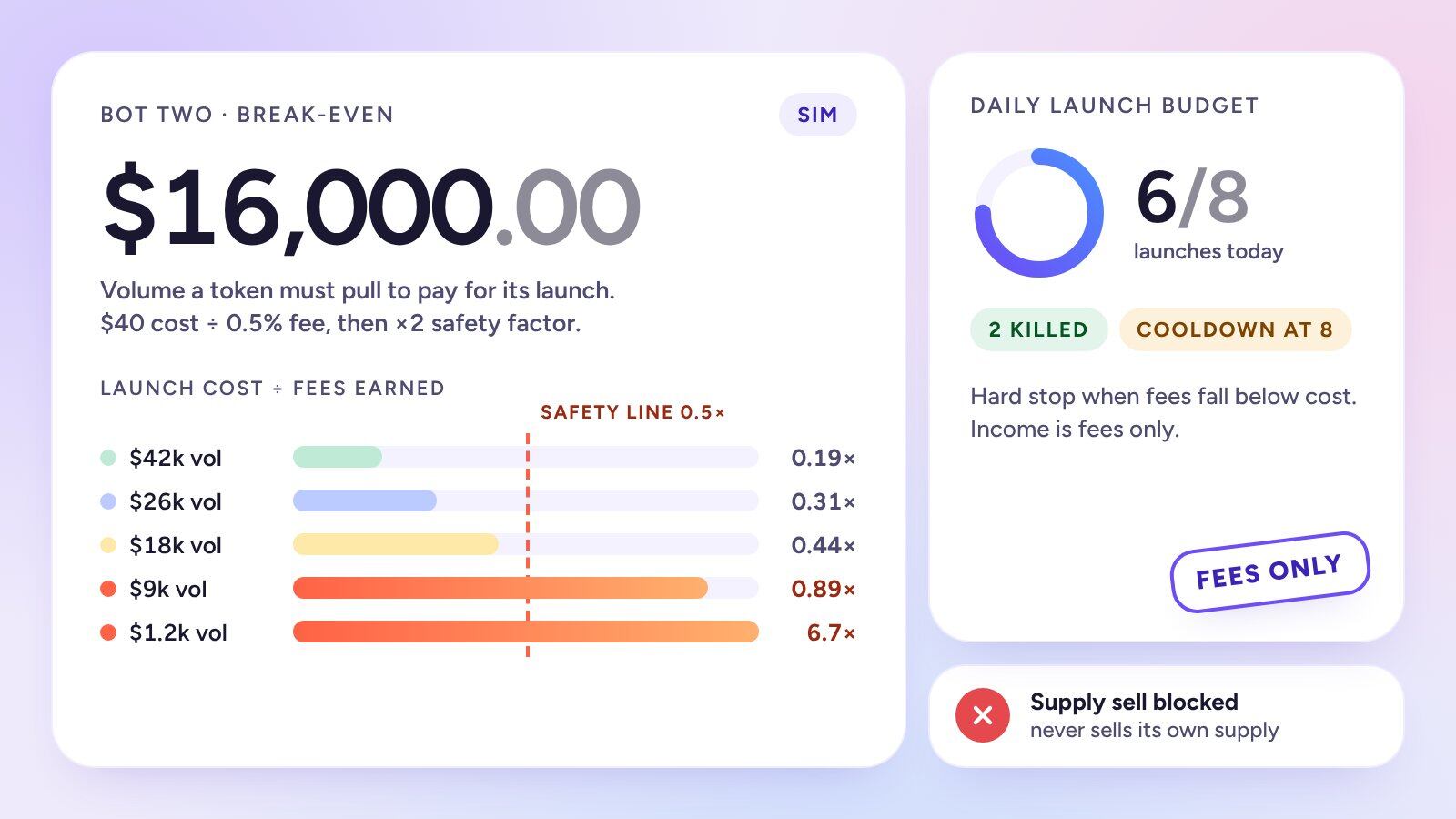
Before the bot goes live, the article says traders should calculate break-even conditions. The fee rate multiplied by expected trading volume per token must exceed the cost of a single issuance, and there should be a 2x safety factor. Put differently, expected fee income should be at least twice the cost of launching one token.
Then comes the more serious failure mode. A fee model earns from user trading activity. But once the bot starts holding the tokens it issued and selling them into buyers, it is no longer just acting as a fee-taking house. The article says that crosses into a rug, with reputation risk, platform risk, and legal risk concentrated in that move. Profit screenshots do not show any of that.
The rule here is also explicit: a house bot should not hold or sell the tokens it issues. Its income should come only from fees. It should also have a daily issuance budget, and token launches should stop once fee income falls below cost.
Follower bots: even if the wallet is right, your entry can still be wrong
Follower bots track profitable wallets, rank them, and copy their trades. Their edge is borrowed: they try to piggyback on someone else’s proven trading advantage. Their weak point is delay. Even if the wallet being copied is right, the copied trade can still go through at the wrong price.
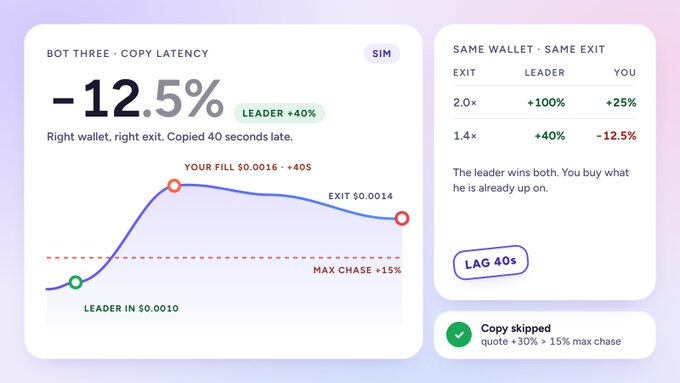
The article says a 40-second lag is not trivial in memecoins. It can decide whether a trade ends green or red. It gives a simple example: if the tracked wallet buys at $0.0010 and your copy order fills 40 seconds later at $0.0016, you have chased the price by 60%.
From there, the payoff profile changes sharply:
- If the token rises to 2x the tracked wallet’s entry, or $0.0020, that wallet makes 100%, while you make only 25%.
- If the token rises to 1.4x the tracked wallet’s entry, or $0.0014, that wallet makes 40%, while you lose 12.5%.
The article’s point is that the same wallet, the same token, and the same exit time can still produce one profitable copy and one losing copy, because the original wallet may already be sitting on a large unrealized gain when you enter. The worse case is when the tracked wallet is selling into the buying pressure created by you and other followers. In that setup, you are not following smart money. You are providing the liquidity it needs to exit.
The rules proposed for follower bots are practical: set a chase limit, skip the trade if the expected fill price is more than 15% above the tracked wallet’s entry, follow sells as well as buys, cap the capital allocated to any single wallet, and lower that wallet’s tracking priority after three consecutive copy-trade losses.
Four mistakes traders make with bots
The article also lists four recurring mistakes.
- First, comparing returns without comparing failure modes. A 10x day only shows the best case. It says nothing about what can wipe out the wallet.
- Second, trusting a single run. Even 24 hours of continuous operation is still one sample. Engineers do not call a part reliable because it passed one test.
- Third, running the system at the limit. If a stop-loss mechanism needs to check once per second to work, then checking once per second is not enough. The system needs margin.
- Fourth, treating risk control as a settings option. A slider in the interface only expresses a preference. A real rule has to be embedded in the order flow and tested so that failure triggers an error.
Risk control can cap losses, not guarantee profits
The article closes with a narrow conclusion. Risk controls do not make a bot profitable, and they do not make its judgment correct. Rug pulls, honeypot contracts that allow buys but not sells, and liquidity that can disappear within a single block do not go away because a circuit breaker exists. Risk controls can limit losses. They cannot remove risk.
For actual adjustments, the article says traders should first fix the issues that can threaten the whole account. For most users, that means correcting the position-sizing rule in gambler bots first, then setting a chase cap for follower bots, and only after that checking whether a house bot’s revenue can cover its costs.
If a strategy depends on dumping self-issued tokens, trading ahead of followers, or profiting by bypassing platform rules, the article says no amount of risk control can fix the strategy itself.
Its final point is simple: instead of asking how much a bot can make, ask how much you can afford to lose when it breaks.