
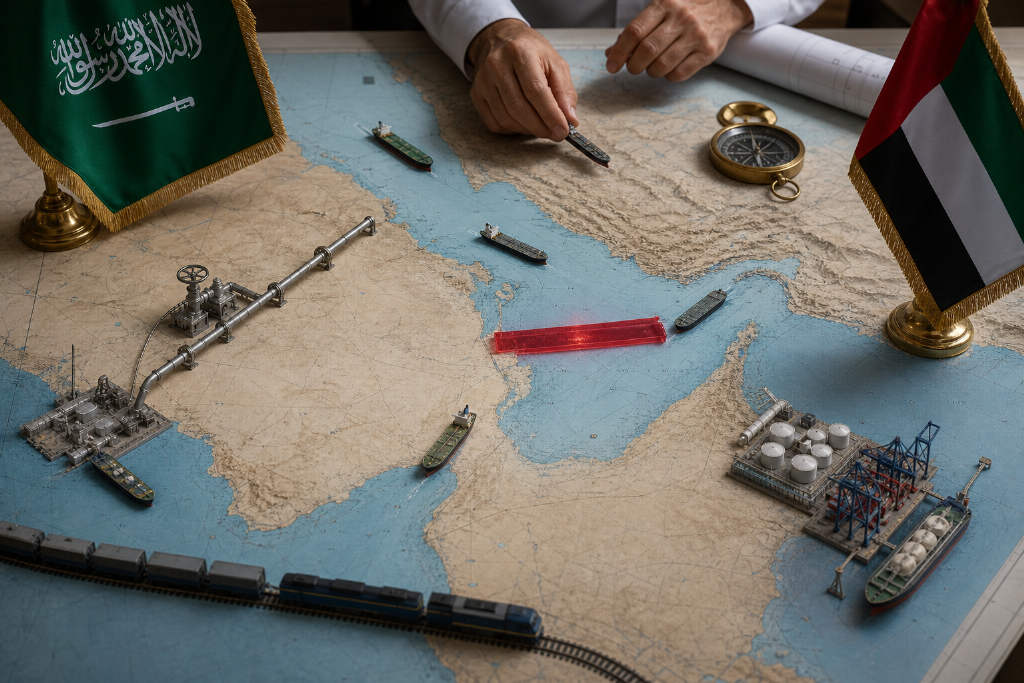
Gulf countries including Saudi Arabia and the United Arab Emirates are speeding up investment in ports, pipelines and railway projects as the Iran war continues to disrupt shipping through the Strait of Hormuz, according to BlockBeats on Aug. 31.
Before the conflict, the strait carried about one-fifth of global oil flows. Traffic is still running far below normal levels.
Saudi Arabia studies east-west pipeline expansion
Saudi Arabia is studying an expansion of its east-west crude pipeline linking its eastern oil-producing region with Yanbu on the Red Sea. The pipeline currently has capacity of about 7 million barrels per day. Saudi Arabia is considering adding another 1 million to 2 million barrels per day and is also discussing whether neighboring states could use the network to bypass the Strait of Hormuz.
UAE advances Fujairah port and pipeline plans
The UAE is also accelerating work tied to Fujairah port. DP World agreed in July to develop two new terminals under a 50-year concession. The Al Rugaylat container and multipurpose terminal will have capacity of as much as 2.5 million TEU per year, while the Dibba general cargo terminal will add 3.6 million tons of cargo handling capacity.
Abu Dhabi is also moving ahead with a new crude oil pipeline expected to start operations in 2027. That project could double the UAE’s crude export capacity through Fujairah outside the Strait of Hormuz.
Economic and shipping data show the strain
Disruption in the Strait of Hormuz has already hit Gulf economies. A Reuters survey in July projected that Qatar and Kuwait would see their economies contract by 8.1% in 2026, while Saudi Arabia was expected to grow 1.4%.
Qatar has been hit especially hard because its liquefied natural gas exports rely heavily on the strait. Since the war began, LNG export volumes have fallen 96%.
Shipping traffic has recovered only in a limited way. Preliminary data from Kpler showed that only seven commodity vessels passed through the Strait of Hormuz last Thursday, compared with a 10-day average of 15 previously.
Gulf states are using the disruption to speed up construction of alternative energy and trade corridors along the Red Sea and the Arabian Sea, aiming to reduce future strategic dependence on a single maritime chokepoint.