
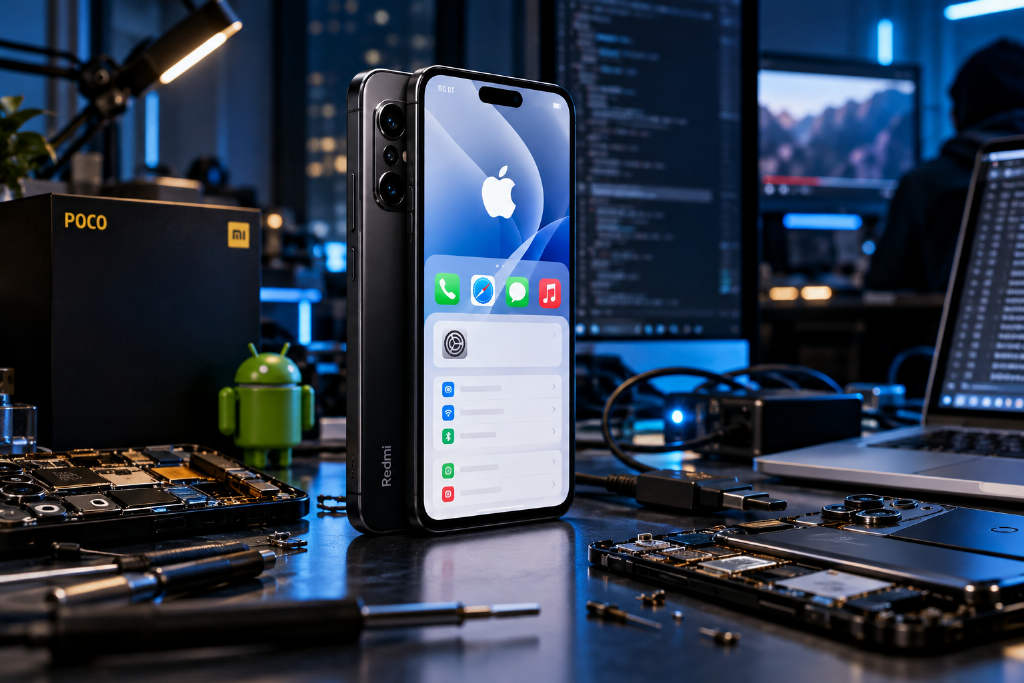
Hackers and hobbyist developers are now booting Apple’s iOS on Android phones, something that had not been publicly demonstrated in the other direction before. The videos are spreading quickly on social media. One clip showing iOS 16 on a Redmi Note 12 has topped 2 million views on X, and another developer has posted a build running on a Nothing 3a.
iOS is the operating system that powers the iPhone, from the touchscreen layer to apps and system functions, and it is built to run only on Apple hardware. For years, choosing a phone effectively meant choosing its software as well. That boundary is now being tested in a new way.
Android had reached iPhones before, but not the reverse
This is not the first time phone enthusiasts have crossed platform lines. In April 2010, a project called iDroid let early iPhones boot Android. A decade later, security firm Corellium launched Project Sandcastle, which brought Android 10 to iPhones using Apple’s A10 chip.
What had not happened until now was getting iOS to run on Android hardware.
One X post said: 「WTf, Running real iOS on Android hardware. HackiOS is attempting a full code rewrite to run actual iOS on Android hardware. They’re in the final polishing stage. If it works, the project will be completely free and open no paywalls, no premium tiers.」 The post was dated October 16, 2026.
Public code on GitHub shows partial progress
The closest publicly available code appears to be an open-source GitHub project called ios-sweet, built for the Redmi Note 10 Pro.
The project takes XNU, Apple’s open-source kernel, and patches it so it can run on the phone’s Qualcomm Snapdragon 732G chip. On top of that, developers use unmodified iOS 16.7.16 files taken from an iPhone X.
Its readme describes the effort as an 「experimental bring-up, not a usable phone OS」. According to that documentation, the Redmi Note 10 Pro can reach the lock screen, home screen, Control Center, and Settings, and both touch input and physical buttons respond.
Major limitations remain. Wi‑Fi, Bluetooth, mobile data, audio, and the camera do not work. The gesture used to leave an app does nothing. Without a graphics driver, the processor draws the display itself at roughly 20 to 30 frames per second.
A separate team claims iOS 16.5 on a Poco X5 Pro
A different group calling itself OOSexGang says its HackiOS project runs iOS 16.5 on a Poco X5 Pro using a custom UEFI and the XNU kernel.
The researcher who shared the demo also noted that there is no public source code and no independent verification. In a newer clip, Safari downloads an Android APK file from APKMirror and then fails to open it, which Decrypt noted is consistent with how iOS has always handled Android apps.
Another X post said: 「iOS 16.5 just Running on an Android phone hardware. and it can’t open Apk because of iOS,Safari pulls an APK from APKMirror, then fails to run it. New HackiOs/OOSexGang demo it can be soon public release」. That post was dated October 19, 2026.
AI-assisted tooling is speeding up this kind of work
The idea of making software run where it was never meant to run has been attracting more enthusiasts, and Decrypt ties part of that momentum to AI tools that can generate and refine code very quickly.
Just days earlier, security firm Calif.io jailbroke an iPhone 18 Pro on stage at the Hexacon conference in Paris, and the root access survived a reboot. Jailbreaking removes Apple’s restrictions and gives users deeper control over the device.
Decrypt also pointed to REA, short for Reverse Engineer Anything, a free toolkit that allows AI coding assistants to take software apart. One example cited in that toolkit’s orbit was a developer demo of GTA V running on iOS.
For now, it remains a proof of concept
In practical terms, the ceiling is still low. On the Redmi Note 10 Pro, running iOS currently means getting to the iOS home screen. Wi‑Fi, mobile data, and audio do not work, the display is rendered by the processor at roughly 20 to 30 frames per second, and the first boot sits on the Apple logo for four to five minutes.
Anyone considering trying it should expect trade-offs. The installation wipes Android user data from the phone, leaves most security protections switched off, and the developers themselves say users should not keep personal information on the device.



