
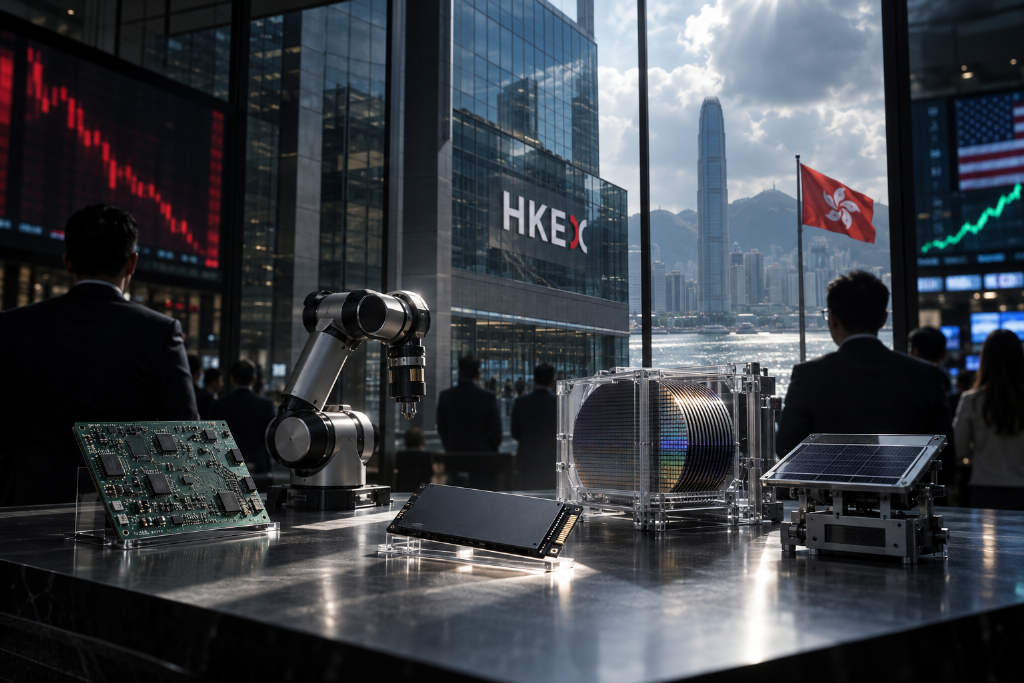
Global markets rose again during China’s National Day holiday, but Hong Kong tech stocks moved in the opposite direction. On Oct. 2, Japan’s Nikkei gained nearly 4%, South Korea’s Kospi rose 2%, and the Nasdaq closed at another record high. On the same day, the Hang Seng Tech Index opened lower and kept falling, touching 4,111 intraday, its lowest level in a year, before ending down 2.26%. From its October 2025 high, the index has fallen nearly 40%.
Among index constituents, Xiaomi Group dropped more than 5%. Bilibili, JD Health, and XPeng each fell more than 4%, while Kuaishou, Li Auto, Baidu, Horizon, Leapmotor, and JD.com each lost more than 3%. NIO was the only stock in the basket that closed in positive territory.
A-share hard-tech firms continue lining up for Hong Kong listings
Just days earlier, the Hong Kong Stock Exchange welcomed four new listings in quick succession: PCB leader Kinwong Electronic, photovoltaic automation equipment supplier Robotech, photoresist maker Tongcheng New Material, and robot actuator company Benmo Technology. Three of the four are A-share companies pursuing secondary listings in Hong Kong.
Kinwong Electronic drew the most attention. Based on 2025 revenue, it was the world’s largest supplier of automotive electronics PCBs with a 10.6% market share. It ranked No. 11 among global PCB manufacturers and held an overall 2.5% share of the global PCB market. Its customer base extends beyond automakers, and the company also supplies PCBs for high-speed computing hardware, placing it inside the AI infrastructure chain.
Before the market had fully absorbed those listings, another name appeared on Oct. 2. Dapu Micro, referred to in the article as the first A-share-listed “AISSD” company, said it plans to appoint Pan-China International as the H-share offering auditor and submit an A1 application to the Hong Kong Stock Exchange in the near term, with a listing expected by late 2026 or early 2027.
According to IFR, Dapu Micro has already made a confidential filing and plans to raise at least $1 billion through a secondary listing in Hong Kong. CITIC Securities, Haitong International, and UBS are said to be working on the deal together.
Dapu Micro moves toward Hong Kong only months after its ChiNext debut
Dapu Micro listed on Shenzhen’s ChiNext board in April 2026 and moved to start its Hong Kong IPO plan in October, only about half a year later. The article links that timing to the company’s first interim results after going public.
For the first half, Dapu Micro posted revenue of 4.722 billion yuan, up 531% year over year. Net profit attributable to shareholders came in at 1.334 billion yuan, compared with a loss of 354 million yuan in the same period a year earlier. As of Sept. 30, the stock closed at 339.9 yuan on the A-share market, giving the company a market capitalization of 148.27 billion yuan.
The southbound fundraising queue is concentrated in the AI hardware chain
Seen over a longer stretch, Dapu Micro is not an isolated case. It is simply the latest company to join a broader move by A-share hard-tech firms heading south for capital.
The top three Hong Kong IPO fundraisings in 2026 all came from A-share hard-tech companies. Zhongji Innolight raised HK$61.422 billion in its debut, setting a new Hong Kong fundraising record for the past seven years. Luxshare Precision raised HK$25.060 billion, and Avary Holding raised HK$23.135 billion. Together, the three deals brought in more than HK$110 billion.
The businesses in this queue overlap heavily. Zhongji Innolight makes optical modules. Avary Holding produces AI server PCBs. Luxshare Precision is involved in connectors and server contract manufacturing. Dapu Micro focuses on enterprise SSDs. Kinwong Electronic makes automotive and AI-related PCBs. Robotech works in photovoltaic and semiconductor automation. Tongcheng New Material produces photoresist. Benmo Technology makes robot actuators.
Nearly all of them sit somewhere along the AI computing hardware chain.
The article argues that this reflects a common reality. By 2026, the AI arms race had pushed optical modules, PCBs, SSDs, and robot actuators into aggressive capacity expansion. Expanding capacity requires money on a large scale, from factory construction to equipment purchases and capacity reservation. At the same time, refinancing channels in the A-share market have not fully opened for these companies, and valuations remain constrained. Hong Kong has become another pool of capital, one that can provide access to U.S. dollar funding, while secondary listing procedures are relatively faster and international investors recognize these companies’ positions in the global AI supply chain.
Dapu Micro is presented as a case in point. Its first-half revenue jumped more than fivefold, and it moved toward a Hong Kong listing soon after turning profitable. The article says that does not reflect a struggle for survival, but rather the fact that expansion funding needs are rising faster than retained earnings.
Strong fundraising, weak aftermarket support
That said, the article also warns that Hong Kong’s capacity to absorb new supply is showing signs of strain.
So far in 2026, nearly 120 companies have listed in Hong Kong, raising around HK$400 billion in total. That puts the exchange near the top globally by fundraising scale. Zhongji Innolight alone reset Hong Kong’s seven-year fundraising record. On the surface, this looks like a return of Hong Kong as a global financing hub.
But the other side of the story is a post-listing break rate above 70%. Since September, most new listings have broken below their offer prices on the first trading day. The gap between a hot primary market and a soft secondary market has become hard to miss.
The article explains that primary issuance is supported by cornerstone investors and anchor investors that lock in allocations before listing and help stabilize the offer price. Once the lock-up periods expire, however, those shares begin to loosen and the secondary market does not appear to have enough follow-on buying power to support prices. The money that subscribes in the IPO is not the same money that later takes stock in the open market.
That framework is used to explain the Hang Seng Tech decline on Oct. 2. Roughly HK$400 billion of IPO fundraising over the year requires steady secondary-market liquidity to absorb supply. As more hard-tech companies come to market and incremental capital in Hong Kong fails to keep pace, the index comes under pressure. The article says Xiaomi’s drop of more than 5% in a single day was not about a company-specific problem, but about dilution across the sector as supply increased.
It also notes that IPO fundraising is not the only reason behind the latest leg down in Hang Seng Tech. Elevated U.S. Treasury yields are weighing on valuations, some Chinese brokerages have been restricted from allowing mainland clients to buy, and southbound funds have been intermittently absent. With those forces stacked together, the market’s ability to absorb new listings has become more fragile.
Not a glory moment for Hong Kong stocks, but a funding search by hard-tech issuers
Put together, the article’s central line is straightforward. AI hardware companies have already told their story in the A-share market and are now turning to Hong Kong because the next round of expansion needs more capital. Zhongji Innolight raised HK$61.422 billion, Luxshare Precision raised HK$25.060 billion, Avary Holding raised HK$23.135 billion, and Dapu Micro is now seeking at least $1 billion more. These companies are not coming to Hong Kong merely for a listing ceremony. They want real U.S. dollar funding to support capacity expansion.
Whether the secondary market is willing to keep paying for that is a separate question. A break rate above 70% suggests that international investors are willing to assign valuations to these AI hardware companies in the primary market, but become much more cautious once trading begins in public.
Set against that, the Nasdaq is still making record highs. In the article’s reading, global capital has not left AI. It is just choosing to stay in large-cap U.S. tech stocks rather than chase new-economy paper in Hong Kong. The weakness in the Hang Seng Tech Index is presented as the clearest expression of that preference.
The next thing to watch, the article says, is not simply how much these companies can raise in Hong Kong. What matters is whether, after raising funds and building out capacity, their earnings can keep up. If demand for AI computing power continues to rise, and the added capacity funded through these listings turns into revenue and profit, this southbound listing wave will prove worthwhile. If demand softens, the 70% break rate will become a mirror of that risk.
In the end, getting listed only means getting the money. Turning that money into the next phase of growth is a different story.