
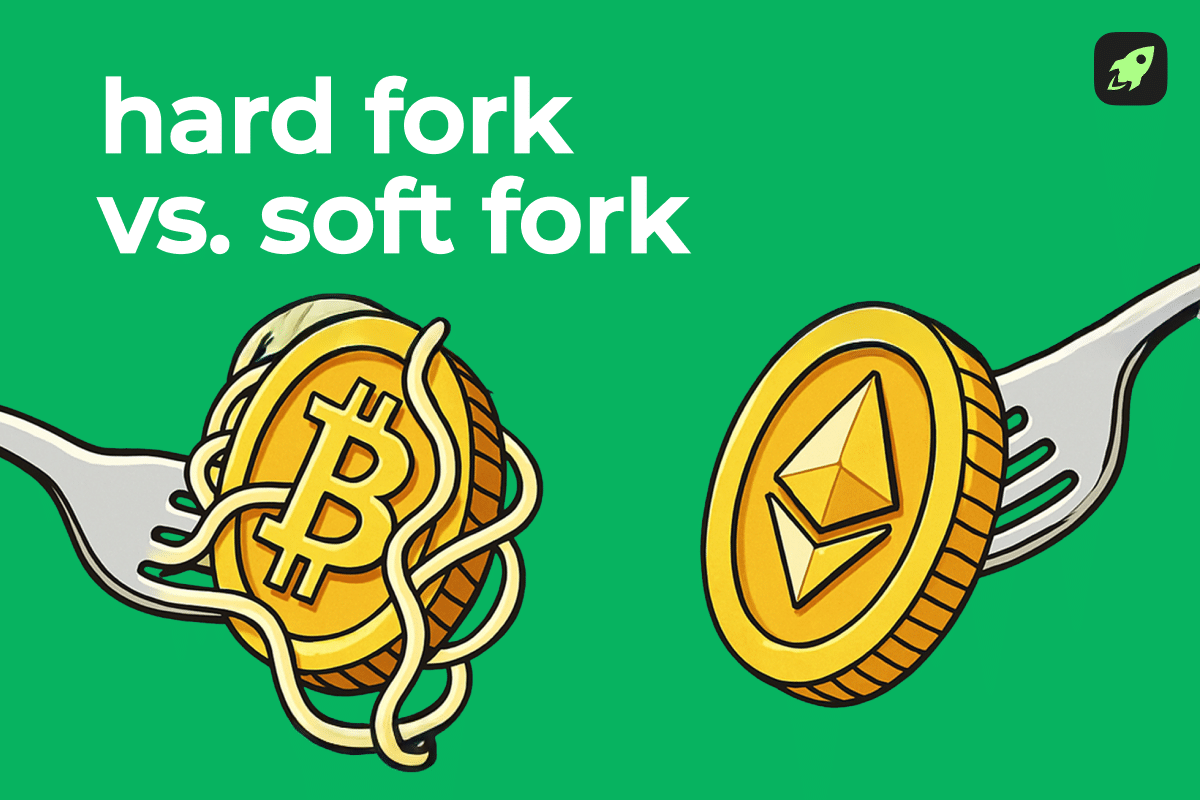
Every meaningful blockchain upgrade starts with a rule change, and that rule change can become a fork. The key distinction is simple: a soft fork keeps compatibility with older software, while a hard fork introduces rules older nodes cannot follow, which can leave a network split across separate chains.
Why soft forks usually keep one network intact
A soft fork tightens existing rules without replacing the old framework entirely. Nodes that do not upgrade may still recognize and validate new blocks, as long as those blocks remain inside the stricter rule set. That makes soft forks a common option for changing validation logic, limiting what can go into a block, or improving efficiency without forcing a full network break.
Activation often happens through a user-activated soft fork, where validators and users coordinate support until enough miners or nodes accept the upgrade. The upside is clear: no new chain has to be created, and coordination is generally easier than with a hard fork. The trade-off is consensus pressure. If support is weak, the network can run into confusion or stalled transaction flow.
Why SegWit remains a defining soft fork example
One of the most recognized soft forks on Bitcoin was Segregated Witness in 2017, introduced through a Bitcoin Improvement Proposal. It changed how signature data was stored in blocks, freeing more room for transactions without increasing the block size limit. The upgrade also reduced transaction malleability, an issue that had lingered in Bitcoin’s design for years.
SegWit was activated as a user-driven soft fork and gained support from most miners and exchanges. New blocks followed stricter validation rules, but the network stayed unified. That outcome is exactly why soft forks are often described as a way to evolve a chain without breaking it apart.
What changes when a blockchain goes through a hard fork
A hard fork is a much sharper protocol revision. Once activated, old nodes no longer understand the new rules and continue following the legacy chain. The result can be two live networks: one running the updated code, the other preserving the older version. Both can remain technically valid, but they stop recognizing each other’s blocks.
Developers use hard forks when they want larger feature changes, need to fix critical bugs, or are trying to resolve disputes over scaling and block structure. Some hard forks are planned in advance. Others happen accidentally when nodes disagree over timing or block validation behavior.
Bitcoin Cash and Ethereum Classic show how splits form
Bitcoin Cash is one of the clearest hard fork cases. A dispute inside the Bitcoin community centered on transaction capacity. One side wanted to raise the block size limit to 8 MB so each block could carry more transactions, while critics argued that this would weaken decentralization. The disagreement ended with Bitcoin Cash becoming a separate chain. Later, Bitcoin SV and Bitcoin Cash ABC also emerged with different views on block size and governance.
Ethereum’s well-known split came in 2016 after The DAO exploit. Developers chose to roll back stolen funds and create the chain now known as Ethereum. Users who rejected that rollback continued on the original chain, which became Ethereum Classic. That split turned a technical crisis into a governance debate over immutability and trust.
Forks are technical events, but consensus decides the outcome
Both soft forks and hard forks are changes to a blockchain’s underlying protocol. The real difference is how much compatibility survives and whether the community can agree on the path forward. Soft forks aim to avoid fragmentation by narrowing the rule set. Hard forks change the rules so deeply that, if coordination fails, users, miners, and developers may end up backing different chains.
That is why forks matter beyond engineering. For developers, they are tools to patch flaws and introduce upgrades. For holders and traders, they can bring new coins, altered network rules, and shifts in perceived value. In decentralized systems, no central authority settles these disputes. Code, adoption, and community support do.