

An on-the-ground market commentary published by MarsBit describes a hard-tech financing boom in China’s private market running into a far more conflicted public-market response.
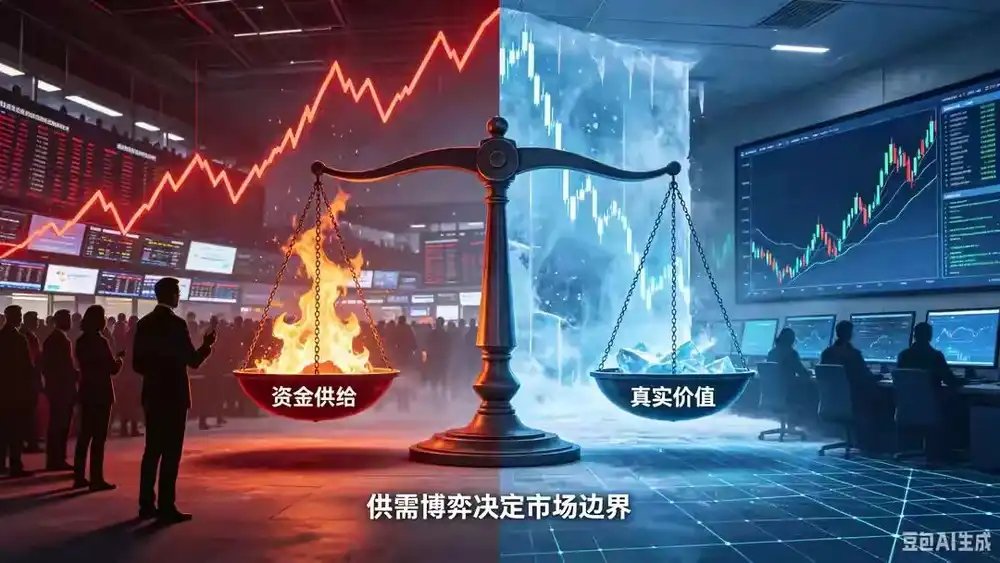
The piece opens in Qingdao, where the author says a family trip for a child’s school enrollment turned into an impromptu work session after several partners flew in for in-person meetings. The main subject was a world-model project the group had followed for a long time.
According to the author, world models were still one of the hardest areas in AI last year: technically demanding, difficult to monetize in the short term and hard to package into a convincing commercial story. This year, that has changed dramatically. The article says projects only need to put “simulating the real physical world” into a pitch deck to draw lines of capital, and that the company discussed in Qingdao raised tens of billions of yuan over half a year, with the next round being priced near the high hundreds of billions. Even then, getting an allocation is not guaranteed. For the author, the episode captures the fear of missing out now driving the primary market.
Private-market money is clustering around a narrow set of themes
From that single project, the article expands to a broader diagnosis of China’s capital markets. It notes that Unitree listed on the STAR Market and briefly surged at the open before retreating quickly, with market enthusiasm falling short of what had been seen in the earlier IPO of ChangXin Storage. At the same time, the listing application of Yangtze Memory has already been accepted. The author adds that more computing-power, AI and semiconductor companies are lining up for A-share listings in the second half of the year, on top of the hard-tech names that already came public in the first half.
The article argues that the structural heat in the primary market has reached an almost surreal level. It cites Qingke Research data showing that China’s equity investment market completed 5,944 investment cases in the first half of 2026, up 14.7% from a year earlier, while investment value rose 31.9% to about 565.4 billion yuan. Venture firms, in that reading, have accelerated deployment as frontier hard-tech projects move closer to practical implementation.
But the key question in the piece is where the money has actually gone. Citing an industry tally, the author writes that 90% of first-market funding this year has concentrated in AI, robotics, world models, quantum technology, controllable nuclear fusion, integrated circuits and commercial aerospace. The article stresses how extreme that number is: nine out of every ten yuan going after the same labels.
That concentration, the author says, is pushing valuations higher at unusual speed. One partner is quoted as saying a brain-computer interface project tripled in valuation within two months. Some projects, the article adds, reprice within a week and can run three financing rounds at the same time. Founders have also become tougher in negotiations, taking positions such as “no performance bets, no repurchase clauses, invest if you want,” with some companies even unwilling to cooperate fully in due diligence.
The conclusion is blunt. Investors may hesitate, but if one firm does not invest, another will. FOMO is shaping decisions across the market.
More hot money has not automatically produced better industrial progress
The article does not treat this flood of capital as proof of stronger industrial outcomes. It says many founders are not focused on refining product-market fit, but on switching tracks toward whichever sector is being rewarded by investors. The author does add that not all teams fit that pattern and that a minority still have clear medium- and long-term strategic plans.
Even so, the broader atmosphere is described as a game of passing the parcel: build a demo, craft a narrative, push valuation upward and rely on the next round to provide an exit.
Many investors understand the risks in that process, the article says, but feel forced to compete for allocations because of the market environment. After two to three years of weakness across venture investing, some structural problems have not been corrected. The author contrasts that with the policy line from the Third Plenary Session of the 20th Central Committee, which called for the development of “patient capital” and encouraged early-stage, small-ticket and long-term investment in hard-core industries. In practice, the article argues, investors truly willing to accompany industrial growth over time remain a minority.
Public-market sentiment is split between optimism and fatigue
When the discussion shifts to the secondary market, the article sees a clear divide. One camp remains optimistic because policy support for hard technology continues to strengthen, thematic supply is abundant and market liquidity is still ample, leading them to think A-shares have room to run. The more pessimistic camp is just as visible. In the article’s telling, quantitative trading tools have become more influential, many retail traders believe human decision-making cannot match algorithmic speed and speculative trading in thematic names often departs too far from business fundamentals to be analyzed rationally. Some simply choose not to enter.
The author says he does not trade stocks himself and instead watches the underlying logic of the economy and capital flows. His view is that no matter how sophisticated trading tools become, the stock market remains a contest of supply and demand. Quant strategies can magnify short-term swings, but they cannot rewrite the core logic of pricing. Whether buyers or sellers dominate for a time, a one-sided imbalance cannot last indefinitely.
In that framework, this year’s pattern in several hard-tech IPOs — a sharp opening spike followed by sustained valuation declines — is presented as a direct expression of violent supply-and-demand bargaining.
Unitree and ChangXin Technology highlight two very different pricing models
The article says the contrast between private and public markets ultimately returns to the real economy. However financial tools evolve, and however many new business models the internet creates, finance must still serve industrial activity. The author attributes the strong market recognition of ChangXin Storage to what he calls a genuine industrial breakthrough, while also saying China cannot expect every hard-tech company to become another ChangXin.
On Aug. 19, Unitree, described in the article as the “first humanoid-robot stock,” debuted on the STAR Market. Its opening price was 1,100 yuan per share, up 629.44% from the issue price of 150.80 yuan, and its market capitalization briefly reached 444.9 billion yuan. One day later, the stock closed at 687 yuan, down 18.70%, pushing the market cap below 300 billion yuan. More than 160 billion yuan in value was erased within two days.
The author says this was not an isolated case. In the same week, Pinzhun Laser, a company in the quantum and semiconductor-laser segment, also hit what the article calls a stage high right after the opening and then fell back quickly.
That is why the piece says “peak on listing day” is not a joke but an active feature of the market.
The comparison becomes sharper when Unitree is placed next to ChangXin Technology, which went public a month earlier. On July 27, according to the article, ChangXin Technology closed its first trading day at 49 yuan, up 465.82% from its 8.66 yuan issue price. Its market capitalization reached 3.28 trillion yuan, overtaking Industrial and Commercial Bank of China to become the largest stock in the A-share market. Turnover for the day hit 141.187 billion yuan, a record for a single stock in one trading day on the A-share market.
Both names surged, but the article insists the basis for their valuations was entirely different. It lists ChangXin Technology’s first-quarter 2026 revenue at 50.8 billion yuan and net profit attributable to shareholders at 24.76 billion yuan. Unitree, by contrast, posted about 1.152 billion yuan in revenue in the first half and 274 million yuan in net profit attributable to shareholders. Unitree’s static price-to-earnings ratio is given as 1,228 times, while ChangXin Technology’s dynamic price-to-earnings ratio is listed at 38.86 times.
The author reduces that gap to one line: one company is priced on profits, the other on dreams.
The IPO line keeps growing, and absorption capacity is the real question
The article goes on to list more hard-tech companies moving toward public markets. Yangtze Memory’s IPO application has been accepted, with a planned fundraising size of 33 billion yuan. Suiyuan Technology has completed registration and plans to raise 6 billion yuan. LandSpace is in the inquiry stage. Kunlunxin has completed filing for listing guidance. DeepSeek, according to the article, has begun preparing for an IPO.
Each of these companies is tagged as hard tech and as strategically important. The author’s question is simple: how much of this supply can the capital market really absorb?
China’s economy cannot rely on only one ChangXin, the article argues, but it also cannot end up with a market full of headline-grabbing companies that peak on day one. Every thematic boom pulls financial resources and public attention toward a small group of star names. Every first-day frenzy followed by a second-day slide consumes not only money, but also public patience and expectations for domestic hard technology.
Meanwhile, the author says, high-quality startups that have been working deeply in niche sectors, but lack a traffic-friendly narrative or bargaining power, remain outside the spotlight. Those are the companies that most need to be seen and funded, yet they often fail to secure capital commensurate with their value and risk being drowned out by this game of passing the parcel.
What registration-based reform was meant to do
The article closes by returning to the original purpose of the registration-based IPO system. In the author’s view, the system was designed to clear a path for technological and industrial breakthroughs, not to create a stage for pure thematic speculation. Capital naturally seeks profit, but “patient capital” does not mean charity. It means supporting industrial growth over time rather than trying to cash out quickly on a hot theme.
Back in Qingdao, with the sea wind blowing through the discussion, the tone of the meeting turned heavier. The author says the conversation came down to two questions: whether capital is acting as an accelerator for industry or as chips on a gambling table, and why a market that keeps invoking patient capital still behaves as if speed and quick turnover are all that matter.
The article does not claim to have an answer. It says only that the question itself deserves serious thought. Without support from the real economy, financial games become little more than a passing-the-parcel exercise. At some point, the music stops.
The article was originally published on the WeChat public account “Skye Suisui Kan” and written by Skye.