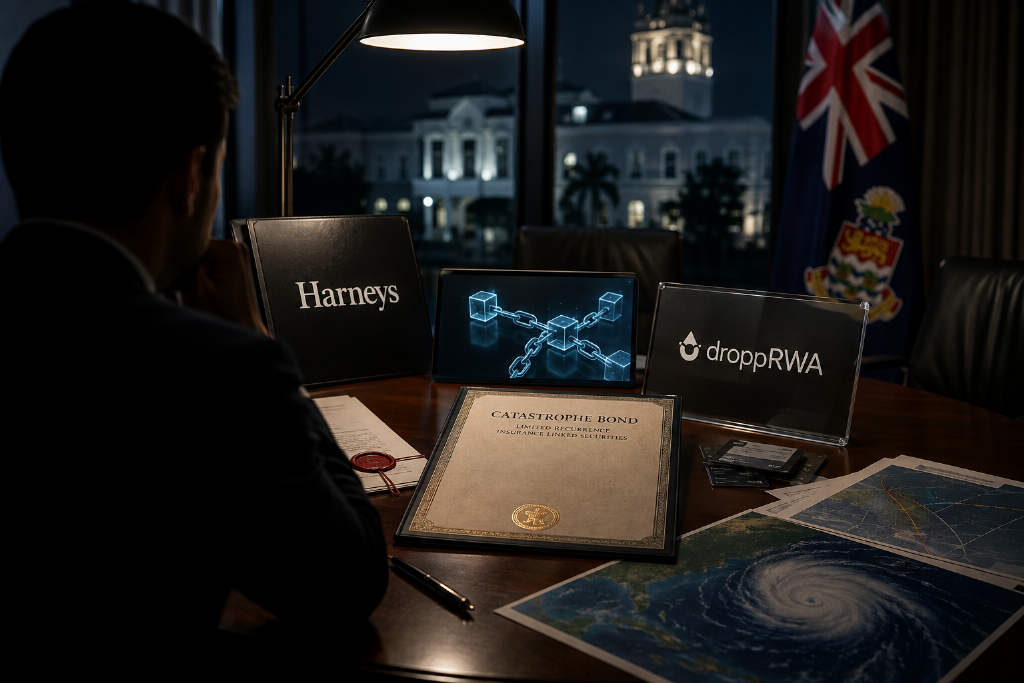
Law firm Harneys and tokenization platform droppRWA have announced plans to issue the first catastrophe bond that directly records ownership on a blockchain, targeting an initial transaction in early 2027. The structure would make the blockchain a legally enforceable record of ownership, integrating investor registration, eligibility checks, and payment flows into a single system, reducing reconciliation time from days to seconds, subject to regulatory approval. The catastrophe bond market, valued at $65.6 billion, allows insurers, reinsurers, and governments to transfer natural disaster exposure to capital markets. The tokenized asset market has grown nearly threefold in the past year to over $33 billion, with Citigroup projecting it could reach $5.5 trillion by 2030. The second quarter of 2026 was the largest on record for catastrophe bond issuance, with 48 transactions totaling $11.3 billion. The Bermuda Stock Exchange hosted 93% of global catastrophe bond issuance in 2025. To lower the investment threshold, investors can purchase beneficial interests in a vehicle that holds the bonds and passes through returns, potentially reducing the minimum investment to $5,000, compared to the typical $250,000 minimum for direct catastrophe bond notes. The project still requires regulatory approvals, and any platform administrator role must be licensed under Bermuda's Digital Asset Business Act 2018.
Harneys and droppRWA Announce First Blockchain-Based Catastrophe Bond
Harneys, a law firm focused on asset management and securitization, and droppRWA, a tokenization platform, are teaming up to build a catastrophe bond that logs ownership straight onto a blockchain. Big shift. The idea is to make settlement faster and cheaper for investors. The two firms said they plan to issue the first bond of its kind, with the first transaction aimed at early 2027. Under the proposed setup, the blockchain would serve as a legally enforceable ownership record, while investor registration, eligibility checks, and payment flows would sit inside one system. That could cut reconciliation time from days to seconds. But the project still needs regulatory approval.
Market Data and Tokenization Trends
Catastrophe bonds make up a $65.6 billion market. Insurers, reinsurers, and government entities use them to shift natural disaster exposure into capital markets. At the same time, the tokenized asset market has almost tripled over the last year to more than $33 billion, according to the data. Citigroup says the market could hit $5.5 trillion by 2030. And the second quarter of 2026 set a record for catastrophe bond issuance: 48 deals worth $11.3 billion. In 2025, the Bermuda Stock Exchange handled 93% of global catastrophe bond issuance.
Lowering Investment Thresholds and Regulatory Requirements
The project is also trying to bring the entry point down. Instead of buying the notes directly, investors would be able to buy beneficial interests in a vehicle that holds the bonds and passes through returns. That matters because the notes usually come with a minimum face value of $250,000. Here, the minimum investment could fall to just $5,000. Still, the project remains subject to applicable regulatory requirements and approvals. And any platform administrator will have to be licensed under Bermuda's Digital Asset Business Act 2018.
This article was originally published by Bit.Fan. For more cryptocurrency news and market insights, visit www.bit.fan. Disclaimer:
The market information, project data, and third-party content displayed on this platform are for industry information sharing only and do not constitute any form of investment advice or return commitment.
Cryptocurrency trading carries high risks. Users should fully assess their risk tolerance and make independent decisions. All profits, losses, and legal responsibilities are borne by the users themselves.