

Hashdex will close and liquidate its Hashdex Bitcoin ETF, listed on NYSE Arca under the ticker DEFI, in what marks the first formal shutdown of a spot Bitcoin ETF in the U.S. market.

In its Aug. 3 announcement, the asset manager said the decision followed a review of the fund’s assets under management, trading liquidity, operating costs and investor interest. As of July 30, DEFI had about $14.7 million in assets and held roughly 225.58 BTC.
Final trading day set for Aug. 17
According to the notice, Aug. 17 will be the final trading day for DEFI shares. After that date, the fund will stop accepting creation orders from authorized participants and will be delisted from NYSE Arca.
Shareholders who still hold the fund on the final trading day are expected to receive cash liquidation proceeds, with payment anticipated on or about Aug. 28.
DEFI started as a futures ETF before converting to spot
DEFI first began trading in September 2022 as a Bitcoin futures ETF. The source article described it as the first Bitcoin futures ETF in the U.S. registered solely under the Securities Act of 1933, launched through a partnership involving Hashdex, Teucrium Trading and Victory Capital.
In January 2024, the U.S. Securities and Exchange Commission approved 11 spot Bitcoin ETF applications, including Hashdex’s. In March that year, DEFI completed its conversion from a futures-based strategy to a spot strategy and was renamed the Hashdex Bitcoin ETF. Its fee was set at 0.25%.
The fund has delivered cumulative performance of about 166% since inception, but its asset base remained weak for an extended period. Its historical peak was only about $17.54 million before falling back again.
Hashdex keeps expanding other crypto products
Hashdex is a global asset manager focused on indexed crypto investing. It was founded in Rio de Janeiro in 2018 by Marcelo Sampaio, Bruno Caratori and others.
The firm worked with Nasdaq in 2020 to develop the Nasdaq CME Crypto Index, launched products including HASH11 in Brazil in 2021, and later expanded into Europe and the United States. In February 2025, Hashdex launched the multi-asset crypto ETF NCIQ in the U.S., which currently tracks seven crypto assets. As of July 28, 2026, Hashdex said its global crypto index products had more than $888 million in assets across eight countries.
At the same time it is winding down DEFI, the company is still pushing new product features. On July 24, Hashdex filed with the SEC to disclose that NCIQ had been cleared to stake crypto assets held by the fund, with Coinbase Cloud named as the initial staking service provider.
Under the disclosed allocation, net staking income up to an amount equal to an annualized 25 basis points of the net asset value of ordinary shares goes to the sponsor. Any amount above that is split with 40% to the sponsor and 60% to shareholders.
U.S. spot Bitcoin ETF assets remain heavily concentrated
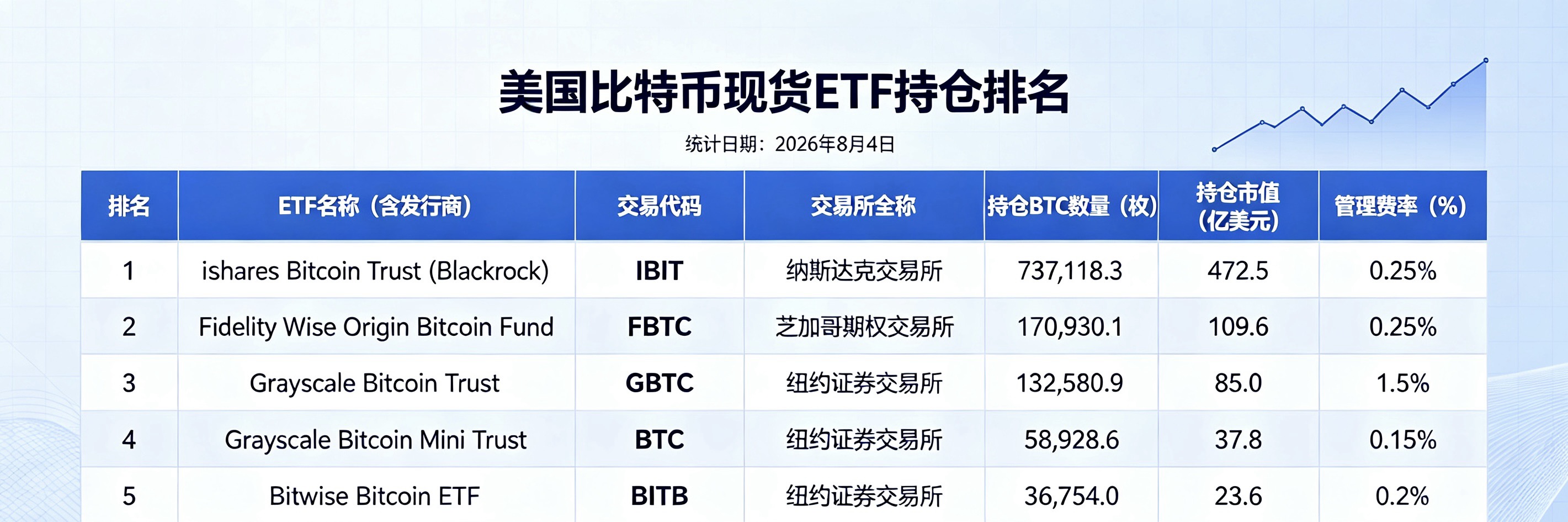
Data from BitBo showed that as of Aug. 4, the U.S. market had 13 spot Bitcoin ETFs holding a combined roughly 1.212 million BTC, equal to about 5.773% of Bitcoin’s total supply, with aggregate assets of around $77.7 billion.
Those assets are concentrated in a small number of products. The five largest funds accounted for about $72.85 billion, taking almost the entire market.
BlackRock’s iShares Bitcoin Trust, IBIT, held about 737,000 BTC valued at roughly $47.25 billion, or more than 60% of the market, with a 0.25% fee. Fidelity’s Wise Origin Bitcoin Fund, FBTC, held about 171,000 BTC valued at around $10.96 billion, also charging 0.25%.
Grayscale Bitcoin Trust, GBTC, held about 133,000 BTC worth about $8.5 billion. The source article noted that despite its 1.5% fee and long-running net outflows, the fund remained the third-largest product because of its first-mover position and large legacy holdings. Grayscale’s mini trust, BTC, held about 59,000 BTC worth roughly $3.78 billion and charged 0.15%, absorbing a large portion of capital that moved out of GBTC.
Bitwise’s BITB at 0.2%, ARK 21Shares’ ARKB at 0.21%, and VanEck’s HODL at 0.25% formed the middle tier, with assets ranging from $1 billion to $2.4 billion. Morgan Stanley’s MSBT held about 6,231 BTC worth around $399 million and was described in the article as the first Bitcoin ETP directly held by a Wall Street investment bank.
Valkyrie’s BRRR, Franklin’s EZBC and Invesco’s BTCO each had between $340 million and $380 million in assets. WisdomTree’s BTCW had about $143 million. By contrast, Hashdex’s DEFI held about 225.6 BTC worth around $14.46 million, placing it last in the market ranking.
Fee revenue was far below operating costs
The article argued that the economics were difficult from the start. ETF issuers make most of their money through management fees charged as a percentage of assets. For DEFI, a 0.25% fee on $14.7 million in assets translated into annual management fee revenue of only about $36,700. Even at the product’s peak asset level of roughly $17.54 million, annual revenue would still have been under $44,000.
Against that, the fixed costs of running a spot Bitcoin ETF include custody fees, with qualified custodians such as Coinbase commonly used for Bitcoin holdings, plus legal, compliance and audit costs tied to SEC reporting, anti-money-laundering reviews and annual audits. There are also market-making and liquidity expenses, exchange listing fees, directors and officers insurance, and general administrative costs. The article cited industry estimates putting the minimum annual operating cost for an ETF at more than $500,000 to $1 million.
It drew a contrast with larger issuers. Valkyrie’s BRRR and Franklin’s EZBC, both with assets above $300 million, would generate about $900,000 a year at the same fee level, leaving room for profit after expenses. WisdomTree’s BTCW, with assets below $150 million, would generate about $357,000 in annual fee income and was described as being near break-even.
DEFI’s fee income was only around one-tenth of that level. With shares shrinking and no fresh inflows, the source article said continuing to subsidize the product no longer looked commercially sustainable, making liquidation a rational outcome.
Brand and distribution disadvantages in the U.S.
The article said DEFI’s problems went beyond small scale. It pointed to a structural disadvantage tied to Hashdex’s market position in the United States.
Hashdex was built in Rio de Janeiro and established stronger brand recognition in Latin America and Europe. Its HASH11 product was at one point the largest crypto index ETF in Brazil. But the U.S. ETF market is dominated by established Wall Street firms, and institutional allocators tend to weigh brand trust, balance-sheet strength and trading depth heavily when choosing among similar products.
With BlackRock, Fidelity and Morgan Stanley all offering competing vehicles, money managers were more likely to stay with issuers they had worked with for years than move to a sponsor from an emerging market without the same roots in traditional U.S. asset management.
The gap is also visible in customer acquisition costs. Leading issuers already have large client bases. BlackRock and Fidelity can cross-sell through their own platforms and through channels such as pension plans, endowments and family offices, sharply lowering marginal acquisition costs. Grayscale, for its part, brought over a large pool of long-standing crypto-native investors.
Hashdex, by comparison, had to build its U.S. presence from scratch. Attending industry conferences, maintaining visibility on data terminals and supporting market-making relationships all required spending. At the same 0.25% fee level, the article said a revenue gap that ran into multiples of tens left Hashdex unable to match the marketing and investor education budgets of larger rivals.
Even a higher Bitcoin price would not automatically solve the issue
The source article also tested a more favorable scenario. If Bitcoin kept rising and DEFI’s assets recovered to $50 million through price appreciation and new inflows, annual fee revenue would still only reach about $125,000. That would leave the operating gap intact.
According to the article’s calculation, a real break-even point would require assets to move beyond $200 million, which would need both strong net inflows and a higher Bitcoin price. In a concentrated market where new money continues to flow toward the largest products, that hurdle remains high.
The article cited BlackRock’s IBIT, which has attracted tens of billions of dollars since launch, as an example of how assets continue to cluster at the top. It added that small ETFs often capture only limited spillover even in a bull market. DEFI’s own peak of just $17.54 million during Bitcoin’s 2025 high was presented as evidence of that limitation.
Which smaller funds look vulnerable
As of Aug. 4, the four smallest U.S. spot Bitcoin ETFs by assets were WisdomTree’s BTCW at $143 million, Invesco’s BTCO at $348 million, Franklin’s EZBC at $370 million and Valkyrie’s BRRR at $377 million.
Among them, BTCW was described as closest to the safety margin. At a 0.25% fee, it would generate about $357,000 a year, and further shrinkage could push it into loss territory. The article added that WisdomTree, as a long-established ETF sponsor, may still choose to keep the fund running for strategic reasons tied to maintaining a complete product lineup. Invesco, Franklin and Valkyrie, each with assets around $350 million, would generate roughly $870,000 in annual fee revenue and face less immediate pressure.
Earlier closures involved futures or other Bitcoin-linked funds
Before DEFI, the U.S. market had already seen closures of Bitcoin-related ETFs, though those were futures-based or other non-spot products.
In January 2024, VanEck shut its Bitcoin futures ETF XBTF when the fund had about $50 million in assets, after deciding to focus resources following the approval of spot ETFs. Earlier, in October 2022, Valkyrie liquidated VBB when its assets were only about $570,000.
DEFI is the first case involving a U.S. spot Bitcoin ETF.