
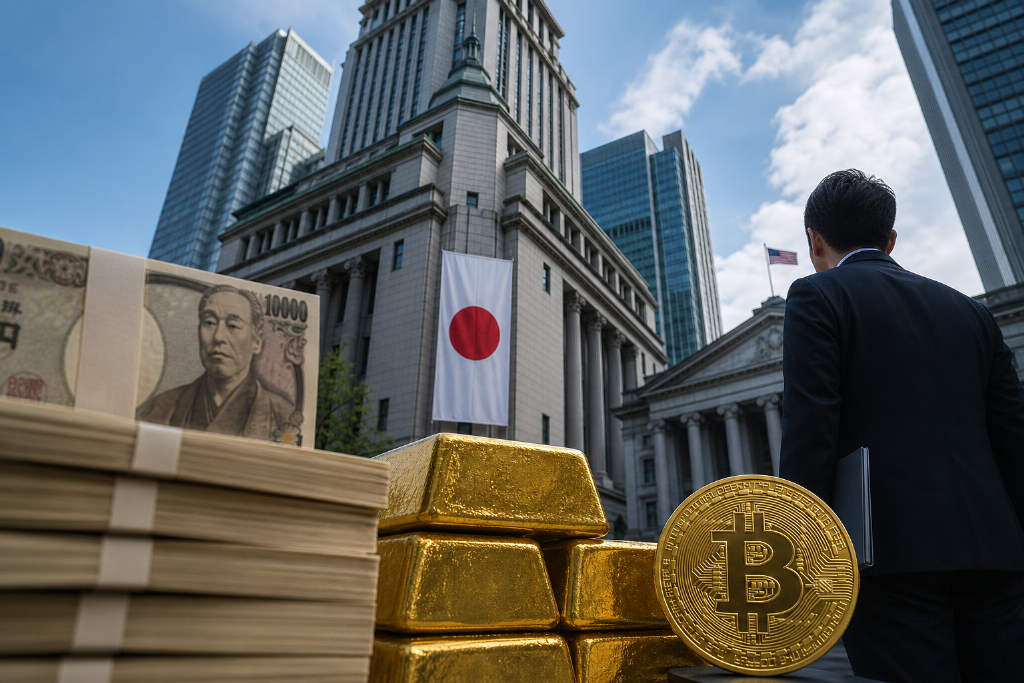
HashKey Group chief analyst Jeffrey Ding says global markets are at a historic turning point, with the Bank of Japan’s tightening cycle, Federal Reserve rate cuts and the unwind of yen-funded carry trades converging into what he describes as the end of a 30-year financial regime.
A narrowing rate gap is putting a decades-old structure under strain
In the article, Ding writes that by August 2026 the Bank of Japan had lifted its policy rate to 0.75% after a year and a half of consecutive hikes, the highest level since September 1995. Over the same period, the Federal Reserve had lowered rates to 3.75% from their peak as inflation cooled and economic growth softened.
That shift reduced the U.S.-Japan interest-rate gap from as much as 560 basis points to about 300 basis points in roughly two years. Ding argues that the change is larger than a routine adjustment in monetary policy. In his telling, it marks the breakdown of a global financial model that depended on borrowing cheap yen and moving that capital into higher-yielding dollar assets.
He frames the Federal Reserve’s Foreign and International Monetary Authorities repo facility, known as FIMA, as the policy tool now drawing the market’s attention, with some investors treating it as a way to buy time for an orderly retreat from a massive carry structure.
HashKey places the broad carry-trade estimate at as much as $19.2 trillion
Ding starts with scale. On the narrowest measure, Japanese banks’ yen-denominated loans to overseas non-bank institutions stood at $310 billion at the end of 2024. But once rehypothecation, layered leverage and derivatives positions are included, the broader estimate climbs dramatically, ranging from $9.3 trillion to $19.2 trillion.
He says that amount is comparable to the combined gross domestic product of Japan, Germany and the United Kingdom.
The composition of the trade matters as much as the headline size. Before 2023, the standard version of the strategy was straightforward: borrow yen, buy U.S. Treasuries, collect the yield spread and treat foreign-exchange gains or losses as a secondary factor. Ding says that changed after 2023, when aggressive Fed tightening lifted Treasury yields and sustained yen weakness reinforced one-way positioning.
According to his account, more hedge funds moved away from traditional cash-bond arbitrage and into U.S. technology stocks, especially artificial-intelligence names, using yen funding. He cites Goldman Sachs data showing AI investment accounting for more than 1% of U.S. GDP, with a meaningful share of that capital supported by yen financing.
That, in HashKey’s view, means the carry trade is no longer just a fixed-income arbitrage strategy. It has become part of the valuation support behind global risk assets, particularly large-cap U.S. technology shares.
The implication is direct. If a stronger yen forces liquidations, the selling pressure may hit not only Treasuries but also the most liquid and richly valued tech positions. Ding presents that as a key reason markets have become unusually sensitive to yen appreciation.
How FIMA works in HashKey’s framework
Ding then turns to FIMA itself. The facility allows foreign central banks and monetary authorities with accounts at the Federal Reserve Bank of New York to pledge U.S. Treasuries as collateral and borrow dollars from the Fed through repurchase agreements, usually overnight or for seven calendar days.
He writes that the current cap on outstanding borrowing is $60 billion per counterparty. For Japan, which he says holds about $1.1 trillion in U.S. Treasuries, that means the Ministry of Finance can convert bonds held at the New York Fed into usable dollar liquidity without selling those securities in the open market.
That is the central tension in the piece. In a conventional currency intervention, a country supporting its exchange rate by selling dollars and buying its own currency generally needs to use foreign-exchange reserves. If those reserves are not enough, it may need to sell overseas assets to raise cash. In Japan’s case, that would mean becoming a net seller of Treasuries.
Ding argues that such a move would be highly destabilizing because Japan is the largest foreign holder of U.S. government debt. He notes that the 30-year Treasury yield briefly rose to about 5.33% on Aug. 19, 2026, the highest since 2007, which he treats as a sign of how sensitive the market already is.
Under the FIMA route, Japan can obtain dollars without directly hitting the Treasury market. The Ministry of Finance pledges Treasuries to the Fed, the Fed creates dollars, and Japan then sells those dollars in the foreign-exchange market to buy yen. In that sequence, the yen gets support while Treasuries avoid an immediate wave of forced selling.
The trade-off: more dollar liquidity in the global system
Ding says the cost of that arrangement is often understated. The dollars created by the Fed do not disappear after Japan sells them. They move into the broader financial system and are absorbed by international commercial banks, hedge funds and other financial institutions.
His argument is that the process is economically similar to quantitative easing. As FIMA usage expands, the Fed’s balance sheet expands with it, dollar supply rises, the dollar weakens and inflation pressure builds.
The piece also cites a recent article by Arthur Hayes, who described the setup as a form of money printing ultimately borne by U.S. taxpayers. Ding presents that remark as Hayes’ view.
Why the yen became the world’s funding currency
The article traces the carry trade back to Japan’s prolonged era of extraordinary monetary easing. After the asset bubble burst in the early 1990s, Japan entered a balance-sheet recession. In September 1999, it cut the policy rate to zero. Apart from two brief periods of rate hikes, Japan then kept rates at the lowest end among major economies for nearly three decades.
In January 2016, the Bank of Japan moved policy rates to -0.1%, and in September that year it introduced yield curve control. Ding says this combination made yen funding exceptionally cheap, deep and liquid, turning the currency into the dominant source of leverage for global investors.
At the same time, countries led by the United States offered higher yields. As long as the interest-rate spread was larger than currency risk and trading costs, the carry trade remained profitable.
Ding breaks the development into several stages. The trade first gained traction in the late 1990s as Japanese rates fell and the U.S. spread widened. It expanded again after 2002 with rates staying low in Japan. The major leap, in his view, came after the launch of Abenomics in 2013, when quantitative and qualitative easing ushered in unlimited government-bond buying, the yen entered a decade-long depreciation trend and U.S. rates moved higher.
Over those three decades, Japanese banks, households and institutional investors all became part of the structure. Ding says the trade evolved from a straightforward arbitrage into a core element of global asset allocation.
Each major reversal has been painful
The article points to earlier episodes of carry-trade stress. During the 2007-2008 global financial crisis, expectations for Fed rate cuts drove a large retreat from the trade, and USD/JPY fell from 125 to 87, a drop of nearly 30%. Ding says another reversal shook international markets in 2015, and the pandemic shock in 2020 intensified volatility as risk appetite turned lower and positions were unwound.
He treats the “Black Monday” episode of August 2024 as the clearest warning. According to the article, an unexpected BOJ rate hike triggered large-scale deleveraging, USD/JPY fell by nearly 15 big figures in three weeks, Japanese equities dropped 12% in a single day, the S&P 500 lost 3% in one session and the VIX briefly rose above 60.
That episode, Ding argues, showed regulators that the unwind of yen-funded leverage is not a localized market event. It can become a trigger for broader systemic stress.
His description of the mechanism is a feedback loop: a stronger yen causes carry losses, those losses force the sale of risk assets, that selling pushes the yen higher, and the stronger yen then drives even more liquidation. Because the scale, leverage and valuations involved have all grown, each reversal can become more destructive than the last.
Why Ding says this cycle is different
HashKey’s core claim is that the three pillars supporting the carry trade are eroding at the same time.
The first is Japan’s low-rate backdrop. Ding writes that the BOJ exited negative rates and yield curve control in March 2024, then raised rates again in July 2024, January 2025 and December 2025, taking the policy rate from -0.1% to 0.75%. He adds that markets still expect more tightening, with some institutions projecting a move to 1% before year-end.
The second is the shrinking U.S.-Japan spread. The article says that gap peaked at 560 basis points in early 2024. By the end of 2025, with the Fed at 3.75% and Japan at 0.75%, it had narrowed to about 300 basis points. In Ding’s reading, the trade’s return profile is being squeezed even as currency risk rises.
The third is the fading assumption of steady yen depreciation. For decades that expectation reduced FX risk and helped make long USD/JPY one of the market’s most crowded trades. Now, with BOJ hikes and Fed cuts happening at the same time, USD/JPY has retreated from levels above 160, and some market participants are discussing a fair value for the yen closer to 90.
Put together, Ding says, those three shifts mean the market is not dealing with a routine bout of volatility. It is watching the rapid breakdown of the demand inertia that sustained yen carry trades for 30 years.
How capital may move as positions are unwound
The article splits the adjustment into two stages.
The first stage is already under way, according to Ding. Carry traders are forced to sell overseas assets, chiefly U.S. technology stocks and Treasuries, convert the proceeds into dollars, then into yen, and repay yen loans. That creates a positive feedback loop between yen strength and asset sales, while pushing capital back toward Japan. In this phase, Japanese equities and Japanese government bonds become the first landing zone for returning funds.
HashKey says U.S. technology shares are likely to bear the brunt of the pressure because large hedge-fund positions funded in yen are now being reduced. AI-linked names that benefited from cheap financing over the past few years could face a sharper valuation reset. Treasuries are also exposed: traditional long-Treasury carry positions are being unwound, and hedge-fund positions that shifted after 2023 toward shorting Treasuries add another layer of complexity.
The second stage depends on which policy path Washington and Tokyo choose. If they rely on FIMA, the Fed would create dollars and lend them against Japanese Treasury collateral. Once Japan sells those dollars, they flow into the global financial system, expanding dollar liquidity.
That is where Ding places Bitcoin and gold. He summarizes Arthur Hayes’ main argument as a clear positive relationship between Fed balance-sheet expansion and Bitcoin prices. When the Fed injects more liquidity into the financial system, Bitcoin and similar assets have tended to rise. Gold, in his account, also benefits as confidence in fiat money weakens, even if it may be sold in the early phase of a liquidation cycle to raise collateral and meet margin calls.
If the FIMA route fails or proves too small, Ding says Japan could be forced to sell Treasuries directly to obtain dollars. In that case, Treasury prices would fall, yields would jump, global dollar liquidity would tighten and risk assets would come under broader pressure. He presents that as the worst-case path and one the U.S. would rather avoid.
Why HashKey calls FIMA the only workable choice for both sides
The piece outlines three broad policy options and argues that FIMA best aligns the interests of both the U.S. and Japan.
One option would be much more aggressive BOJ rate hikes. Ding argues that this could create large unrealized losses on the BOJ balance sheet and trigger a global stampede out of carry trades. He notes that when the yen moved from 160 to 140 in July 2024, both the Nasdaq 100 and the Nikkei fell by more than 10%.
A second option would be direct sales of overseas assets by Japan to repatriate yen. The article says that would turn “Japan Inc.” from a major buyer of U.S. securities into a seller, with immediate consequences for both U.S. equities and Treasuries.
The third option is FIMA. Ding says it is the only route that can support the yen while avoiding a Treasury-market breakdown. The U.S. priority is to prevent Japan from dumping Treasuries. Japan’s priority is to preserve intervention capacity without exhausting its own reserves. FIMA addresses both, though at the cost of a larger Fed balance sheet and weaker dollar credibility.
The article adds that authority over FIMA adjustments sits with the Foreign Currency Subcommittee of the Federal Open Market Committee, whose voting members include the FOMC chair, the FOMC vice chair and president of the New York Fed, and the vice chair of the Federal Reserve Board. Ding says the committee publishes neither minutes nor voting records, leaving markets to infer changes from outcomes rather than advance guidance.
Asked whether FIMA would be tightened abruptly once the yen reaches a target level, the article answers no. In Ding’s framework, an abrupt pullback would deprive Japan of dollar intervention capacity before the rate differential problem is fully resolved, risking a return to pre-intervention exchange-rate levels. As long as the risk of Japan being pushed into Treasury sales remains, he says, the facility has a reason to stay available.
He sees a gradual transition as more likely: active FIMA use would fade into a backstop role while BOJ rate hikes take over as the main stabilizing force for the yen. The article notes that FIMA has been a standing Fed facility since July 2021 and says it is more likely to remain in place with balances eventually falling back toward zero than to disappear outright.
“Not Dunkirk, but Waterloo”
Ding closes by rejecting the idea that this is simply a “Dunkirk” moment for the carry trade. He says the analogy works only in the limited sense that FIMA can buy time and reduce the odds of a disorderly stampede.
His objection is that Dunkirk was a retreat by forces expected to return. In this case, the participants being shielded are market players closing positions, and many of them may never return to the old model of borrowing yen to buy dollar assets. That makes the shift strategic rather than tactical.
So his preferred metaphor is Waterloo: a controlled defeat and the end of an era. The article also quotes an unnamed analyst saying the yen carry unwind is more of an amplifier of market declines than the sole trigger of a crisis, while warning that concentrated yen shorts, central-bank policy shifts and a valuation reset in global technology shares can interact in ways that intensify stress.
HashKey’s asset-allocation conclusion
For investors, Ding says the message is straightforward. The model that helped lift U.S. stocks and Treasuries through decades of cheap yen funding is losing force, and asset-pricing logic is being rebuilt.
In that environment, he argues, assets less tied to the credit of any single sovereign, especially Bitcoin and gold, stand to be revalued if dollar liquidity expands again through mechanisms such as FIMA. At the same time, U.S. technology stocks may continue to face deleveraging pressure in the short run, while their longer-term outlook will depend on how valuations reset and earnings hold up.
Treasuries, in his view, may avoid the worst outcome if FIMA remains in use, but a sustained withdrawal of carry capital could still leave yields structurally above pre-crisis levels. Emerging markets, which the article describes as weaker absorbers of external stress because of thinner liquidity, may face sharper pressure during the unwind, though economies with solid fundamentals could look more attractive after the adjustment runs its course.
Ding’s closing point is that the end of the yen carry trade is not the end of the world. It is the end of one chapter in global capital flows. What comes next, he says, will depend on the Fed’s balance sheet, the BOJ’s path for rate hikes and how investors choose to reallocate capital under a new regime.