
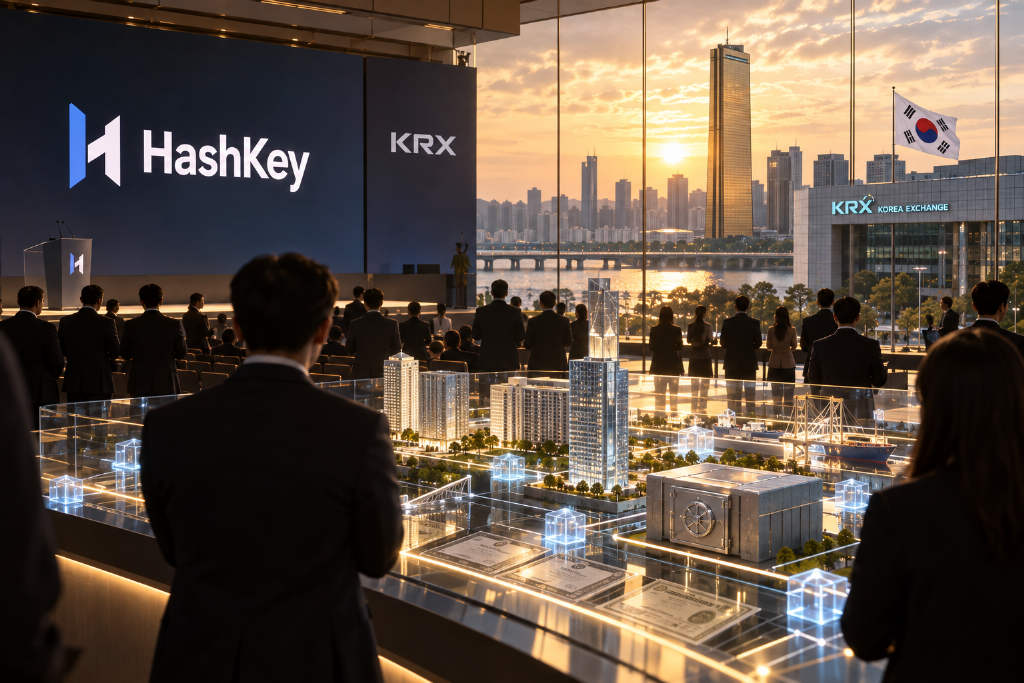
HashKey RWA CEO Anna Liu said at STO Summit 2026 in South Korea on Oct. 2 that, with Korea’s tokenized securities bill having passed and set to take full effect in February 2027, the sector’s next task is to build a market with genuine liquidity and trading depth.
The summit was part of Korea Premium Weeks 2026, a series jointly organized by the Financial Services Commission (FSC) and the Korea Exchange (KRX). The event was designed to promote exchanges and cooperation between the Korean market and global investors and institutions. International participants included Franklin Templeton and Webull Technologies. Representatives from the FSC, the Korea Securities Depository and the KRX were also invited.
Focus shifts from regulation to market function
In her remarks, Liu said that once the legal framework is in place, the central question becomes how to turn that framework into a market that can actually trade, settle and sustain depth.
She described three structural shifts in the financial system: a move from offshore to onshore, a move from digitally native assets to on-chain representations of real-world assets, and a move from off-chain settlement to on-chain settlement.
Four lessons from HashKey’s RWA work
Based on HashKey’s RWA practice, Liu shared four takeaways:
- Asset quality matters more than technology.
- Tokenization is a method, not the goal itself.
- Liquidity must be built proactively.
- Compliance is a foundation, not a formality.
She placed special emphasis on one point: 「Liquidity must be actively built; it will not emerge on its own.」
In her view, an on-chain capital market that can function in practice needs suitable assets, licensed distribution channels, and settlement infrastructure that links the funding side with the asset side. Citing secondary trading of tokenized funds in Hong Kong, she said market-making mechanisms and liquidity monitoring have already been incorporated into the regulatory framework, while stablecoins and tokenized bank deposits are helping move the funding side on-chain.
Korea should plan trading and settlement from day one
On the development of Korea’s tokenization market, Liu said: 「Beyond planning how assets will be issued, the market needs to think from day one about how capital and assets can actually trade and settle on-chain.」
She said institutional tokenization today still mainly uses a Certificate on-chain model. Over the longer term, the direction is toward Asset on-chain, allowing on-chain transfers to achieve final settlement and embedding ownership, compliance conditions and transfer rules into the asset itself, which would unlock the full potential of programmability.
Liu added that tokenization can move from a regulatory framework into a functioning market only if a full closed loop is formed among regulated capital, compliant infrastructure, licensed trading venues and investment-grade products. As she put it, 「The framework is in place. The market that comes next needs to be built by everyone in this room.」