
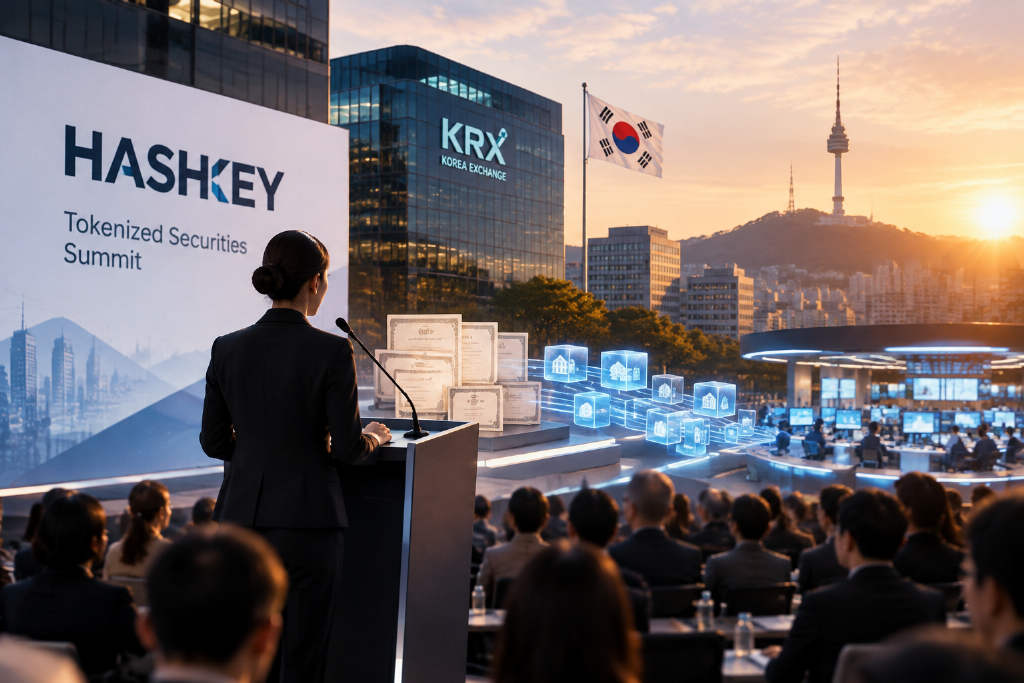
HashKey RWA CEO Anna Liu said at South Korea’s STO Summit 2026 on Oct. 2 that the industry’s next job is simple: build a market with real liquidity and actual trading depth. Her timing was pointed. The country’s tokenized securities bill has passed and will fully take effect in February 2027.
The summit was part of Korea Premium Weeks 2026, a broader program jointly hosted by the Financial Services Commission, or FSC, and the Korea Exchange, or KRX. The goal was to tighten ties and cooperation between the Korean market and global investors and institutions. Big international names showed up, including Franklin Templeton and Webull Technologies, along with officials from the FSC, the Korea Securities Depository, and KRX.
Three structural shifts in finance
In her speech, Liu said finance is now going through three structural shifts: from offshore to onshore, from digital-native assets to on-chain mapping of real-world assets, and from off-chain settlement to on-chain settlement.
Using HashKey’s RWA work as the backdrop, she argued that any serious talk about tokenization should begin with a basic question: can the market actually work in practice? Not just whether the tech can be rolled out.
Four lessons from RWA implementation
Liu laid out four lessons from the firm’s real-world asset tokenization work:
- asset quality matters more than technology;
- tokenization is a method, not the goal;
- liquidity must be built actively;
- compliance is the foundation, not a formality.
She stressed liquidity in particular, saying, "Liquidity has to be built actively; it does not appear on its own."
Liu said a working on-chain capital market needs the right assets, licensed distribution channels, and settlement infrastructure that connects the capital side with the asset side.
She pointed to secondary trading of tokenized funds in Hong Kong as one case in point, saying market-making mechanisms and liquidity monitoring have already been folded into the regulatory framework. And, she said, stablecoins and tokenized bank deposits are now pushing capital onto the chain.
Advice for the Korean market
Speaking about the growth of Korea’s tokenization market, Liu said, "It is not enough to plan how assets will be issued. From day one, you also have to think about how capital and assets will actually trade and settle on-chain."
She said institutional tokenization in the real world still mainly relies on a certificate on-chain model. But over time, the direction should move toward asset on-chain. That would let on-chain transfers achieve final settlement, while also embedding ownership, compliance conditions, and transfer rules into the asset itself. In her view, that is the path to fully unlocking programmability.
From framework to market
Liu said tokenization will only make the jump from a regulatory framework to a real market if it creates a full loop linking regulated capital, compliant infrastructure, licensed trading venues, and investment-grade products.
She ended with a blunt message to the room: "The framework is already in place. What comes next is a market that everyone here needs to build together."
The article was authored by HashKey Group. The original text said the piece reflects the views of a PANews column contributor, does not represent the position of PANews, and does not constitute investment advice.