


HashKey RWA’s first tokenized security under the hToken series is being presented as more than another on-chain investment product. In MarsBit’s analysis, the launch offers a window into a larger question facing tokenization: not just whether assets can move on-chain, but whether issuers can do so in a way that is commercially viable and repeatable.
The article argues that tokenization is now about changing how financial assets are issued, distributed, settled, and used. Traditional institutions have compliant assets but lack on-chain accounts and pools of digital capital. Crypto platforms have accounts and stablecoin liquidity but lack access to traditional financial products. In that setup, the contest around RWA is not limited to technology. It also comes down to resource integration, issuance services, and market connectivity.
The real bottleneck is economic viability, not technical feasibility
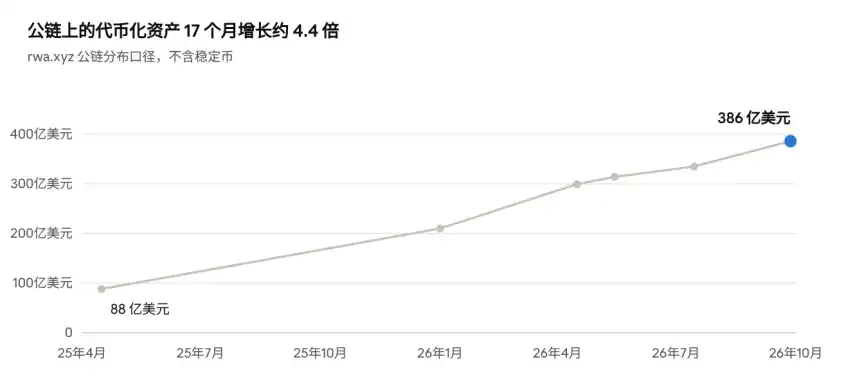
Tokenized U.S. Treasuries, money market funds, private credit, gold, and equities have all appeared over the past few years. According to RWA.xyz, tokenized assets available for distribution on public blockchains reached $38.6 billion as of the end of September 2026.
Still, the structure of that market remains concentrated. MarsBit says tokenized U.S. Treasuries, money market funds, and gold account for more than half of the total, even though they represent only a small slice of the broader traditional financial system. A much larger pool of funds, bonds, equities, and structured products already operates with mature management and servicing frameworks, yet many of them still do not have a cost-effective route into digital asset markets.
That is why the issue is not simply whether an issuer can mint a token. The harder question is whether there is enough economic incentive to do it. For asset managers, tokenization starts as an investment decision. If an issuer has to redesign legal structures, build technical systems, coordinate custodians and registrars, establish distribution channels, and then carry ongoing compliance and operating costs, a successful launch does not automatically make the business worthwhile.
The article says this is especially true for smaller and mid-sized institutions, where upfront spending may exceed the short-term value of any new business generated. The economics include at least three parts: one-time market entry costs, ongoing operating costs during the life of the product, and the new capital and service revenue brought in by the new channel. Tokenization only becomes commercially meaningful if the third item can cover the first two and the risks attached to them.
That framework also explains why firms such as BlackRock and Nasdaq are willing to keep investing, according to the piece. Large institutions can spread initial costs across a broader base and connect tokenization to existing trading, custody, collateral financing, and settlement services. Most financial institutions cannot realistically build a comparable system on their own, and for many of them it would not make economic sense.
This is where specialized RWA service providers enter the picture. MarsBit says the opportunity does not come only from assets that are already on-chain, but also from issuers with mature products that still have no practical way to bring them into digital markets. In that reading, HashKey RWA is trying to lower more than the technical cost of token issuance. It is trying to combine asset management, legal compliance, on-chain technology, custody, settlement, and investor distribution into a service that reduces duplicated buildout and coordination work.
How HashKey Group positions RWA inside its broader strategy
MarsBit places HashKey RWA inside HashKey Group’s wider corporate plan. In the group’s mid-2026 interim results, Chairman and Chief Executive Officer Xiao Feng said the company was advancing along three paths: from a digital asset trading platform to a digital asset financial market, from a single market to an Asian market network, and from native crypto assets to RWA and tokenized financial assets.
The article lists three data points for the first half of the year. Institutional clients accounted for 82% of platform trading volume. HashKey proposed the acquisition of APEX, which holds both a recognized market operator license and a recognized clearing house license in Singapore. The group’s on-chain RWA total reached HK$2.68 billion, up 167.8% year over year.
Within that framework, the role of RWA becomes clearer. The exchange side of the business has already built an institutional investor base and a digital asset capital network. Traditional financial markets, by contrast, offer a much larger and more diverse asset pool. Connecting the two would allow the group to move beyond crypto trading and into the issuance, distribution, and operation of traditional financial products.
The article stresses that this cannot be handled by an exchange or a technical team alone. Tokenizing traditional financial assets involves legal rights, product structure, investor protection, and ongoing management. Even if the asset record sits on-chain, the underlying asset management, custody, and legal responsibilities still rest with real-world institutions. That is why the group needs a dedicated team that understands traditional finance, can coordinate multiple specialist firms, and can organize a full issuance process. MarsBit identifies that role as HashKey RWA.
In February 2026, HashKey Group announced a one-stop RWA issuance solution covering structure design, compliant issuance, on-chain technology, custody arrangements, investor distribution, and post-issuance management.
The article says the model is supported by both internal capabilities and outside partnerships. Internally, HashKey RWA combines its own experience in tokenization design, project execution, and operations with HashKey Capital’s underlying asset resources, HashKey Exchange’s licensed trading venue and institutional investor network, and technical support from HashKey Chain.
Externally, MarsBit points to fiat settlement services from JPMorgan, cooperation with BitGo on institutional custody and RWA tokenization, work with Franklin Templeton on the distribution of on-chain funds in Asia, and participation in a DTCC industry working group as well as the Hong Kong Monetary Authority’s Project Ensemble.
In the article’s view, the value of a one-stop service is not that one institution does everything itself. The value is that issuers do not have to assemble everything from scratch. By combining internal group resources and coordinating outside auditors, custodians, banks, and other service providers, HashKey RWA is trying to deliver a complete issuance plan while cutting repeated build costs and lowering coordination expenses.
Why the hToken structure matters
MarsBit says the most important feature of hToken is not the underlying asset itself, but the issuance route it chose.
Traditional funds entering on-chain markets generally follow two paths. One is to tokenize the fund units themselves. The article uses BlackRock’s BUIDL as an example, noting that Securitize acts as transfer agent and that on-chain records directly participate in the registration of fund units. That route usually requires changes to fund documents, registry systems, custody arrangements, and operating processes. The second path is to keep the original fund structure in place and issue a tokenized certificate through a separate legal and product arrangement, giving investors economic exposure linked to the underlying asset.
hToken follows the second route. Based on product disclosures cited in the article, HashKey RWA uses the HFOL Class A fund as the underlying asset and provides investment exposure through a certificate structure without requiring a large-scale restructuring of the existing fund. MarsBit describes this as the mainstream approach at the current stage of the industry.
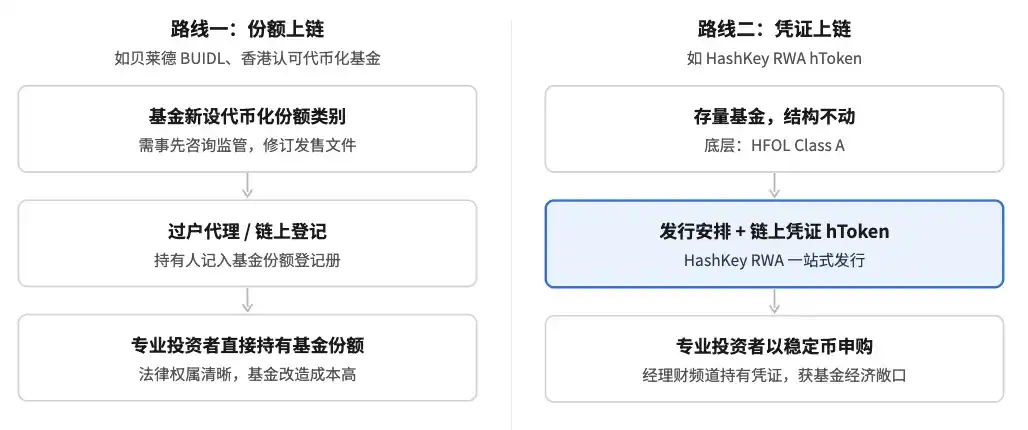
The article frames that choice as a reassessment of transformation costs in traditional finance. The global asset management industry already has a large stock of mature products. If every move into digital asset markets requires a redesign of the underlying structure, issuance timelines get longer and legal and operating costs rise. By linking existing products through an external certificate, some projects that would otherwise require major restructuring can be turned into more manageable issuance and servicing work.
The design of hToken also extends beyond structure. MarsBit says the product offers a subscription channel to qualified professional investors through HashKey Exchange, allowing the tokenized product to connect directly with an existing network of digital asset investors. In the article’s reading, that helps address the question of where new capital for the asset will come from.
This ties back to two economic constraints in tokenization. Issuers need to keep the upfront cost of entering a new market under control. They also need newly issued financial products to reach real investor demand. If the same issuance service can be reused repeatedly, technical modules, operating procedures, and compliance experience can gradually be standardized. Fixed costs can then be spread across more products, bringing down the average cost of each new launch. That would move HashKey RWA away from one-off tokenization projects and toward an ongoing specialist business built around issuance and asset services.
From a single product to financial infrastructure
The article broadens the lens from hToken to the RWA market as a whole. Its argument is that tokenization is shifting from isolated innovation projects run by individual financial institutions to a model based on professional specialization and routine financial services.
Modern financial markets can support large issuance and trading volumes in part because of specialized division of labor. MarsBit says tokenized markets may evolve in the same direction. Asset managers are strongest at asset selection, investment management, and risk control, not at deploying smart contracts or building trading systems. HashKey RWA is not replacing fund managers, banks, custodians, or law firms. Instead, it is organizing those fragmented services into an issuance mechanism that can be used again and again.
The article points to two possible industry changes. One is a broader asset supply base. In the past, tokenization was driven mainly by a small number of large institutions with enough capital, technology, and service capacity. If one-stop services can lower the entry threshold, more small and mid-sized institutions with real asset management capability may join, and RWA growth would come not only from expanding existing tokenized assets but also from bringing in financial products that previously struggled to access digital markets.
The second is a wider set of use cases. At present, tokenized products are still used mainly for primary subscription, redemption, and holding. As legal systems, trading infrastructure, and institutional cooperation mature, some products may move into secondary trading, on-chain finance, and collateral financing, changing how financial assets circulate and are used across markets.
MarsBit argues that the long-term value of HashKey RWA should not be measured only by how many products it issues or how much on-chain scale it builds. The more important tests are whether it can keep attracting independent third-party institutions to use the service, whether it can genuinely lower issuance and operating costs, and whether it can help more high-quality assets reach real investor demand while improving asset efficiency through blockchain.
The article closes on a broader point. The first phase of tokenization was about proving that assets could go on-chain. The next phase is about making more assets worth putting on-chain in economic terms and letting them function inside a new financial network. In that sense, MarsBit says, HashKey RWA is not only exploring a new issuance model. It is also trying to build infrastructure that connects the traditional financial system with the next generation of digital financial markets.