
From price signals to event-based trading
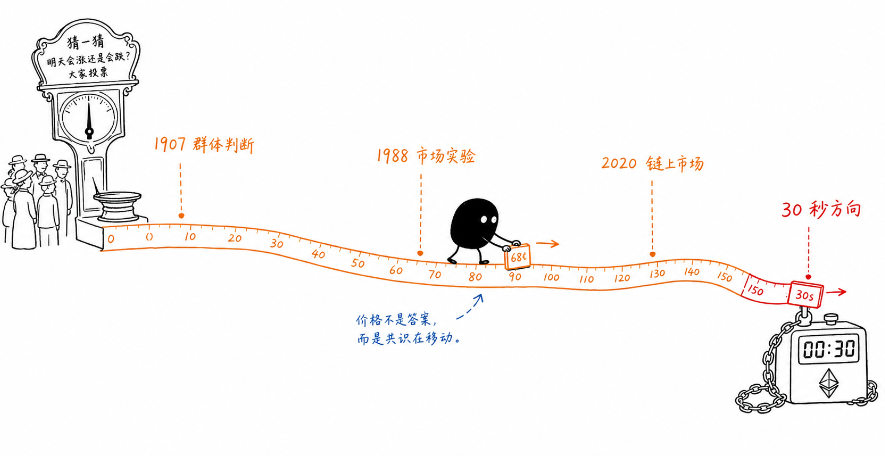
How does a society know what it knows? Foresight frames the history of event contracts around that question, tracing a line from weight-guessing contests at public fairs to political prediction markets and, later, short-duration on-chain event contracts that can be traded at any time. The core structure has stayed the same throughout: turn different judgments about the future into prices, then settle those prices against an eventual outcome. What changed over time were the events being covered, the barrier to entry, the trading cycle and the infrastructure underneath.
Seen through that lens, Polymarket turned prediction markets into a global internet product, while TurboFlow pushed event contracts deeper into an on-chain trading setting aimed at everyday traders. They belong to different stages and product forms, but both moved the idea of trading future outcomes beyond economics research and toward mass-market use.
1907–1945: from the wisdom of crowds to price discovery
Foresight places the intellectual starting point in 1907. British statistician Francis Galton observed that when a crowd independently estimated the weight of an ox at a fair, the aggregate judgment came very close to the true answer. The episode later became a standard illustration of the “wisdom of crowds”: when participants hold different pieces of information and form judgments with a degree of independence, the pooled result can come closer to reality than the view of any one individual.
Economists later pushed the idea further. If market prices can aggregate information about supply and demand for goods, could they also aggregate information about future events?
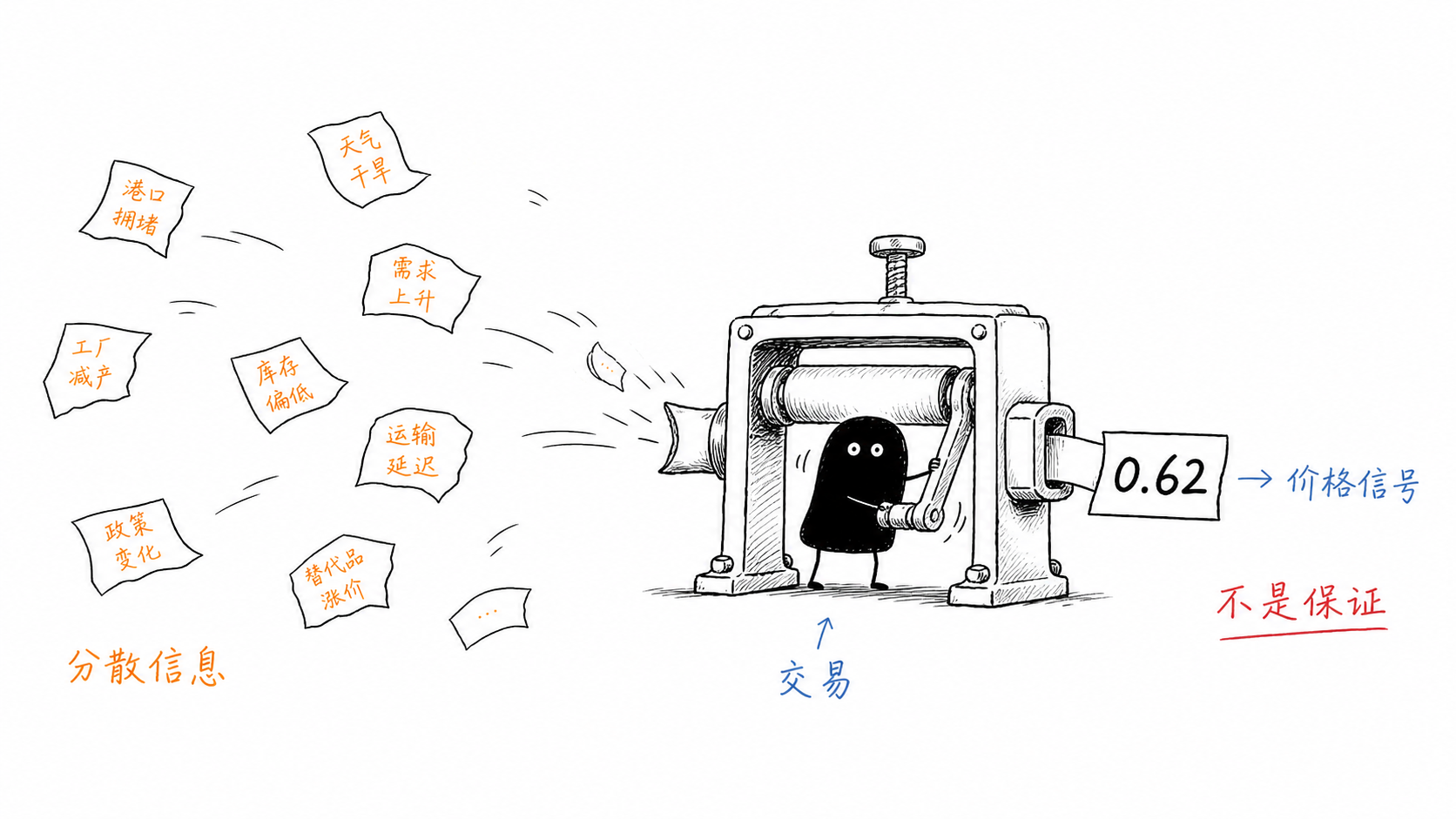
In 1945, Friedrich Hayek laid out the informational function of prices in “The Use of Knowledge in Society.” Knowledge in the real world is dispersed across countless individuals, and market prices compress those fragmented judgments into a continuously changing signal. Following that logic, markets do not only price goods; they can also aggregate views about future outcomes through trading.
Event contracts apply that framework to future states of the world. If a contract tied to whether an event will happen trades at $0.62 and settles at $1 if it occurs and $0 if it does not, then the $0.62 price is commonly read as a market-implied probability signal. Participants put capital behind their views, and new information keeps flowing into price through trading.
That price is still shaped by liquidity, participant mix, market sentiment and trading rules. For that reason, Foresight notes, it is better understood as a real-time market judgment than as a perfectly accurate probability. That point runs through the later development of event contracts.
1988: the Iowa Electronic Markets turned theory into a live experiment
A major modern starting point came in 1988. Researchers at the University of Iowa launched the Iowa Political Stock Market, which later developed into the Iowa Electronic Markets, or IEM. The platform used contracts tied to U.S. presidential election outcomes to test whether markets could improve forecasting quality.
The early market was small, and participation amounts were tightly limited. Even so, it established something important: a limited number of traders can still produce a useful collective signal if they are willing to trade on new information.
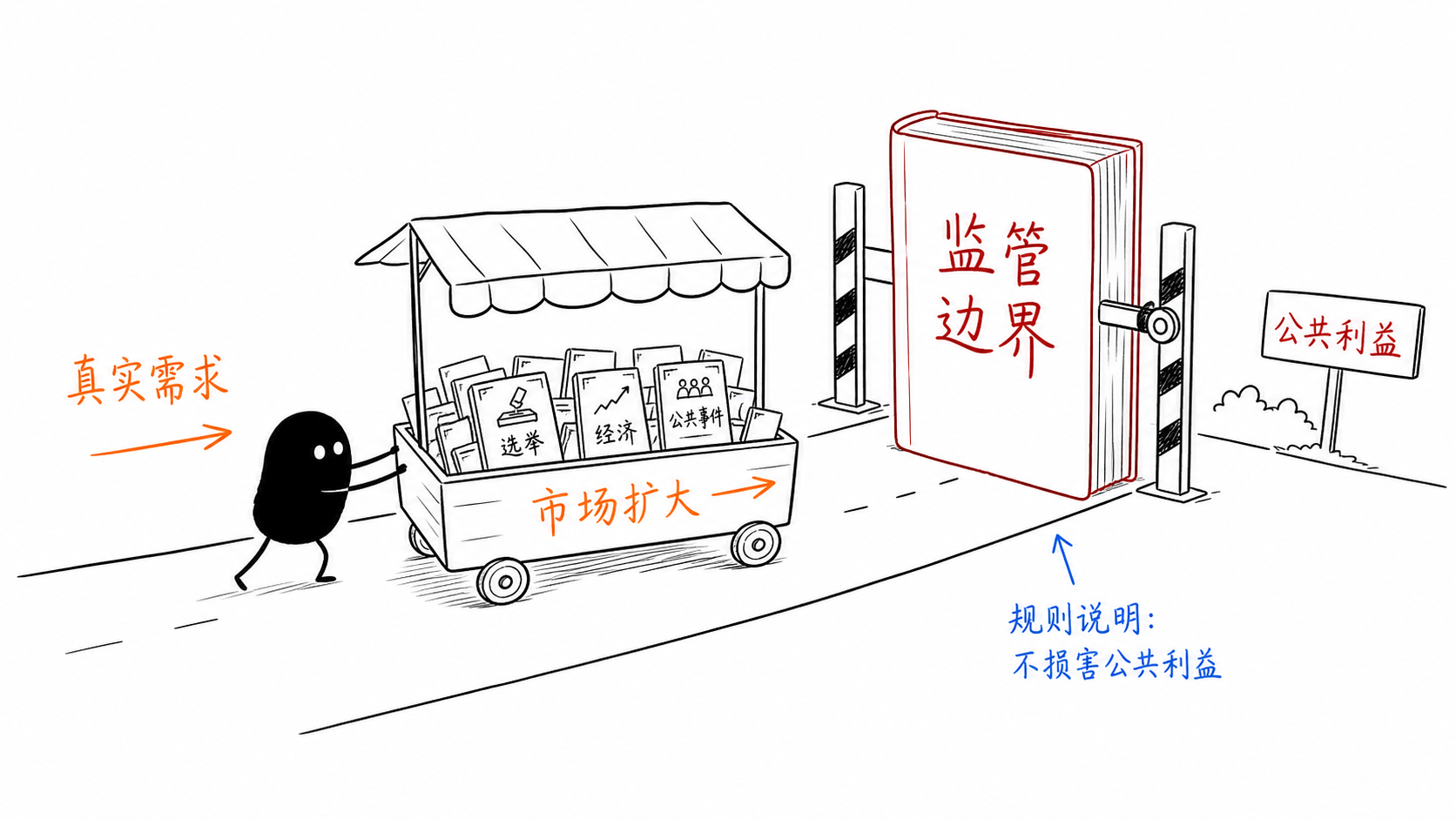
In 1992, IEM received a no-action letter from the U.S. Commodity Futures Trading Commission, allowing it to continue operating under small-scale, research-focused conditions. Event contracts had, for the first time, a relatively stable institutional space. Over the following years, IEM prices were frequently compared with polling data and helped bring prediction markets into the mainstream of economics research.
1999–2013: Intrade showed commercial demand and exposed regulatory limits
After the academic phase, commercial platforms began to emerge. TradeSports and Intrade expanded tradable events into elections, economics, entertainment and international affairs, opening the format to a wider user base.
Intrade gained visibility during multiple U.S. election cycles. Media outlets, researchers and the public started treating market prices as a signal distinct from polling. More capital and more participants produced more active price discovery, and prediction markets moved closer to becoming a mainstream internet product.
Regulatory pressure grew at the same time. In 2012, the CFTC charged Intrade with offering unregistered commodity options trading to U.S. users. The platform later halted service and shut down in 2013. Foresight’s conclusion from that episode is straightforward: event contracts had real demand, but long-term growth required compliance, clearing and market infrastructure that matched the scale of trading.
The same period also exposed moral and public-interest boundaries. In 2003, the Policy Analysis Market, funded by the U.S. Defense Advanced Research Projects Agency, attempted to use markets to forecast political and security developments in the Middle East. The project was canceled quickly after public controversy. The episode showed that whether a contract can be traded depends not only on technical feasibility, but also on market design, public interest and social acceptance.
2014–2020: restricted markets persisted as crypto infrastructure matured
After Intrade closed, restricted venues such as IEM and PredictIt continued to offer trading on political events. They kept the research and product thread alive, but user numbers, trade sizes and the number of markets remained constrained.
At the same time, stablecoins, smart contracts, on-chain wallets and automated market making were maturing. Event contracts started to gain a different technical base: global users could trade on a unified network, rules and settlement could be written into smart contracts, and markets could run around the clock.
That set the stage for another growth cycle. Prediction markets began shifting from websites maintained by a single institution to composable and verifiable on-chain markets.
2020–2025: Polymarket took prediction markets global
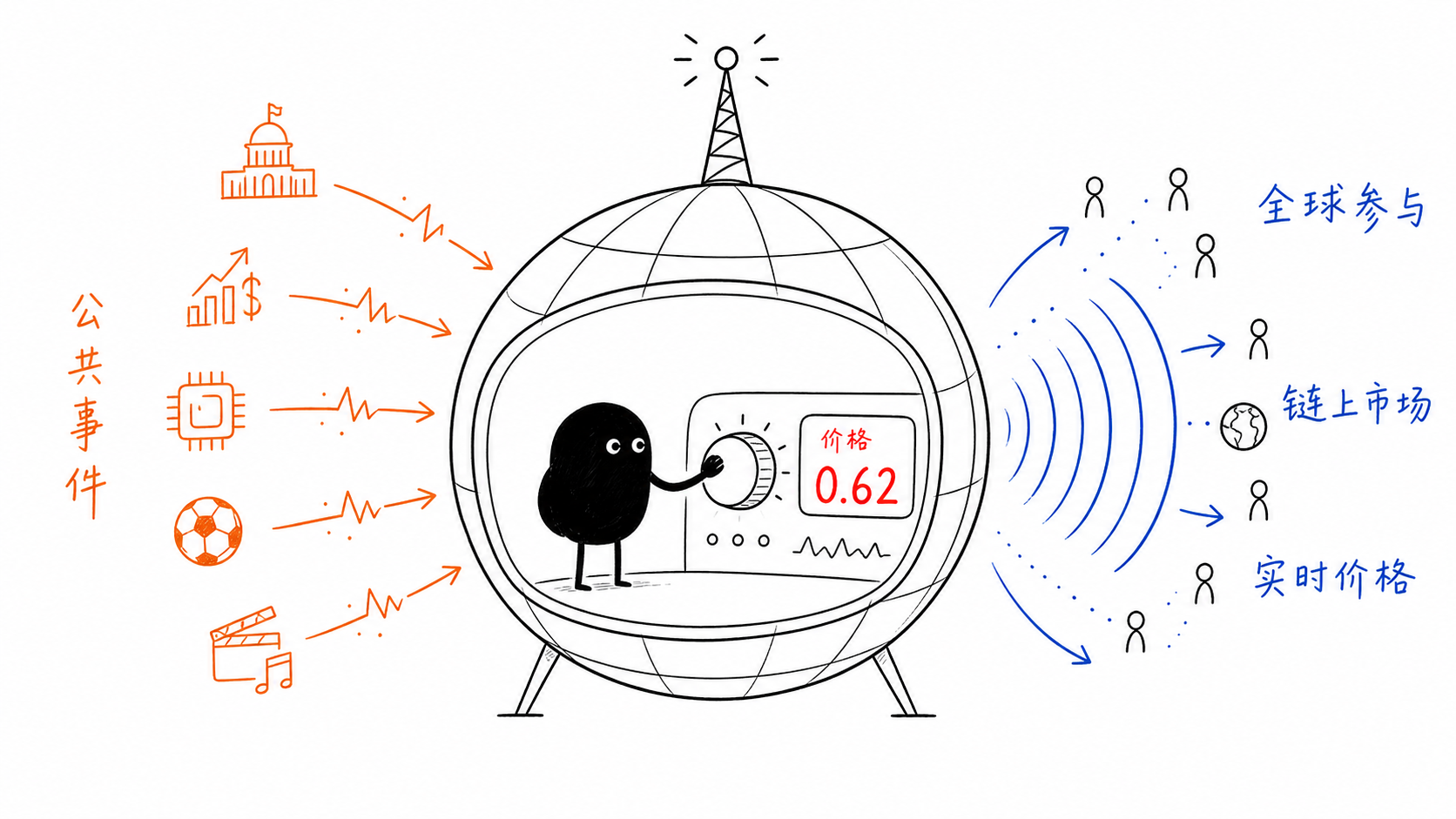
Polymarket launched in 2020 and used stablecoins and blockchain infrastructure to offer event markets around politics, macroeconomics, technology, sports and culture. Users trade “Yes” and “No” shares, with prices moving on supply and demand until settlement once the outcome is known.
The first major change showed up in distribution. Prediction markets went from localized products to global internet products, and their prices could be cited in real time by media outlets, researchers and social platforms. During the 2024 U.S. election, Polymarket drew unprecedented public attention, and event contracts became a high-frequency data source in global news discussions.
Its growth also came with compliance adjustments. In 2022, the CFTC reached a settlement with the platform over unregistered on-chain event contracts and required it to deal with markets that did not meet the rules. After that, Polymarket continued building a path into regulated markets.
In 2025, Intercontinental Exchange, the parent company of the New York Stock Exchange, said it would invest up to $2 billion in Polymarket and planned to distribute its event-driven data. Foresight treats that partnership as symbolic: probabilities formed through market trading were beginning to be viewed by traditional financial infrastructure as a data product that could serve institutional clients.
In that sense, Polymarket marked a key transition in the history of event contracts, moving the category from academic research, niche communities and gray zones into the field of mainstream global finance and media.
Kalshi and the expansion of the regulated U.S. market
Running in parallel with the on-chain route, Kalshi chose to begin as a regulated exchange. It became a CFTC-registered designated contract market in 2020 and launched event contracts around economic data, weather, politics and sports.
In 2024, a U.S. federal district court overturned the CFTC’s ban on Kalshi election contracts. In May 2025, the CFTC withdrew its appeal, bringing the case to an end. That accelerated the expansion of the U.S. event-contract market and opened a fresh round of debate at both the federal and state levels.
By 2026, Foresight writes, event contracts had split into several parallel tracks: regulated centralized markets, on-chain prediction markets for global users, and short-duration products designed around price movements. Each route corresponds to different kinds of information, different participation models and different risk structures.
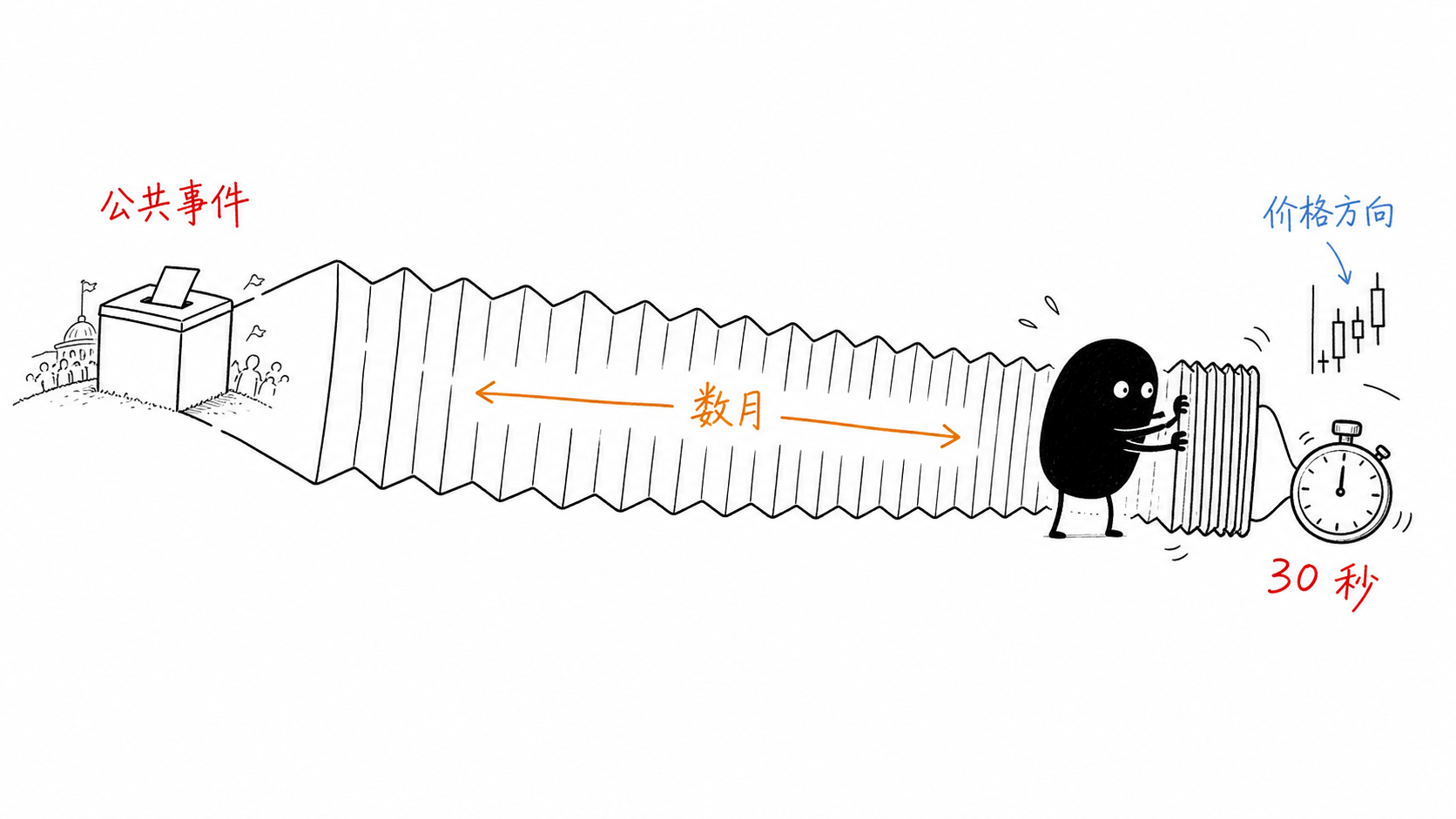
From forecasting public events to trading market outcomes
The product boundary has widened. Earlier markets were mainly built to answer questions such as who would win an election or whether a policy would pass. Newer products can also ask whether BTC will be above or below its current price at a specified future time. Both types convert uncertain outcomes into clear conditions and settle them according to pre-announced rules once the contract expires.
The information they aggregate is different. Political and macro event markets absorb news, research and public information, often over longer cycles. Short-cycle price event products absorb live market data, volatility, order flow and directional judgments from traders, putting them closer to high-frequency market trading.
That shift makes event contracts look more like a general product structure. Users do not need to manage complex position parameters to express a view on a clear outcome. The experience moves from finding an event worth forecasting to expressing a directional judgment quickly in a market users already know.
TurboFlow: event contracts enter on-chain retail trading
Foresight says the market is now evolving along multiple paths. One group of platforms stresses institutional design and regulatory structure, using standardized rules to improve credibility. Another stresses global accessibility and on-chain execution, using open and transparent mechanisms to reduce geographic and infrastructure constraints. A third group is exploring shorter-cycle event products that sit closer to actual trading behavior, with the aim of lowering the barrier to entry and improving capital efficiency.
TurboFlow is presented as part of that third branch. It is an on-chain trading platform for global retail users that combines perpetuals, event contracts and prediction markets in one trading ecosystem, aiming to make professional trading products simpler and easier to access.
In TurboFlow’s event contracts, users can take a view on the price direction of assets such as BTC, ETH and gold over a specified period. Participation starts at $2, and one round can finish in as little as 30 seconds. A simple directional choice, a fixed expiry and a pre-displayed potential outcome lower the threshold for understanding and execution.
TurboFlow also places event contracts inside a broader trading environment. Users can choose short-duration event contracts based on a market view, or use perpetual contracts to manage longer-lasting directional exposure.
On the infrastructure side, the platform brings in professional market makers for liquidity and uses transparent on-chain execution to support a more market-driven trading experience. Foresight links that design back to Hayek’s price-discovery logic: different participants bring their judgments into the market, and prices and odds move with supply, demand and incoming information.
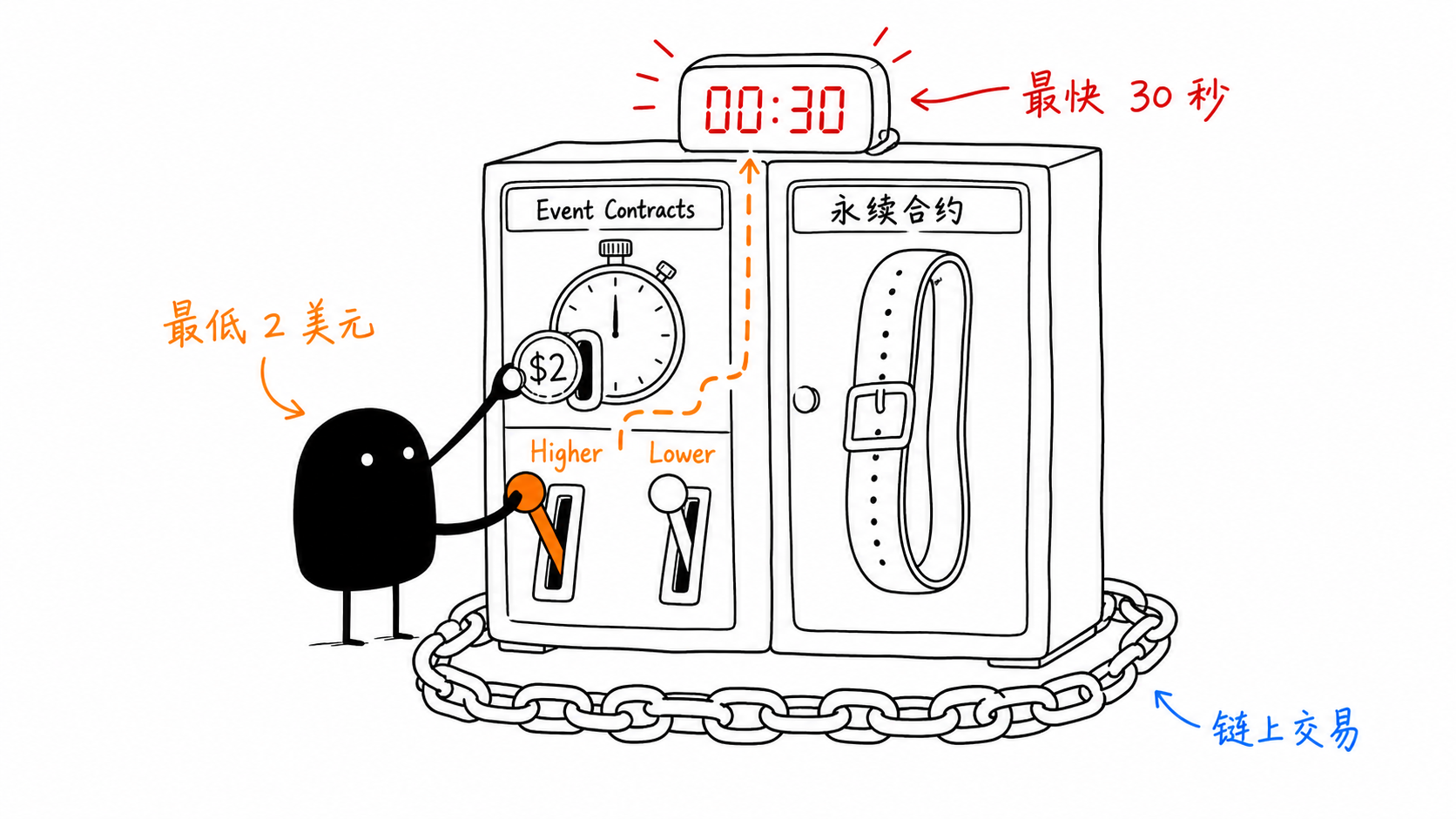
TurboFlow and Polymarket, in this framing, represent two typical use cases. Polymarket lets users trade public events in politics, economics and culture. TurboFlow extends event contracts to short-cycle market outcomes and connects them with perpetual contracts. That gives event contracts a broader time scale and reaches users with different levels of market experience.
What still matters as event contracts go mainstream
Looking back over this history, Foresight says the long-term value of event contracts comes down to three elements.
- First, the rules need to be clear. The underlying, observation time, data source and settlement conditions should all be disclosed before trading begins.
- Second, markets need liquidity. The number of participants, market-making quality and order depth shape how quickly price absorbs information and how users actually experience trading.
- Third, risk needs to be understood correctly. Binary outcomes concentrate gains and losses at the moment of settlement, and short-cycle trading amplifies the role of volatility and timing. Prices and odds reflect judgments formed under a given set of rules and liquidity conditions; they are not a guarantee of the final result.
Those principles connect IEM, Polymarket, Kalshi and TurboFlow. Technology and interfaces keep changing. Clear rules, transparent execution and sufficient liquidity remain the base required for event contracts to scale.
From information markets to an everyday trading entry point
From crowd-based guessing in 1907 to Hayek’s account of price as an information mechanism; from the Iowa Electronic Markets in 1988 to Polymarket bringing prediction markets onto blockchain, and then to TurboFlow combining short-cycle event contracts with perpetuals on one platform, Foresight describes a long evolution from idea to experiment, from market structure to product.
That history also helps explain why the category keeps expanding. People continue to need a simple way to express a view on the future. Today, event contracts can cover political outcomes months away or market direction 30 seconds ahead. The time frame has shortened, participation has become lighter, and the logic of price discovery is still intact.
If traditional prediction markets mainly aggregate views through medium- and long-duration event trading, today’s short-cycle event contracts extend the same mechanism into faster and more frequent trading settings. In Foresight’s telling, that is the direction TurboFlow is pursuing: letting more ordinary users take part in transparent, easy-to-understand on-chain trading supported by real market liquidity.
Disclaimer: Markets carry risk, and caution is required. The article does not constitute investment advice. Users should consider whether any opinion, view or conclusion in the piece fits their own circumstances. Any investment decision made on that basis is their own responsibility.