


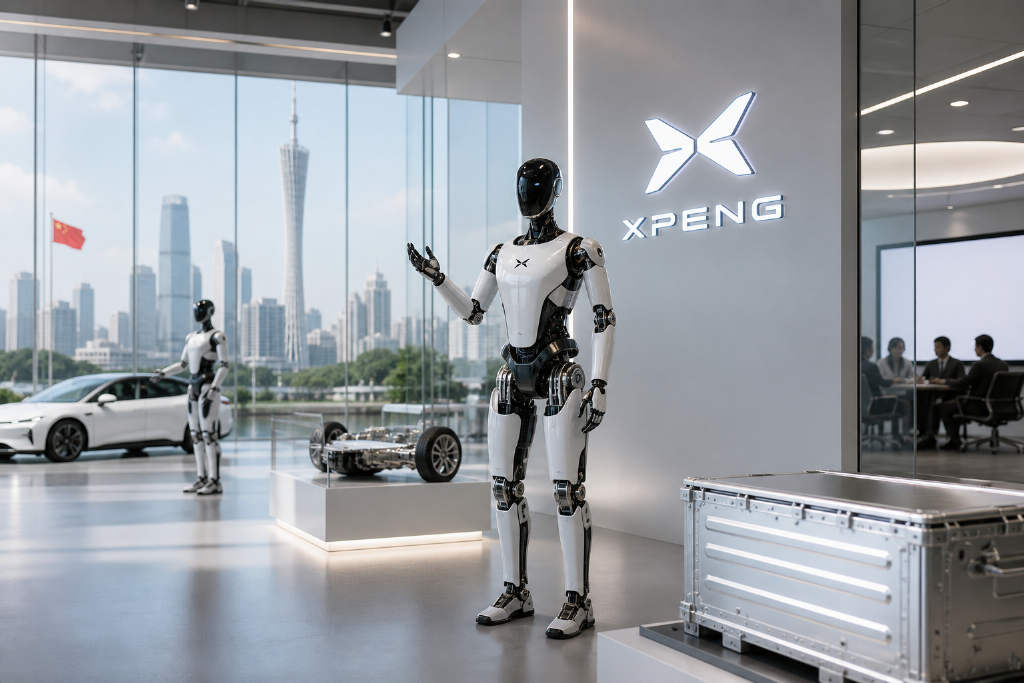
XPeng Chairman He Xiaopeng said at the company’s 2026 half-year earnings briefing that the IRON humanoid robot is planned to enter mass production from the end of this year, with commercial scenarios first rolling out at XPeng stores and campus locations.
According to the plan he outlined, IRON will officially launch in 2027 and target external customers in the retail and service sectors. The company aims for large-scale deliveries in both China and overseas markets, and He said monthly production capacity could quickly scale to several thousand units next year.
Mass-production push and first-round financing
He also said he has concurrently served as CEO of the robotics business since June this year. In that role, he is integrating resources including XPeng’s automotive supply chain, automotive-grade manufacturing, global footprint, and Turing AI chips to drive mass production and commercialization.
On the same day, XPeng announced that its humanoid robotics business had secured more than $900 million in first-round financing at a post-money valuation of more than $6.3 billion. IDG led the round. Gaorong Ventures, Tencent, Alibaba and others subscribed $600 million, while XPeng Group and entities controlled by He Xiaopeng and other senior executives subscribed $300 million.
He said the technical threshold for advanced general-purpose robots is at least 20 times that of smart vehicles. He added that lifetime revenue and gross profit per unit would be significantly higher than those of automobiles, and said he expects mass production to generate substantial gross profit and support physical AI research and development.
Robotaxi progress and auto business figures
XPeng also disclosed that its factory-installed, mass-production Robotaxi equipped with the second-generation VLA has completed more than 2,000 internal test orders in Guangzhou. The company has completed development of its cloud-based takeover platform and is targeting passenger-carrying operations without a safety operator next year.
For its auto business, XPeng reported first-half revenue of 32.78 billion yuan, deliveries of 166,000 vehicles, and a gross margin of 20.6%. For the third quarter, it expects deliveries of 115,000 to 121,000 vehicles and revenue of 21.7 billion to 23.4 billion yuan.