
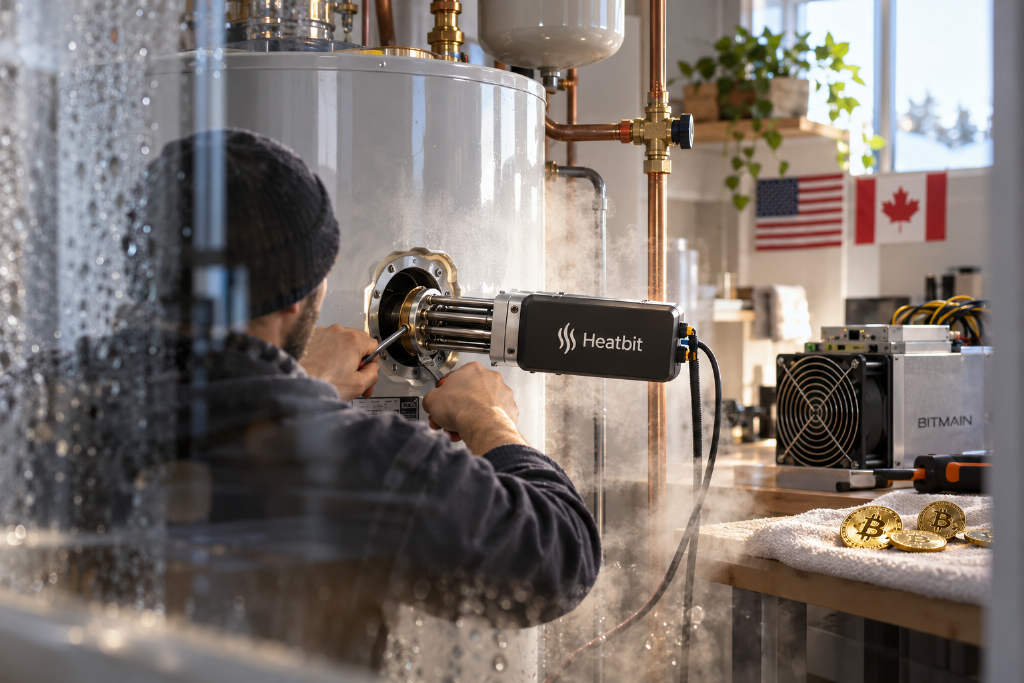
Heatbit on Oct. 22 unveiled Bitwater, a Bitcoin mining heating element built for existing electric water heaters in the United States and Canada. The first preorder batch is priced at $899, with delivery expected in the first quarter of 2027. Heatbit lists the unit at up to 34 TH/s and up to 600 watts.
The company sums up the pitch in one line: 「Same heat, same electricity, plus bitcoin.」
A mining rig built into a water heater element
Bitwater is designed to replace the heating element inside a standard electric water heater, turning the process of heating household water into a Bitcoin mining operation at the same time.
According to the source article, the device uses 20 Bitmain BM1370 chips, with the heat generated by the chips transferred directly into the water. Efficiency starts at 12 J/TH. The 5-nanometer BM1370 is also used in Bitmain's Antminer S21 Pro and S21 XP, as well as the open-source Bitaxe Gamma. Compared with the roughly 270 TH/s S21 XP, Bitwater delivers about one-eighth of that hashrate.
Installation involves replacing the lower heating element while leaving the upper element and thermostat unchanged as backup when more hot water is needed. Heatbit's FAQ says the unit uses a 1-inch NPSM standard thread and fits electric water heaters from 30 to 80 gallons. The compatibility list includes A. O. Smith, Rheem, Bradford White, Whirlpool, and GE.
The process described by the company is straightforward: switch off the breaker, drain the tank, remove the old element, and screw in the new one. Heatbit estimates a do-it-yourself installation will take 30 to 45 minutes. No plumbing changes are required, and no additional circuit is needed. The external power box plugs into a standard 110 to 240 V outlet. Buyers who want help can add a live video installation session for $99 after the product ships.
Low power, long runtime
Heatbit says a typical 4,500-watt heating element in the U.S. heats water quickly and then shuts off, while Bitwater is meant to run at lower power for longer periods, targeting a runtime above 80%. Because the chips are cooled directly by water, the unit does not need a fan and produces no noise.
The article says the product has already been tested through a full winter in households of four to five people in New York and Florida. The first "Genesis batch" is priced at $899, later batches will go as high as $1,299, and preorders are refundable. Initial shipments are limited to the U.S. and Canada. Heatbit also says gas and heat-pump versions are planned later.
Revenue math: about $1.25 a day at full speed
Heatbit's FAQ says the amount of Bitcoin mined depends on network difficulty and the Bitcoin price, and that anyone quoting annual earnings is guessing.
The source article runs its own estimate using Hashrate Index hashprice. At about $36.73 per PH/s per day, 34 TH/s equals 0.034 PH/s, which works out to roughly $1.25 per day at full speed, or about $455 per year. At the 80% runtime cited by Heatbit, that falls to about $365 per year.
Using those figures, the $899 Genesis price implies a payback period of about two years at full speed, or about 2.5 years at 80% runtime. At the later price of up to $1,299, the payback stretches to about 2.9 to 3.6 years.
The warranty listed on the website is only one year.
Halving and default solo mining add more uncertainty
The article also points to the next Bitcoin halving as a factor over a longer timeline. The current block height is about 973,011, and the next halving is set for block 1,050,000. Using an estimate of 144 blocks per day, that would place the event around April 2028, when the block subsidy would drop from 3.125 BTC to 1.5625 BTC.
Another detail is the default mining mode. Heatbit's FAQ says Bitwater ships set to solo mine through the Heatbit pool, meaning the full block reward goes to the user if a block is found. Users can switch to other pools such as Luxor in the app.
Still, based on mempool.space data cited in the article, the Bitcoin network hashrate is about 1,072 EH/s. A 34 TH/s machine represents roughly one thirty-one-million-five-hundred-thousandth of the network, implying an average wait of about 600 years to mine a block solo.
As a standalone miner, the economics look worse
If Bitwater is treated simply as a mining machine, the numbers deteriorate quickly. Running at 600 watts around the clock would consume 14.4 kWh per day. Data from the U.S. Energy Information Administration shows the average residential electricity price in April 2026 was 18.83 cents per kWh, putting daily power costs at about $2.71. That is more than double the estimated $1.25 in daily mining revenue.
That means the product's economic case depends entirely on one assumption: the electricity would have been spent heating water anyway.
Heat pump comparison
The article says that assumption has limits. The U.S. Department of Energy estimates that heat-pump water heaters are two to three times as energy efficient as conventional electric resistance models. Bitwater, by contrast, has the same thermal efficiency as a standard electric heating element, with one unit of electricity producing one unit of heat.
At 600 watts and an 80% runtime, Bitwater would deliver about 4,200 kWh of heat into the tank over a year. Producing the same amount of heat with a heat pump could save about 2,100 to 2,800 kWh annually. At 18.83 cents per kWh, that comes to roughly $400 to $530 in savings, close to or above the roughly $365 in annual mining revenue estimated for Bitwater at an 80% runtime.
Not Heatbit's first home mining appliance
Heatbit is not new to this category. The company previously sold a heater with a built-in mining rig, with the first generation priced at nearly $700 in 2023. Founder Alex Busarov told Decrypt in 2023, 「Dyson won't make you money, this will.」 Bitwater carries the same basic pitch into the water-heater market.


