


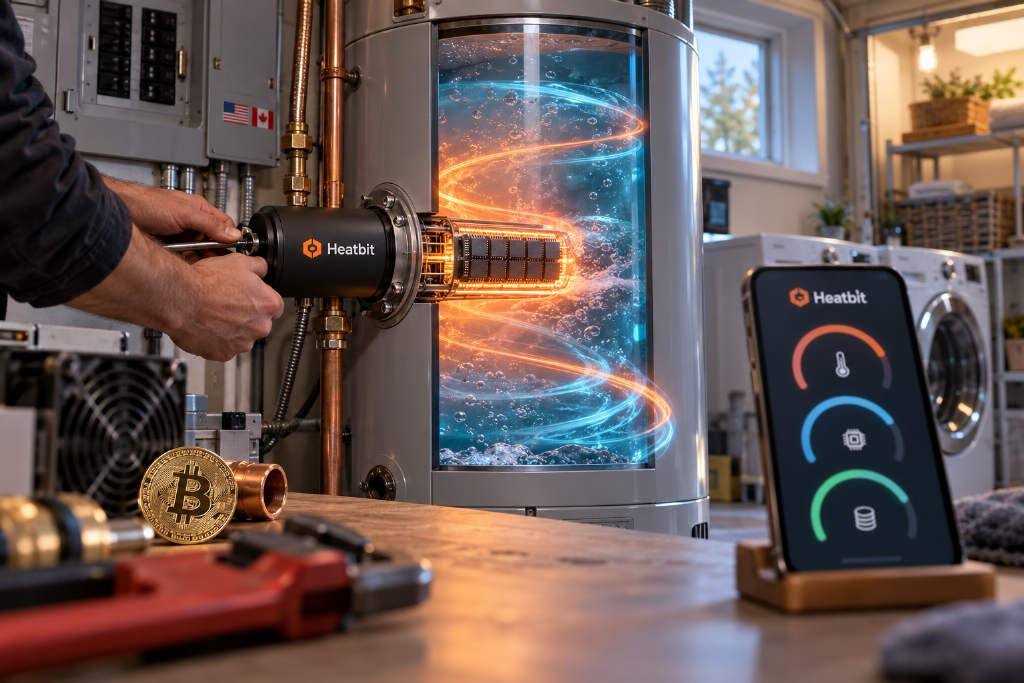
Heatbit has unveiled Bitwater, a water heater element that mines Bitcoin while heating water. The company announced the product in a Thursday post on X, saying it can be installed in an existing electric water tank and use the same process that heats water to also run mining hardware.
According to Heatbit, Bitwater replaces the resistance wire in a standard electric water heater element with 20 Bitmain BM1370 chips. The heat from those chips is then used to warm the water. In its post, the company wrote, 「Same heat, same electricity, plus bitcoin」 and argued that 「the electricity was going to be spent on hot water anyway.」
Heatbit said the device screws into an electric tank a customer already owns and framed the product as a form of physically decentralized mining.
Specs and installation
Bitwater is rated at up to 34 TH/s, draws up to 600 watts, and operates at 12 J/TH. Heatbit said the water cools the chips, which means the unit does not need fans and runs without noise.
The company described installation as a do-it-yourself process: switch off the breaker, drain the tank, remove the old element, and thread in Bitwater with the included wrench. In a follow-up post, Heatbit said the product fits the standard one-inch port used by regular 30- to 80-gallon electric tanks in the U.S. and Canada, including models made by A. O. Smith, Rheem, Bradford White, Whirlpool, and GE. It also said no plumbing changes or new circuit are required.
Heatbit added that Bitwater’s maximum 600-watt draw is far below the 4,500-watt elements commonly used in U.S. tanks. Those conventional elements heat water quickly and then shut off. Bitwater heats more slowly but runs for longer. When hot water demand jumps, the tank’s existing upper element still acts as backup.
App features, pricing, and shipping
Users can track water temperature, hashrate, and mining earnings in an app. They can also choose between solo mining and joining a pool, with mined Bitcoin sent to an address they control.
Heatbit said preorders for its first production run, which it calls the Genesis batch, are priced at $899. Later batches will cost as much as $1,299. The company said the preorders are refundable and are scheduled to ship in the first quarter of 2027.
Heatbit also said it tested the element through the winter with households of four and five in New York and Florida. The company also teased a product aimed at homes that use gas water heaters.
Earnings estimates and runtime
Heatbit did not publish its own earnings forecast. Instead, it shared a reply from xAI’s Grok chatbot that estimated daily earnings at about $1 to $1.25, while adding that 「estimates aren't guarantees.」 Decrypt said that range was broadly in line with its own calculations.
Using the current hashprice of about $36.73 per PH/s per day from Hashrate Index, a unit running at the full 34 TH/s would mine about $1.25 worth of Bitcoin per day, or roughly $455 per year. Heatbit said the element is designed to run more than 80% of the time, while actual earnings would move with Bitcoin’s price and network difficulty.
Heatbit’s pitch for home mining
Heatbit is presenting Bitwater as a way to spread Bitcoin mining across households. The company said homes around the world use about 300 terawatt-hours of electricity each year to heat water, compared with about 170 terawatt-hours for the entire Bitcoin network.
In its post, Heatbit wrote, 「Public miners are fleeing to AI and dumping coins to pay Wall Street and CEO salaries.」 It added, 「Home miners answer to no one.」
Large public mining companies have been expanding into AI. Earlier this year, Bernstein said Bitcoin miners had signed 17 deals worth more than $110 billion over two years, contracting out roughly 6 gigawatts of power to companies including Google, Amazon, Microsoft, Nvidia, and CoreWeave. The bank said it expects AI revenue at the miners it covers to rise from $1.2 billion in 2026 to $10.7 billion by 2030. It also said the sector’s planned power capacity of more than 27 gigawatts makes miners important suppliers for the AI buildout.
The two businesses do not use power in the same way. Bitcoin miners can shut down to ease pressure on the grid, while AI data centers need continuous power. Speaking to Decrypt in March 2025, Compass Mining’s Shanon Squires said, 「We're interruptible [as Bitcoin miners], whereas a traditional data center needs (to be) on 100% of the time.」
Earlier Heatbit product
Heatbit’s first product was a space heater with a built-in miner, priced at almost $700 in 2023. At the time, founder Alex Busarov told Decrypt that the product would always generate some return regardless of changes in mining economics, because the heat it produced replaced that of a conventional heater. 「Dyson doesn't make you any money. This one does,」 he said.