
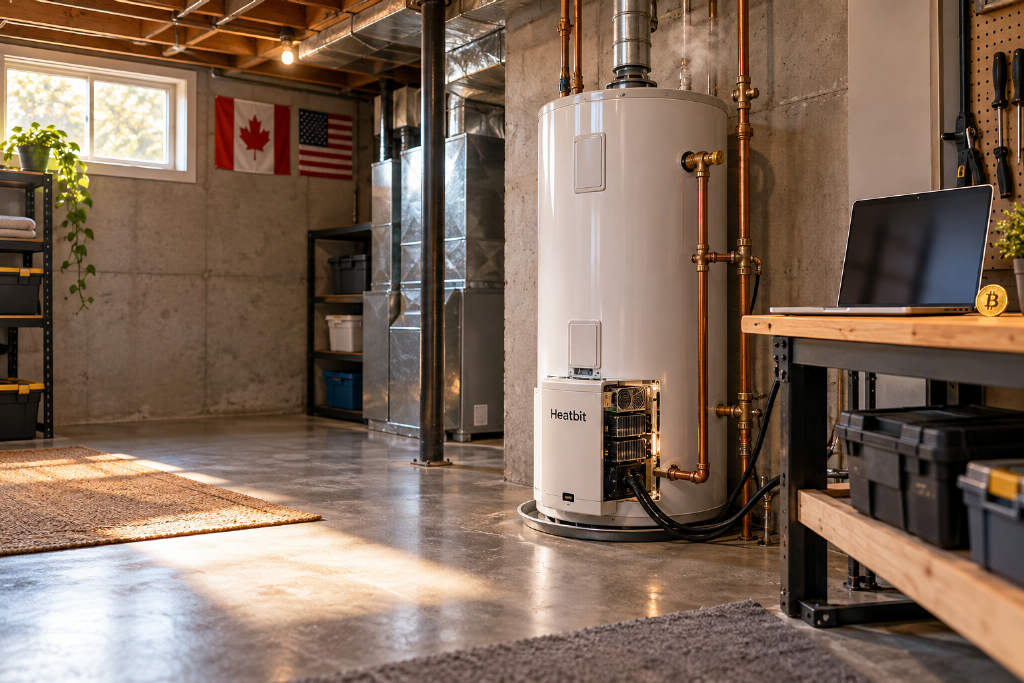
Heatbit, the company that earlier put out a Bitcoin-mining heater, is now rolling out a water-heater element called Bitwater. It swaps out the resistance wire inside a standard electric water heater and replaces it with 20 Bitcoin mining chips. The heat from those chips is then used straight away to warm the water in the tank.
Heatbit’s pitch is pretty simple: that power was going to heat hot water anyway — “the same heat, the same electricity, plus Bitcoin.” The company also said households around the world burn through about 300 TWh of electricity each year heating water. That is higher than the roughly 170 TWh used by the Bitcoin network, and Heatbit points to that gap to make the case for pushing mining into homes.
Specs and cooling design
Bitwater runs on 20 Bitmain BM1370 chips. Hashrate can reach 34 TH/s, power draw can hit 600 watts, and efficiency is listed at 12 J/TH. And because the unit is water-cooled, there is no fan. No noise either.
Installation and compatibility
Heatbit says the unit is built so people can install it themselves. The job is straightforward: switch off the breaker, drain the tank, pull out the old element, then screw in Bitwater using the wrench that comes in the box.
The company says Bitwater matches the one-inch standard interface used in common 30- to 80-gallon electric water heaters across the U.S. and Canada. That includes brands like A. O. Smith, Rheem, Bradford White, Whirlpool, and GE. No plumbing changes. No extra electrical circuits.
App features, pricing, and shipping
In the app, users can see water temperature, hashrate, and mining income. They can also pick solo mining or join a mining pool. Any Bitcoin the device mines goes to an address the user controls.
The first “Genesis batch” is up for pre-order at $899. Later batches will go for as much as $1,299. Pre-orders can be refunded, and shipping is scheduled for the first quarter of 2027.
Testing and revenue estimate
Heatbit says it ran the system through a full winter in New York and Florida, in households with four and five people.
Using a current hashprice estimate of about $36.73 per PH/s per day, the company says a fully loaded 34 TH/s unit could mine around $1.25 in Bitcoin each day. That works out to about $455 on an annualized basis.


