
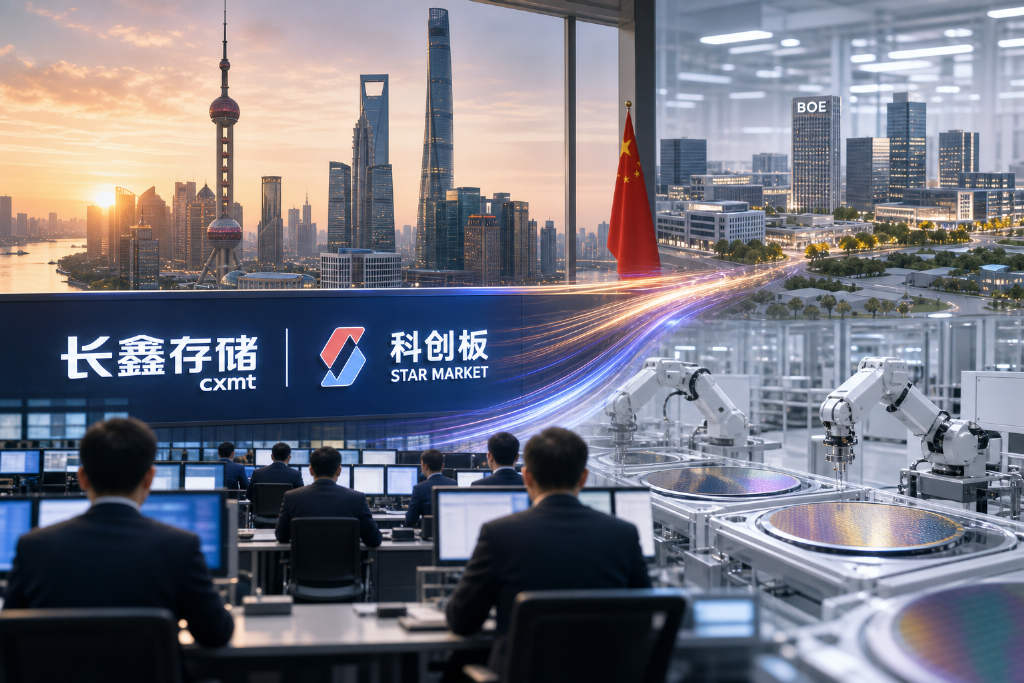
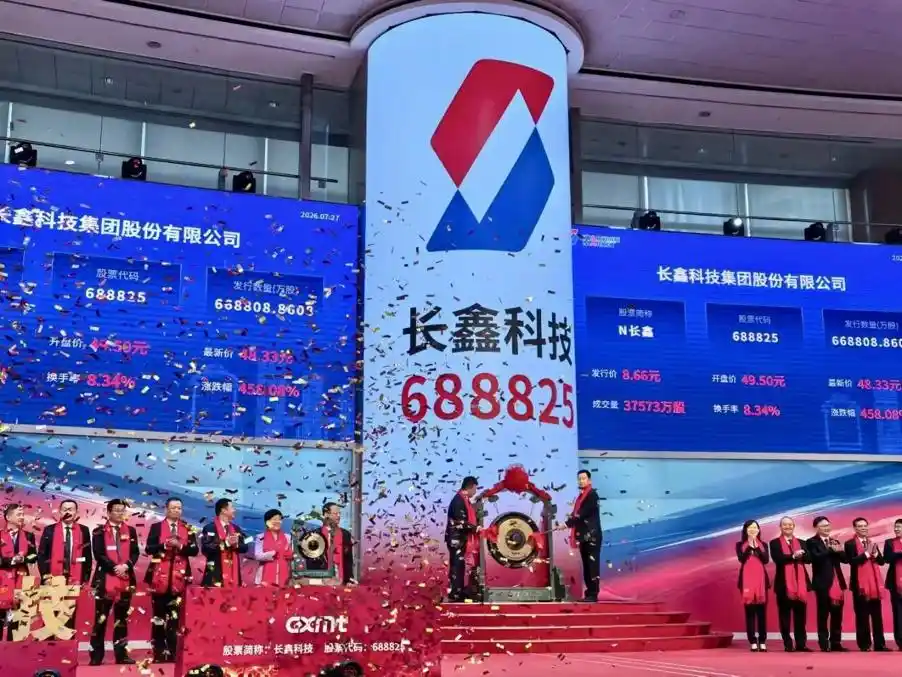
Before the opening bell rang on Shanghai’s STAR Market on July 27, 2026, Changxin Technology Group Co. had already become a top watchlist name across Chinese trading terminals. At 9:30 a.m., Changxin Memory began trading at its RMB 8.66 offer price.
The first few minutes were relatively restrained. Buy orders kept building. Around 9:40 a.m., the stock began to climb sharply, and brokerage quote screens refreshed with deeper bands of red as the gain expanded.
By the close, the stock was up more than 465%, giving the company a market capitalization of about RMB 3.3 trillion. Overnight, it moved ahead of Industrial and Commercial Bank of China, which had long held the top spot by A-share market value. The rally continued the next day, when Changxin’s total market capitalization briefly reached RMB 3.66 trillion and dominated the headlines of Chinese financial media.
The people most directly affected by that chart were in Hefei. Based on the final shareholding ratio cited in the source article, the paper gain of Hefei’s state-owned capital system jumped to more than RMB 1 trillion in a single day. The starting point was an investment of less than RMB 30 billion made roughly a decade earlier.
A ten-year run that began in 2016
To understand where that trillion-yuan gain came from, the story goes back to 2016.
That year, Zhu Yiming carried a DRAM industrialization proposal across much of China. He was not an unknown founder. Eleven years earlier, he had left a stable job in Silicon Valley and used $920,000 in seed capital assembled with several Tsinghua University alumni to set up GigaDevice in an unfinished two-story building in Tsinghua Science Park. The company later listed in Shanghai after building a business in the NOR Flash segment.
What Zhu wanted to do in 2016 was far larger. China was spending more than $200 billion a year on imported chips, domestic self-sufficiency was close to zero, and Samsung, SK Hynix and Micron controlled the DRAM market. Zhu wanted to build a Chinese DRAM fab of its own, with phase-one spending alone set at RMB 18 billion.
He approached many places and was turned away almost every time on the grounds of excessive risk. When the project reached Hefei, few expected the provincial capital, then still often mocked from outside as China’s “largest county town,” to take it on. It lacked both a prominent industrial base and deep fiscal resources. Hefei still said yes.
In July 2018, Zhu made a move that surprised the capital market. He stepped down as general manager of GigaDevice, kept only the chairman role there, and took on full-time duties as chairman and CEO of Changxin Technology. He also made a pledge: if the company did not turn a profit, he would not take a salary.
That was not a slogan. It proved to be an accurate preview of the next several years. Changxin Memory remained loss-making for nearly a decade, with cumulative losses of more than RMB 36 billion.
One later comment quoted in the source article put it bluntly: “Over ten years, Changxin accumulated losses of more than RMB 30 billion. Any purely market-driven capital would have left long ago.” Hefei’s state capital did not leave. Neither did the National Integrated Circuit Industry Investment Fund. Their calculation was not based on a three- to five-year payback window, but on a much longer horizon.
Not until the first quarter of 2026 did Changxin finally turn the corner, helped by a memory-chip upcycle driven by artificial intelligence demand. It posted revenue of RMB 50.8 billion and net profit of RMB 33 billion for the quarter, enough to offset the losses built up over the previous years.
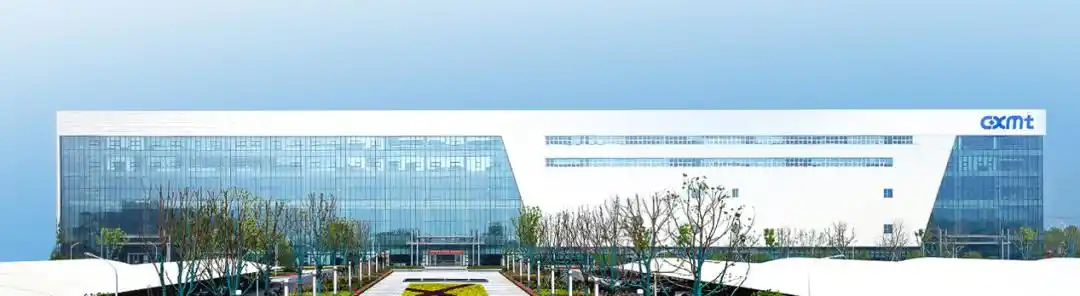
During that long stretch, Hefei did more than provide capital. According to the article, the city also helped with talent recruitment and other “nanny-style” support, while putting in RMB 100 billion to build a storage industry cluster that included wafer manufacturing, supporting industrial parks and an international township.
How the “Hefei model” was priced
That all-in approach has come to be known as the “Hefei model.”
Hefei had once been seen as a textbook example of the “central China slump.” It was neither a coastal opening-up city nor a traditional industrial heavyweight. Its clearest strength lay in education and research. The article says that around 2005, Hefei decided to pursue “industry-based city building,” but lacked money, projects and industrial support. Under those constraints, the local government began to act more like a venture investor, using limited fiscal funds as seed capital to attract promising but underfunded strategic industries. The goal was not simply a financial return. It was also tax revenue, jobs and technological spillover that would stay local.
In that framework, the real logic of the “Hefei model” was never to bet on a single blockbuster project. It was to use one chain-leading company to pull in an entire industrial chain.
The Changxin numbers in the article are laid out clearly. The phase-one project in 2016 required total investment of RMB 18 billion, of which Hefei contributed RMB 14.4 billion. Over the next decade, Hefei’s state capital added more, bringing cumulative investment to roughly RMB 26 billion to RMB 30 billion.
On the IPO date, Hefei state capital held about 36.79% in total through platforms including Qinghui Jidian, Changxin Jicheng and Hefei Jixin. That stake amounted to around 22.138 billion shares, valued at more than RMB 1 trillion.
The National Integrated Circuit Industry Investment Fund Phase II also shared heavily in the upside. Its total fund size is RMB 200 billion. The article says the market value of its Changxin stake alone now exceeds RMB 250 billion, close to recovering the fund’s entire principal from a single investment.
BOE was the earlier turning point
Push the clock back another 12 years and the same playbook begins with BOE.
In 2008, with the global financial crisis hanging over manufacturing, BOE was under pressure and frequently written down by capital markets. It approached local governments hoping to find a city willing to host construction of China’s first sixth-generation LCD panel line.
More developed cities such as Shenzhen hesitated. Hefei made a choice that was hard for many to understand at the time. To concentrate its limited financial resources on the project, it suspended previously planned subway construction and redirected the saved money into the display maker, which was still posting losses year after year.
Outside criticism was almost uniformly negative. The decision was described as a mad gamble. Why would a provincial capital that had not even built its subway yet bet on an LCD line that required investment running into the tens of billions of yuan?
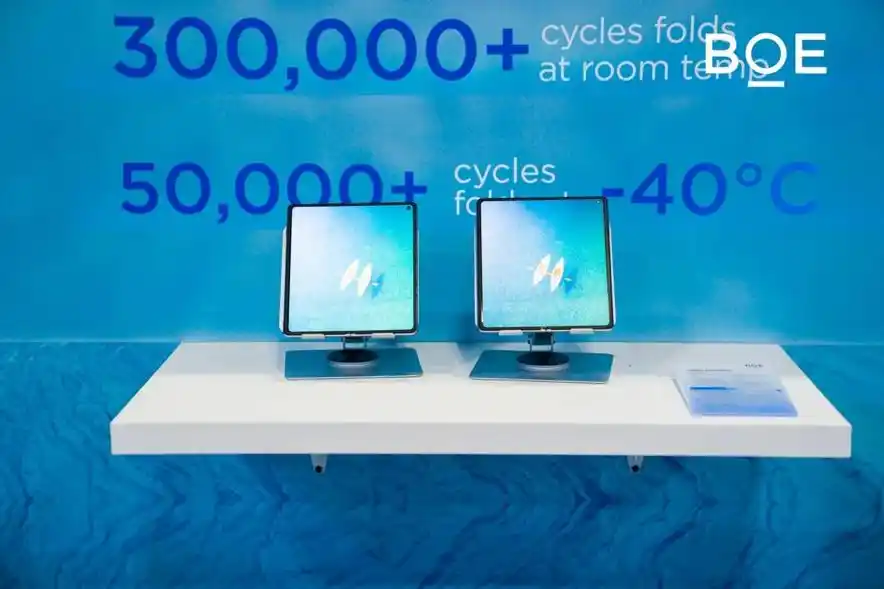
The gamble worked. About one-tenth of the world’s laptop panels and one-fifth of LCD screens are now produced in Anhui, according to the article. BOE’s arrival also drew an entire upstream and downstream chain to the Hefei area, including glass substrates and polarizers. Nexchip, which landed in Hefei in 2015, has since grown into one of the world’s top ten wafer foundries.
Hefei eventually built its subway as well. But the money saved in those earlier years became the first foundation of the city’s later signature industries.
“Equity finance” and a changing local fiscal narrative
In the article’s view, the BOE and Changxin stories, separated by years and shaped by different levels of risk, combine into what people now call the “Hefei model”: using the credit and patience of state capital to enter when companies are at their weakest and when few others are willing to take the other side, staying with them through repeated industry cycles, and then relying on capital markets to magnify the paper value of long-held equity positions. The gains can then flow back into the city’s fiscal base and industrial development.
A frequently cited line from Hefei Party Secretary Yu Aihua captures that ambition: this is not venture capital, but industrial investment; not gambling, but hard striving.
The reason the approach has been discussed so often in 2026 is tied to a broader shift in China’s local fiscal story. For two decades, land-transfer income was a central support for local governments. That stream no longer looks as dependable as it once did, and “equity finance” has therefore drawn more attention.
The article frames the shift this way: local governments are no longer relying only on land sales for cash. They hold equity in high-quality industrial projects, use state capital to guide and amplify investment, and attract more private and social capital into industry. The result, if it works, is both a local industrial cluster and a long-term fiscal return from the appreciation of the equity itself.
In Hefei, the contrast is especially striking. From 2015 to 2021, total land-transfer revenue in the city came to about RMB 551.6 billion. The paper gain on Changxin alone has now exceeded RMB 1 trillion.
During the 14th Five-Year Plan period, Hefei’s SASAC system invested more than RMB 220 billion in state capital and drove project investment of more than RMB 840 billion. That works out to nearly RMB 4 of follow-on social investment for every RMB 1 of state capital committed.
Industrial concentration brought another long-term dividend: people. Over the past decade, Hefei’s permanent resident population increased by about 200,000 a year on average, making it one of the Chinese cities with the largest net population gains.
Why others have struggled to reproduce it
If the story stops at “Hefei won,” it misses the more important question. The logic is clear, the numbers are attractive, and local governments across China have spent years studying the example. Yet after 18 years, almost no second “Hefei” has emerged in full.
The article breaks the answer into several layers.
First is patience, and not the ordinary kind. Suspending a subway line that had already been planned and betting on a display maker with years of losses required city leaders to absorb accountability pressure over many years, survive repeated rounds of doubt across multiple five-year assessment cycles, and persuade successive leadership teams not to change course easily.
The article argues that Hefei’s successive leadership teams maintained an unusually high level of continuity on industrial investment strategy. The ability to keep going for well over a decade, while staring at accounting losses and still refusing to exit, is described as a scarce political resource that most localities find difficult to preserve through leadership transitions.
Second is a professional operating team. According to the report, the “Hefei model” was never just a matter of a general investment-promotion office making instinctive calls. It relied on the coordinated work of state-owned platforms such as Hefei Construction Investment, Hefei Industrial Investment and Hefei Xingtai, each with different roles. Through repeated real-world transactions, they built a market-oriented system covering fundraising, investment, management and exit.
The article says the industrial judgment and risk-control experience formed through repeated trial, error and review in projects such as BOE and Changxin are genuine organizational capabilities. They cannot be copied simply by handing another city an operating manual.
Third is timing, which the article says should not be explained only by human judgment. Changxin’s latest valuation leap was driven in large part by a global memory supercycle tied to AI demand. From the final private fundraising round in June 2025, when the company was valued at about RMB 158.4 billion, to an IPO valuation of about RMB 579.2 billion, its valuation rose by roughly 3.6 times in a little over a year.
In that reading, Hefei made the right industrial call and also met a highly favorable capital-market window. Timing at that level of precision is difficult to turn into a repeatable guide.
Fourth, and often overlooked, is that many other cities were also deploying real money into semiconductors during the same period, but their stories turned out very differently. Spending aggressively is only an entry ticket. What determines whether a project reaches an IPO bell or runs into a funding break is the combined ability to understand the direction of the industry, withstand a long loss-making period, and resist both external temptation and internal short-termism.
What can be learned and what cannot
Put together, the “Hefei model” can be split into two very different layers.
One layer can be studied and is already being imitated: the idea of “equity finance” itself, along with the toolset built around it. A local government does not rely solely on land sales for cash flow. It uses state capital to obtain equity in industrial projects and manages risk with a market-oriented entry-and-exit framework rather than by simply pouring in money.
The other layer is much harder to carry elsewhere. The article points to 18 years of accumulated operating experience, patience that survived across several leadership teams, the coincidence of industrial and capital cycles, and one more thing that is easy to overlook but central to the whole story: the resolve to keep running alongside a project through long periods of losses when returns are nowhere in sight.
Those are not the kind of things that can be written neatly into an investment-promotion handbook or transferred through a study tour.
In the days of Changxin’s listing, Hefei’s state capital gained more than a paper number above RMB 1 trillion. The source article says the city also secured something more durable and less vulnerable to shifts in market sentiment: more than 450 upstream and downstream companies clustered around Changxin, and an integrated-circuit industry whose output in Hefei rose from less than RMB 18 billion in 2016 to RMB 151.4 billion in 2025, an increase of more than sevenfold.
Those assets embedded in the local economy are, in the article’s telling, what investment-promotion teams across China most want to learn from and what is hardest to package and take away. For local governments looking for a new fiscal narrative, Hefei’s homework may read well. Copying it is likely to require more time and more patience than many imagine.
This article was sourced from the WeChat public account Jiedian Caijing (ID: jiedian2018), by Jiedian Caijing.