
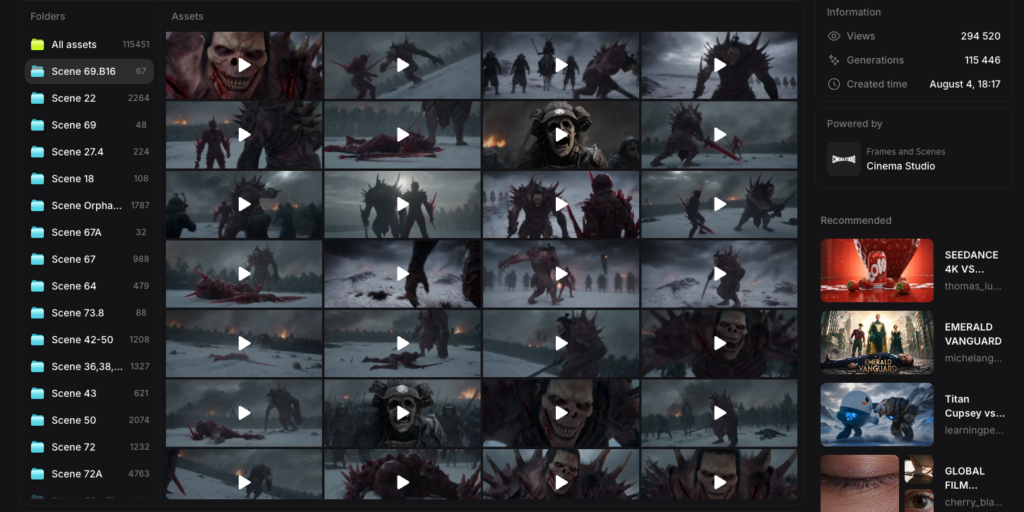
Higgsfield has open-sourced the full production package behind its 95-minute AI film Hell Grind, releasing the project’s prompts, character models, scene assets, iteration history, a 19-minute behind-the-scenes breakdown, and a Claude Skill built around the same prompting workflow.
A central part of the release is a full reconstruction of the film’s largest fight sequence. Higgsfield shows how prompts changed, how many times they changed, and which versions failed. For creators trying to learn AI video production, the package lays out the team’s actual workflow, mistakes, and revisions instead of only showing final outputs.
Nearly $500,000 in production cost
Hell Grind was made by a 15-person team in Almaty, Kazakhstan, over 14 days. Total cost came to nearly $500,000. Higgsfield said close to 80% of that, or about $400,000, went to GPU cloud compute, while the remaining roughly 20% covered staffing.
CEO Alex Mashrabov said the generation process felt “like a slot machine.” In the end, 253 usable shots were selected from 16,181 generations, a ratio of about 64 to 1.
The company also linked the open-source release to promotion for the Higgsfield Global Film Festival, which carries a $1 million total prize pool and a $500,000 first prize.
What the open package includes
According to the project page, the release includes every prompt line, every asset, and every iteration version used in production. Higgsfield said anyone could theoretically rebuild the film from the package, assuming they are willing to pay the cost.
All characters, scenes, and assets are placed inside a single workspace so users do not need to search through multiple folders. Higgsfield also packaged a Claude Skill that can be used in about 30 seconds after clicking the plus sign and uploading files.
The Skill outputs prompts in a fixed four-part structure:
- It starts with simple anchors such as @Roco and @Monster, each tied to a short visual description and reference image so the model does less guessing.
- It then locks spatial coordinates in meters.
- Actions are written as second-based timecodes.
- A strict final rule is added to block the model from inventing missing details on its own.
Lock characters and scenes before generation starts
Before generating final footage, the team first locked recurring characters and environments.
That meant fixing details such as hairstyle, facial features, and clothing. The monster was defined as 4 meters tall, with a skull face, red crystal blades, and no right hand, with bone extending from the elbow into a blade. Higgsfield said the more detailed the setup, the easier it was for the model to recognize and preserve the same character across generations.
How prompts were written to keep shots on track
The first rule, according to the team, was to avoid vague adjectives for camera motion and use comparisons and hard numbers instead. Rather than writing “move the camera faster,” the prompt would specify “3x faster than a typical cinematic dolly push.” An orbit move would be written as a change from 8 meters to 4 meters, with height dropping from 3 meters to 2 meters. A monster transformation would be assigned an exact duration of 0.4 seconds.
Higgsfield’s view is that video models do not respond well to abstract terms such as “dramatic.” Numbers work better than adjectives.
Crowd scale was handled in a similar way. The team used a three-layer setup instead of relying on a single headcount: one clearly visible warrior in the foreground, a dense crowd behind, and silhouettes fading into fog further back. Only about 40 figures were clearly visible, with the rest left for viewers to infer. Fog also doubled as a debugging method. By cutting visibility to 20 meters, unstable background generation could be hidden. Higgsfield added that newer models are much more stable on 4K backgrounds, so the tactic matters less than before, though it still helps when frames are packed with elements.
Movement was also broken down into half-second steps. In one example, a foreground samurai standing up was split into hand motion at 0.5 seconds, helmet motion at 1.5 seconds, and full standing posture at 3 seconds. Locking the timing kept the model from rushing ahead or skipping intermediate states.
The team also followed one practical rule: run at least four generations each time. That was the minimum needed to tell whether a bad result came from random variance or from the prompt itself. Higgsfield said separating “bad prompts” from “bad luck” was key to saving compute credits.
The release also discloses the generation settings for the scene: the model was fixed at CS 2.0, each segment ran for 15 seconds, each pass produced four segments, and there were no hidden settings.
The most expensive lesson: don’t tell the model what not to do
Higgsfield said the costliest lesson from the project was not how to write a prompt, but how not to write one.
In one shot focused on the monster’s right arm, the prompt explicitly said there should be “no handheld object” and “no sword hilt,” yet the model still produced a hand gripping a sword. The team eventually solved it by flipping the instruction into a positive description, lifting the arm and making the empty area clearly visible in frame.
A more expensive mistake came when the entire fight scene started to look like a video game cutscene. The team wrote “not a game” and “no CGI” more than a dozen times, but the model did not understand the negation. It picked up on the repeated word “game” and leaned in that direction.
The fix came in two parts. First, the team replaced prohibitions with positive descriptions. Instead of writing “no cheap effects,” it specified the lighting and materials it actually wanted. Second, it switched from a one-shot sequence to multi-shot editing. A continuous single take is common in games, while films cut between shots. Higgsfield ultimately had the model cut the scene into four shots with four lens setups: a 50mm orbit, a 24mm low angle, an 85mm close-up, and a 35mm wide shot.
Shot-to-shot continuity also had to be written as a hard rule: the pose at the end of the first shot had to equal the pose at the start of the second. Without that, the AI treated each cut as a new scene and reset body positioning.
Impact was described in physical terms as well. Rather than writing “slow motion,” the team specified the distance between the two blades down to centimeters over time, defined the collision angle, and added a rule that crystal always beats steel. That pushed the model to shatter the steel blade and generate sparks.
Diagnosis and selective fixes mattered more than a perfect prompt
Higgsfield’s conclusion was that the real technique in this workflow was not writing one brilliant prompt. It was identifying exactly what had gone wrong and changing only that part. In many cases, shots in the film were built by selecting two different usable pieces from the same batch of generations and cutting them together.