
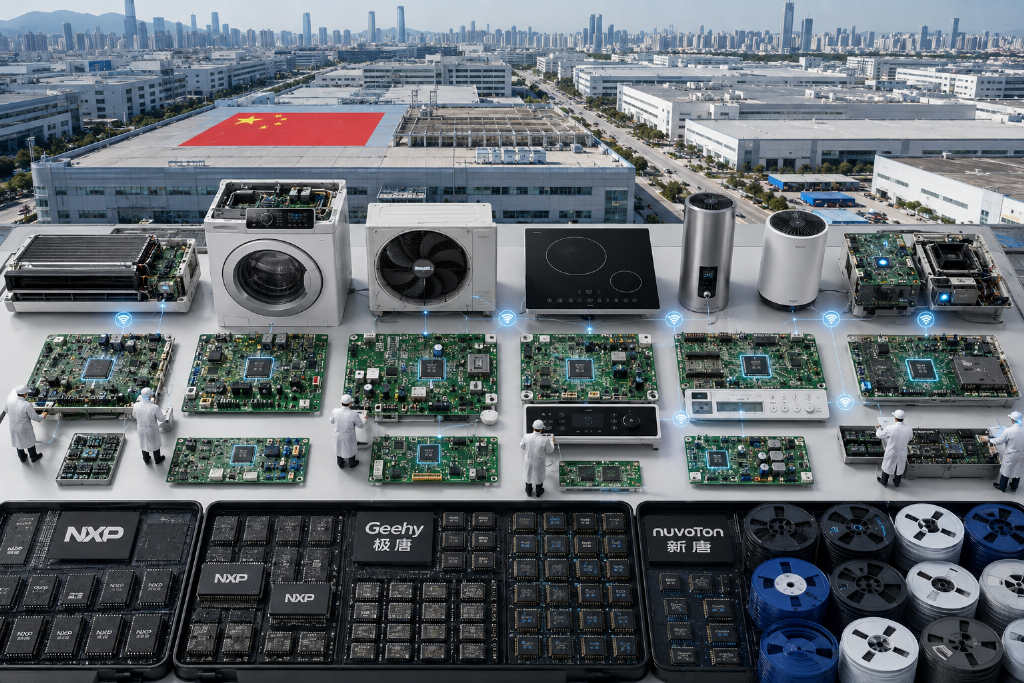
A Flood of New Products From Over a Dozen Vendors
China’s third round of nationwide consumer subsidies stretched into August, and the home-appliance business hit the gas. The MCU fight behind it did too. Chip companies have been firing off new product launches one after another.

Megawin unveiled the MG32F04A064 high-current direct-drive MCU on August 27, aimed at digital-tube displays, appliance control, and other jobs that need strong I/O drive. It uses a 48 MHz Cortex-M0+ core, 64 KB Flash, 4 KB SRAM, works from 2.0 V to 5.5 V, and includes a 12-bit ADC. The selling point is simple: it can directly drive five groups of common-cathode digital tubes with four adjustable current levels. No external transistors. No driver ICs. That trims PCB complexity and lowers BOM cost.
Geehy rolled out the G32M3122/3114/3115 series of highly integrated motor-control SoCs in August for fans, power tools, garden tools, vacuum cleaners, robots, and drone ESCs. The setup pairs a 64 MHz Cortex-M0+ core with 64 KB Flash, 8 KB SRAM, and hardware accelerators for division, multiplication, and CRC. These chips handle both sensored and sensorless FOC motor control. Depending on the model, they pack in 40 V or 200 V gate drivers and an LDO, plus a 12-bit ADC, op-amps, analog comparators, and a temperature sensor, which cuts back on external sampling and driver parts. PWM timers, general-purpose timers, and multiple watchdog protections are also built in.
LKS, a subsidiary of Jingfeng Mingyuan, launched the LKS32MC034F2LF6Q8C in August. It is a highly integrated motor-control MCU for drills, wrenches, angle grinders, vacuum cleaners, and floor washers. By folding in low-power management, back-EMF sampling, bus-voltage detection, a 12 V charge pump, and three bootstrap circuits, it removes more than 30 external components. That means lower BOM cost and an easier PCB. Two control modes are offered: sensorless square-wave and FOC, balancing high-load startup, lower noise, and smoother operation. On-chip protection covers over-voltage, under-voltage, over-current, over-temperature, phase loss, locked rotor, and MOS short-circuit conditions. Pre-driver output current can be adjusted in software.

Nuvoton introduced the KM1M4BF2X series of inverter-control MCUs on August 24, mainly for residential air conditioners and heat pumps. The company is leaning on years of appliance inverter experience here. The series is built for embedded appliance designs and for the move toward HFC-free refrigerants, supporting single-MCU dual-motor control and high-frequency PFC. It uses a Cortex-M4 core running up to 160 MHz, with four OPA/VGA groups as an option and three 12-bit high-speed ADCs. A 5 V process gives it better noise immunity in tougher inverter-control environments.
NXP expanded its entry-level MCX C1 family in August with the MCX C15 and MCX C16, going after cost-sensitive industrial, IoT, smart-lighting, simple motor-control, and energy-management uses. Based on a Cortex-M23 core with up to 64 KB Flash, and with future variants expandable to 512 KB, the parts include an 18-channel 16-bit SAR ADC, a high-speed comparator with an integrated 8-bit DAC, an internal op-amp, and a FlexPWM module for motor control. The shared MCUXpresso software platform makes it easier to move up to the higher-performance MCX A series. So the C1 is being positioned as a bridge for designs shifting from 8-bit or 16-bit to 32-bit.
Toshiba started volume production in July of entry-level M4L-group microcontrollers in its TXZ+ family for next-generation appliances, consumer electronics, and industrial equipment. The Cortex-M4 core with FPU runs at up to 80 MHz over a 2.7 V to 5.5 V supply range, so it fits both 3 V and 5 V systems. Its on-chip high-speed oscillator reaches ±1% accuracy, and an over-current detection comparator can trigger emergency motor shutdown. Flash comes in 128 KB and 256 KB options, alongside 32 KB RAM and 4 KB VE RAM.

Nations Technologies recently showed off its "Motor Control+" platform, built around the N32G033/N32M0xx and N32MD473, for power tools, appliances, servos, and robotics. The N32G033/N32M0xx uses a 64 MHz Cortex-M0 core with 64 KB Flash and 6 KB SRAM. For higher-end servo use, the N32MD473 moves up to a 240 MHz Cortex-M4F core with FPU, DSP, CORDIC, a 220 V three-phase pre-driver, high-speed ADC, PGA, and comparators.
Haisuixin released the TM52F6174 touch-enabled 8051 MCU in August for small appliances such as ovens, air fryers, induction cookers, electric kettles, and fans. It uses an enhanced 8051 core clocked up to 18.432 MHz, with 16 KB Flash and 1,536 bytes of SRAM, and it integrates LED drivers, PWM, a 12-bit ADC, I²C, UART, and a watchdog. The chip provides 26 touch input channels and supports as many as 16 touch keys with both automatic and manual calibration.
MindMotion launched the MindSPIN MM32SPIN0260 series on July 31 for quadruped-robot joint motors, air conditioners, refrigerators, washing machines, e-bikes, water pumps, and garden tools. It packs a 96 MHz Cortex-M0+ core, 128 KB Flash, 8 KB SRAM, dual 12-bit ADCs, advanced PWM timers for motor control, plus 32-bit and 16-bit general-purpose timers and an independent watchdog.

CMS Semiconductor introduced the ultra-low-power CMS32F159 series on May 28 for white goods, kitchen appliances, industrial equipment, and mobile devices. The Cortex-M0+ core runs up to 64 MHz and comes with 256 KB Flash, 32 KB SRAM, and a 1.2 Msps 12-bit ADC. DMA and an event-linkage controller are integrated. The timer block offers eight channels and supports as many as six synchronous-reset or complementary PWM outputs for BLDC and PMSM motor control.
GigaDevice said at AWE earlier this year that the GD32M531 is close to mass production. It is tuned for appliance motor control and targets air-conditioner outdoor units, air-source heat pumps, washers/dryers, dishwashers, and multi-burner induction cooktops. The Cortex-M33 core reaches 180 MHz, with a CoreMark score of 705 and 267 DMIPS. If the ramp and design-ins go well, the GD32M531 would become a major domestic high-performance 5 V motor-control MCU entering the core white-goods supply chain.
HOLTEK launched the HT32L52343/HT32L52353 ultra-low-power USB MCUs on February 6 for white goods, power monitoring, home automation, and industrial sensors. The 48 MHz Cortex-M0+ core is paired with up to 128 KB Flash, 24 KB SRAM, six-channel PDMA, and a 12-bit 1 Msps ADC. Active power consumption is about 55% lower than the previous generation. Deep-sleep current falls as low as 0.71 μA, and deep-standby current drops to 0.125 μA.

Jinghua Zhixin recently released the CB78xx 32-bit MCU family for refrigerators, air conditioners, washing machines, and various small appliances, combining touch, display, and motor control. The Cortex-M0+ core runs up to 48 MHz and includes 256 KB Flash, 32 KB SRAM, an 8 KB independent BOOT area, and a 4 KB user-data area that supports BOOT and AB dual-partition OTA upgrades. Stop-mode current can be as low as 10 μA, and the family provides up to 60 GPIOs.
Silicon Labs offers the SiWx917 for Matter over Wi-Fi applications. It supports Matter 1.4.1 and includes 8 MB of package flash, expandable to 16 MB through external flash. Wi-Fi 6 features include TWT, MU-MIMO, and OFDMA, along with WPA3 security, making it suitable for high-speed networking, OTA firmware updates, and real-time data transfer.
Market Growing Fast, 32-Bit MCUs Taking Over
Home appliances are deep in an upgrade cycle centered on intelligence and energy efficiency. New efficiency rules, whole-home smart systems, and demand for device interconnection are pushing appliance control beyond single-purpose operation and toward coordinated intelligence. That raises the bar for MCU performance. Fast.

BLDC and PMSM motors are spreading quickly, and that is accelerating the shift from 8-bit and 16-bit MCUs to 32-bit parts. Sensorless control and real-time monitoring are pushing performance requirements higher. And safety rules such as IEC/UL 60730 call for watchdog timers, ECC Flash, and clock monitoring to keep systems reliable. Wi-Fi, Bluetooth, and Matter are also pushing appliances beyond merely being controllable and into being connected.
Industry Online expects China’s home-appliance MCU market to reach 13 billion yuan in 2025, with white goods serving as a major growth engine. Low-cost products still use 8-bit and 16-bit MCUs, sure. But 32-bit chips are becoming the mainstream pick because they strike a practical balance among performance, power consumption, and cost. The fight is no longer just about price. Now it spans performance, energy efficiency, algorithms, connectivity, and security. Embedded appliance design has also moved out of the premium niche and into the mass market. Under the Montreal Protocol, China will ban the production of household refrigerators and freezers using HFC refrigerants starting in 2026, which makes HFC-free designs a fresh must-have.
Price War Reaches Extremes: $0.06 MCUs on the Shelf
Engineers across the market say 32-bit MCU price competition is getting harsher. One user told EEWorld that MindMotion’s Cortex-M0 MCU, specifically the MM32G0001A1T, has fallen to 0.5 yuan. That user argued its performance already handles simple appliance relay-control jobs, so pushing prices even lower does not accomplish much.

Other engineers pointed to PUYA’s MS32C001, priced at about 0.41 yuan including tax on e-commerce platforms. Another said the PY32F002B is being used at a similar level, around 0.4 yuan, though that comes with trade-offs in DMA and ADC functions in real products.
32-bit MCUs have dropped into a brutally low price band. In appliances where performance needs are limited but cost pressure is intense, vendors are cutting peripherals and resource allocation to squeeze out every last fraction of a yuan. Domestic MCU makers such as Huaxin Weite have already shipped meaningful volume into the appliance market. Some engineers think the continued push toward Matter connectivity and similar upgrades could trigger the next leg of growth for appliance MCUs.
This article first appeared on the WeChat public account "EEWorld" (ID: EEworldbbs) and was written by Fu Bin.