
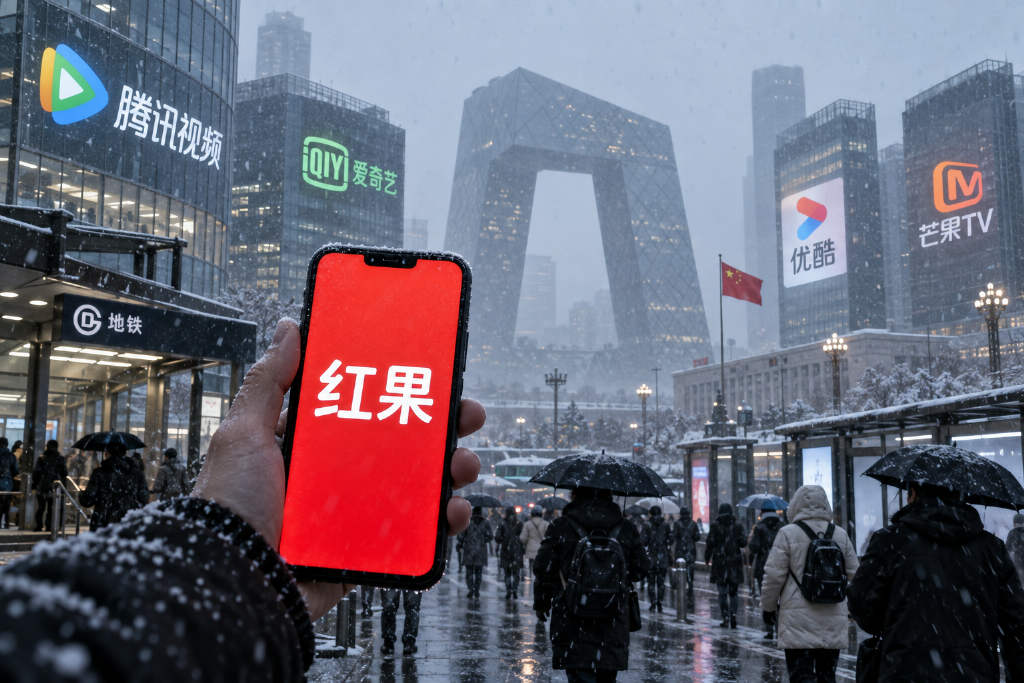
Hongguo, a short-drama app, had 168 million daily active users as of July, according to QuestMobile. That figure was more than double from a year earlier.
Set against the traditional long-form platforms, the gap is striking. Tencent Video stood at 50 million daily active users, iQIYI at 45 million, while Youku and Mango TV were each around 30 million. Together, the four platforms totaled about 155 million, below Hongguo alone.
Viewing time widened the divide
User scale was only part of the story. The article said Hongguo users now spend 125 minutes a day on average on the app, a level that surpasses the time needed to watch two TV episodes back to back.
Over the past year, monthly viewing time on iQIYI, Youku, Tencent Video, and Mango TV fell by 24% to 47%, with Youku close to being cut in half.

Spring Festival data hinted at the shift
The piece said the change was already visible from this year’s Spring Festival period. Average daily box office revenue during the holiday season fell below 1 billion yuan for the first time in six years. During the same stretch, Hongguo recorded 33.6 billion in-platform views and 1.28 billion drama-watching visits.
That contrast, in the article’s telling, showed how aggressively short-drama platforms were taking over user attention.
Free access remained the clearest advantage
The article framed free access as Hongguo’s strongest weapon. By comparison, membership fees at long-form video platforms have gone through three rounds of increases over the past five years, rising from 15 yuan a month to 45 yuan for premium “Xingzuan” tiers. Screen-casting features, it said, often require even more expensive memberships.

As users paid more while getting fewer benefits, the big long-video platforms repeatedly drew criticism over pricing and membership rights. Hongguo took the opposite route and used free access to pull in viewers at scale.
Some of the new audience did not come from long-form video
The article did not reduce Hongguo’s rise to simple user poaching. Its argument was that the app also turned some people who were not previously drama viewers into regular watchers.
Older users were presented as a major source of growth. More than half of Hongguo’s users were over 45, the article said. Users over 50 topped 40 million, meaning one out of every seven Hongguo users was an older viewer. Their daily viewing time was about two hours.

That audience, according to the piece, was never the core paying user base for long-form platforms, but it had more available time and a stronger preference for free content.
ByteDance’s internal loop strengthened both supply and distribution
The report pointed to ByteDance’s internal content chain as another driver. Fanqie Novel supplies web-fiction intellectual property, including rebirth stories, comeback plots, fantasy, and rural-life themes. Hongguo carries the shows. Douyin funnels viewers in, letting users jump straight from a clip to the full series.
In that setup, production, distribution, and conversion all sit inside one ecosystem. The article contrasted that with long-form dramas, where premium releases are limited and genre supply is narrower. Hongguo, by comparison, puts dozens of new shows online every day. Recommendation algorithms then keep viewers moving from one title to the next with little friction.

AI sharply lowered production costs and expanded output
The article also described AI as a major accelerant. In the past, making a short drama meant renting locations, building a crew, and hiring actors. AI short dramas, it said, can be produced by a handful of people working on a computer with prompts, at about one-tenth the cost of live-action productions and in just two to three weeks.
Once costs dropped, output surged. About 128,000 micro short dramas were launched across the industry in the first quarter, with AI micro short dramas accounting for more than 95%, the article said. In the first half alone, more than 220,000 native AI short dramas were newly launched on Douyin. At 100 minutes per title, a person would need 42 years of nonstop watching to finish them all once.
The piece added that some live-action crews in Hengdian had already stopped work. It also cited several AI image-licensing examples: Wang Zuxian licensed her peak-era likeness to a game company, which then released the AI-generated short film Qianying; Ng Kai Wah licensed his 20-year-old face to an AI film company; actress Qi Wei starred in an AI zombie short film.

Traffic rose, but creator economics remained weak
For all the traffic gains, the article argued that the money was not reaching creators. It said there had been reports that Hongguo would generate 15 billion yuan in revenue in 2025. ByteDance denied that figure as inaccurate, though the article also cited unnamed people saying the real number would be no lower.
Even so, one broad industry view remained unchanged: around 90% of short-drama producers were losing money. Some practitioners said revenue per 10,000 views had fallen from around 100 yuan to just 5 to 10 yuan.
Oversupply has made the competition worse. Only 1,055 titles had passed 100 million views, putting the hit rate at 0.47%. Most releases, the article said, simply went online without breaking out.

Long-form drama’s weakness did not erase short drama’s risks
The piece said the pressure on long-form drama was not just about competition from short content. It also blamed weak storytelling and repeated complaints about layered payment models. This summer, more than 10 long dramas were released, but none stood out, the article argued. It also referred to VIP and SVIP add-on charges for final episodes as a “nested charging” model criticized by viewers.
Still, it did not portray Hongguo or short drama as free of problems. If AI-generated faces become repetitive and plots keep copying each other, user fatigue could arrive quickly. The article’s closing judgment was blunt: what defeated long-form drama may not have been short drama itself, but arrogance.
The article was originally published by the WeChat public account Keji Hu, written by Hu Mei and edited by chacha.