
HTX Research said in its latest report that real-world assets and decentralized finance are entering the same next stage, with the market focus shifting from whether assets can be tokenized to whether those assets can be used in meaningful on-chain financial activity.
The report’s core argument is straightforward: the first chapter of RWA was about proving that bonds, gold, fund shares and credit products could be represented on-chain and held there. The next chapter is about whether those assets can be pledged as collateral, traded in secondary markets, used in lending, included in stablecoin reserves, and embedded into repo or structured products. HTX Research applies the same logic to DeFi. In its view, DeFi’s early phase proved that permissionless finance could function. The next phase has to prove that protocol revenue can persist, risks can be managed, and tokens can capture value.
That overlap, the report says, marks a broader shift in crypto from narrative-driven assets to cash flow-driven assets.
From tokenization proof of concept to actual financial use
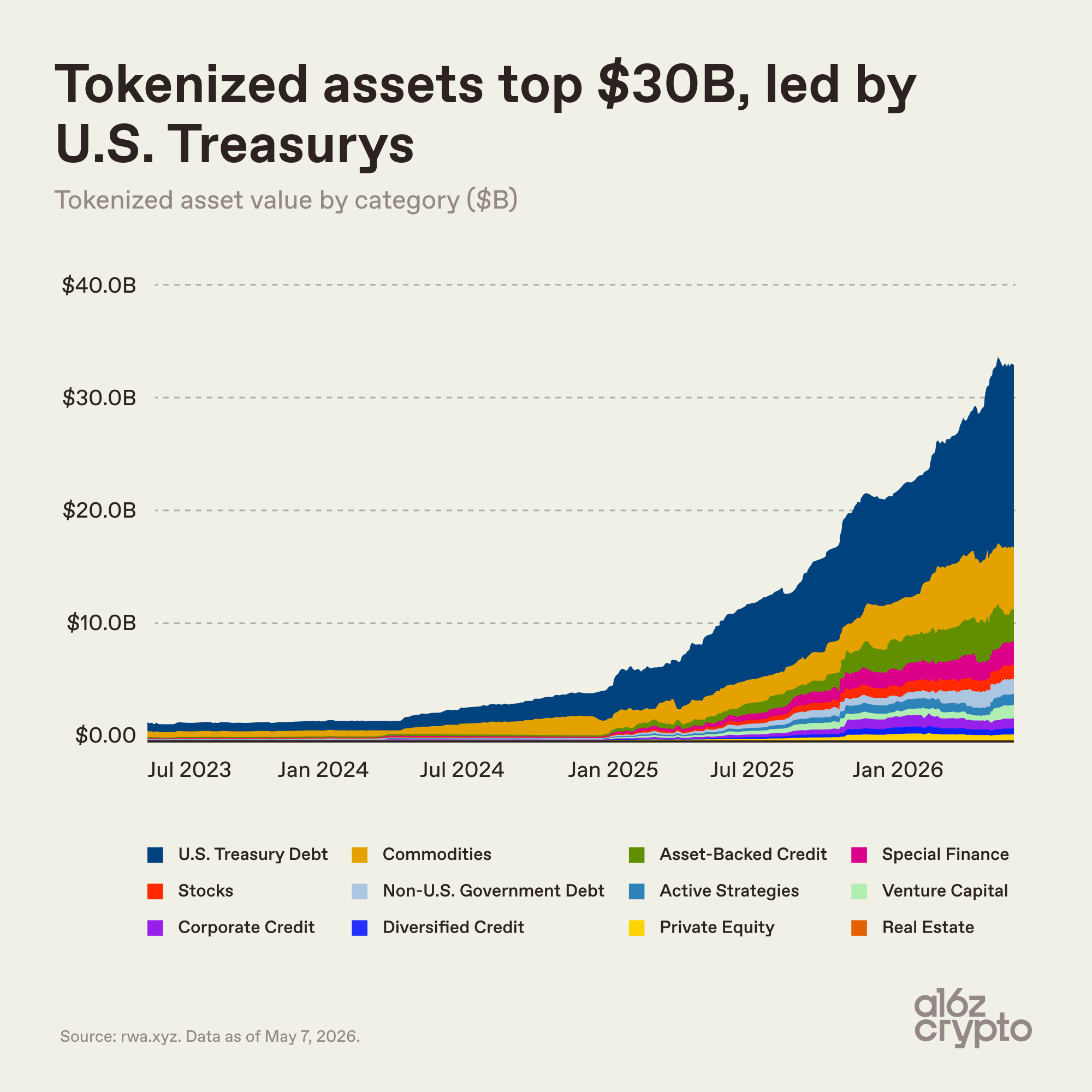
HTX Research said the RWA market has already completed its proof-of-concept phase over the past two years. By its count, the non-stablecoin tokenized asset market grew from less than $3 billion in mid-2024 to more than $30 billion in April 2026, then stabilized around $34 billion in the second quarter of 2026.
The firm said that jump matters for more than narrative reasons. It sees the expansion as evidence that traditional financial assets can now be mapped onto blockchains in a workable way, and that institutions are beginning to treat blockchain networks as viable infrastructure for issuance, settlement and asset management.
Still, the report argues that scale by itself does not mean financialization is complete. A token can represent ownership and income rights tied to a bond, gold, a fund share or a credit asset, but that does not automatically make it a financial building block that can be freely recombined, repriced, posted as collateral or integrated into DeFi protocols.
HTX Research says the market’s central question has now changed from “can assets move on-chain?” to “what can they do once they are on-chain?”
Why the market grew
The report says the rise from under $3 billion to roughly $34 billion was driven by three conditions maturing at the same time: a more compliant cash leg through stablecoins, institution-grade infrastructure, and durable product demand.
On the regulatory side, the report cites a U.S. Office of the Comptroller of the Currency document saying the GENIUS Act took effect on July 18, 2025 and established a regulatory framework for payment stablecoin activity. HTX Research describes stablecoins as the most important cash leg connecting RWA products and DeFi. Once that cash leg has clearer compliance status, institutions can more easily place on-chain capital flows inside their audit, risk-control and operational frameworks.
The second condition is infrastructure. The report says custody, KYC/AML tooling, on-chain identity, oracles, compliant transfer modules, institution-grade wallets and on-chain audit systems are moving from pilot-ready to production-ready status. That lowers the technical barrier for traditional financial firms looking to issue and manage on-chain assets.
The third condition is productization. HTX Research says institutions are moving beyond proof-of-concept experiments. Tokenized Treasuries, money market funds, gold and credit products are turning into operating product lines rather than isolated blockchain tests.
Even so, the report stresses that roughly $34 billion remains a tiny slice of the global bond, equity, gold, credit and fund markets. Its conclusion is not that RWA has already gone mainstream, but that feasibility has now been demonstrated.
The next metric is utilization, not issuance
In HTX Research’s view, the market can no longer be judged mainly by tokenized asset volume, the number of issued products or the number of on-chain holders. The next set of metrics should include utilization, turnover, collateralization, borrowing demand, real yield, default handling, secondary-market depth and protocol revenue.
The report draws a distinction between a tokenized Treasury that sits inside a whitelisted wallet as a yield certificate and one that can be used for collateralized borrowing, repo, stablecoin reserves, DAO treasury management or derivatives margin. Only the second case, it says, represents true entry into the on-chain financial system.
That changes the competitive axis for the sector. The question is no longer who can issue more assets, but who can make assets circulate, combine and be priced on-chain.
Asset classes are splitting into layers
HTX Research says the RWA market is already showing clear segmentation.
The first layer is Treasuries and gold. These are now the largest tokenized asset categories and also the easiest to bring on-chain. The report says U.S. Treasuries are highly standardized, offer stable yields, have transparent pricing and meet clear investor demand. For crypto investors, tokenized Treasuries turn idle stablecoins into money-market-like yield instruments. For institutions, they offer faster settlement, more flexible collateral movement and a cleaner link to digital asset markets. HTX Research says tokenized U.S. Treasuries have been one of the main drivers of recent RWA growth.
Gold, the report says, is also a natural fit for tokenization because it is globally standardized, easy to custody and transparently priced, while traditional finance already has non-physical ownership formats such as paper gold, gold ETFs and gold certificates. Public data, it notes, shows that tokenized commodities are overwhelmingly dominated by gold.
The second layer includes private credit, reinsurance, Bitcoin mining notes and lending-vault tokens that are more closely aligned with native on-chain demand. These products may be smaller in size, but they are designed around collateralization, tranche structures, yield distribution, protocol integration and risk transfer from the beginning. HTX Research says the speed at which asset-backed credit and specialized financial products reached the $1 billion level reflects demand for these structures inside crypto-native markets.
The third layer includes VC funds, actively managed strategies, private fund shares and some equity-like assets. HTX Research says these products are compelling in theory but harder to execute because of legal relationships, valuation mechanisms, investor suitability rules, lockups, disclosure requirements, redemption structures, tax treatment and cross-border compliance constraints.
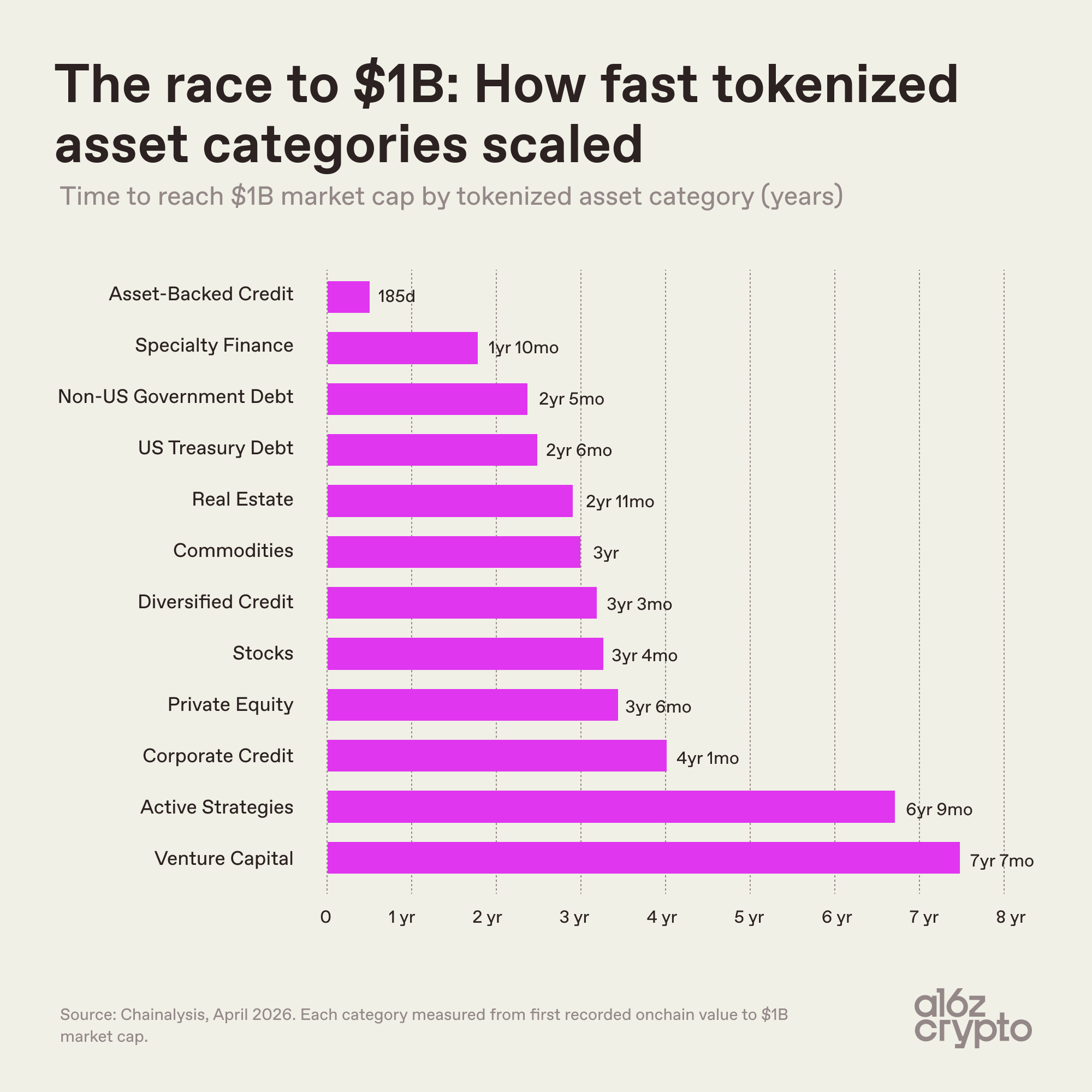
Its conclusion is that RWA is not one homogeneous sector. It is a collection of asset structures, legal structures and financial use cases. In the report’s framing, tokenized Treasuries and gold are closer to digitization, while products such as private credit, reinsurance and on-chain loan shares are closer to actual on-chain financialization.
The utilization paradox
The report says the market currently shows a clear size-activity inversion. The largest asset classes often have the lowest DeFi utilization, while smaller products designed for on-chain use are more likely to end up inside DeFi protocols.
It points to public data showing that tokenized bonds are among the biggest asset classes in the market, yet only about 5% of supply is deployed in DeFi. Reinsurance tokens are much smaller, but a higher share is deployed into DeFi protocols.
That gap matters because tokenization and financial use are not the same thing. HTX Research says many Treasury and gold products are still essentially on-chain receipts. The underlying assets remain managed by traditional custodians, fund managers, transfer agents, compliance service providers and banking systems, while the token mainly serves as a more efficient registration and transfer interface. Those products can improve holding and settlement, but they do not automatically support open transfers, permissionless collateralization, cross-protocol composability or automated liquidation.
The report lists four main reasons for low utilization: transfer restrictions tied to KYC, suitability checks and whitelisting; redemption and NAV cycles that do not match the 24/7 operation of DeFi; immature pricing and risk models for assets without continuous secondary markets; and the fact that legal enforcement and default resolution still happen off-chain.
For that reason, HTX Research says the next stage of RWA is not about putting more assets on display on-chain. It is about making more assets safe to use in on-chain finance through compliant asset standards, permissioned DeFi pools, on-chain identity, verifiable reserves, better oracles, off-chain legal enforcement and workable on-chain liquidation processes.
RWA will not settle on one chain
The report also argues that no single blockchain is likely to dominate the RWA market outright. Ethereum remains the most important base layer because of its DeFi ecosystem, security profile, institutional familiarity and smart contract lead. But BNB Chain, Solana, Stellar, Liquid Network, XRP Ledger, ZKsync Era and Arbitrum have all carved out positions of their own.
HTX Research says public data shows Ethereum accounts for roughly half of the tokenized asset market, while other chains are gaining share in Treasuries, payments, gold, cross-border settlement and lower-cost trading.
The report suggests different chains will attract different assets based on cost, compliance needs, liquidity, ecosystem alignment and issuer distribution. Ethereum is presented as a fit for high-value assets that need strong security and DeFi composability. Stellar and XRP Ledger skew toward payments, cross-border settlement and institutional networks. Solana is positioned as a better fit for high-throughput, lower-cost, trading-oriented assets. ZKsync and Arbitrum, in the report’s view, offer differentiated room around privacy, scalability, compliance proofs and EVM connectivity.
But a multi-chain world creates a harder problem for compliant assets. HTX Research says cross-chain movement for regulated assets is more difficult than bridging ordinary crypto tokens because it also involves investor identity, jurisdictional limits, transfer eligibility, sanctions screening, reserve status and legal-right synchronization. The competitive focus for infrastructure, it says, will shift from issuing assets to making compliant assets move across chains, protocols and use cases.
DeFi valuation is shifting from TVL to profit logic
On the DeFi side, HTX Research says the market’s valuation framework has to evolve as protocols accumulate real users, real transactions and real fees. Metrics such as TVL, trading volume, FDV/TVL and FDV/Revenue capture scale, but they do not necessarily capture profitability or value accrual.
The report proposes a more mature framework that places digital assets along a spectrum between commodities and financial claims. Assets like Bitcoin are driven mainly by scarcity, liquidity, security, monetary premium and adoption, and do not promise future cash flows. Some DeFi protocol tokens are different. Those can be analyzed through revenue, profit, fee distribution, treasury assets, governance structures and the path by which value reaches the token.
HTX Research uses Aave as a representative example. It says Aave has real borrowing demand, real interest income, observable fee structures and an evolving capital-allocation system. The report notes that DeFiLlama breaks down Aave’s fee and revenue streams, with Aave V3 deriving fees from borrowing interest, flash loan fees, liquidation fees, Paraswap swap fees and Chainlink SVR.
Even here, the report says, traditional finance models cannot simply be mapped over. Governance tokens are not the same as equities, and protocol revenue does not automatically belong to token holders.
The real test is the transmission chain
HTX Research says the key mistake in DeFi cash flow analysis is assuming that once a protocol generates revenue, its token should be valued on a conventional P/E or DCF basis. The deeper question is whether the transmission chain from protocol activity to token value is complete.
The report breaks that chain into six parts: whether demand is genuine rather than subsidy-driven; whether the protocol can retain revenue after paying liquidity providers, validators, market makers or outside service providers; whether revenue covers risk costs such as bad debt, failed liquidations, oracle problems and security-module expenses; whether the DAO can allocate capital effectively; whether the token has a clear value-capture mechanism such as buybacks, burns, staking yield or fee rebates; and whether regulators recognize that path of value transmission.
In short, the report says DeFi valuation depends less on headline revenue and more on whether a full chain exists linking real demand, retained income, risk deduction, governance allocation, token capture and legal interpretability.
Aave as an on-chain banking case study
HTX Research describes Aave as one of the clearest examples of an “on-chain bank” in functional terms. It says depositors supply liquidity, borrowers post collateral to borrow assets, and the protocol earns cash flow through spreads, liquidation fees, flash loan fees, partnership revenue, treasury yield and revenue tied to the GHO stablecoin.
The report adds that Aave is not a bank in the traditional sense because it does not run a centralized balance sheet or carry out maturity transformation. But economically, it does provide on-chain money-market and collateralized-lending infrastructure.
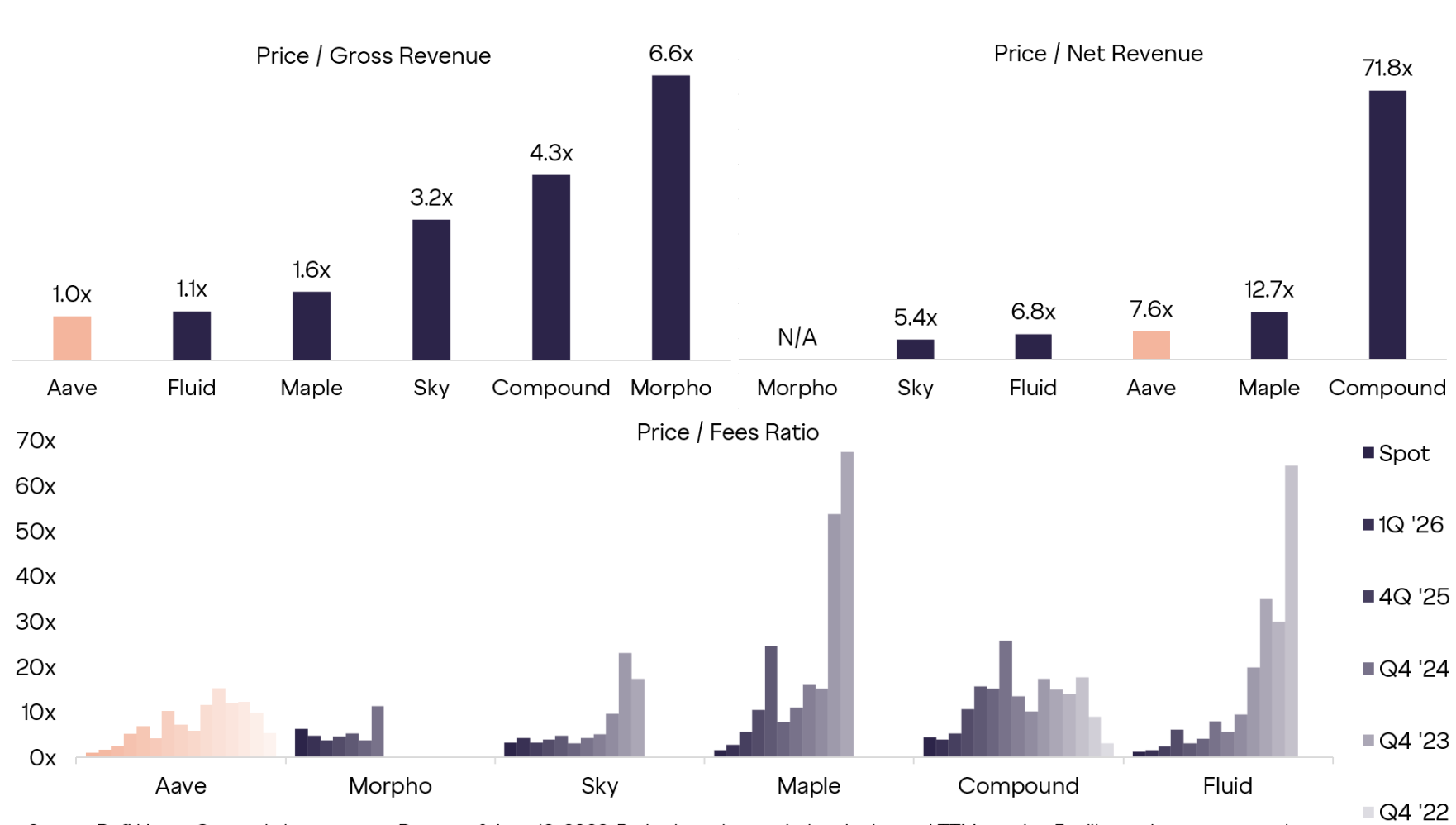
Aave also matters here because it sits at the intersection of RWA and DeFi. Stablecoins such as USDC, USDT and GHO form a critical cash leg for its lending markets. At the same time, the development of institutional markets and permissioned pools could allow protocols like Aave to absorb compliant collateral-financing demand. If tokenized Treasuries, fund shares, private credit and other compliant assets can be safely admitted to permissioned markets, HTX Research says, they stop being static wallet receipts and start becoming base assets for on-chain credit expansion.
The report also makes a cautionary point: protocol revenue does not automatically translate into token value. Whether value reaches governance tokens depends on how revenue enters the DAO treasury, how the DAO allocates it across buybacks, incentives, insurance, security and product investment, whether token holders can reliably capture that value through governance, and whether regulators accept that structure.
HTX Research says the key variable is not revenue alone but the conversion rate from protocol economic activity to token-holder value. Common mechanisms include burns, buybacks, rebates and staking yield, but they differ sharply in directness, sustainability, regulatory exposure and market effect.
Stablecoins, RWA and DeFi as a three-layer system
The report says the overlap between RWA and DeFi starts with stablecoins. Stablecoins are not only quote units for trading. They also act as on-chain cash, collateral, a settlement layer and a distribution medium for yield.
Without stablecoins, HTX Research says, tokenized Treasuries would struggle to attract on-chain capital, DeFi lending would struggle to sustain loan demand, and cross-border payments, institutional settlement and secondary markets for RWA would lack a shared cash leg.
The firm lays out a three-layer structure for the long run. The first layer is compliant stablecoins and on-chain cash management for payments and settlement. The second is tokenized Treasuries, money market funds, private credit, gold and securitized assets for yield and collateral. The third is protocols such as Aave, Maple, Sky, Pendle, Uniswap and Hyperliquid for lending, trading, rates, risk and leverage.
According to the report, the closer these three layers become, the closer on-chain finance comes to functioning like a real capital market. Stablecoins solve the money problem, RWA solves the asset problem, and DeFi solves the financial-function problem.
Risk rises with integration
HTX Research also argues that combining RWA and DeFi does not simply improve efficiency. It also stacks traditional financial risk, smart contract risk, market-liquidity risk and regulatory risk on top of one another.
The report identifies five broad risk categories: authenticity and reserve risk around whether the represented assets really exist and are properly custodied and audited; liquidity mismatch risk when weekday-only or periodic-redemption assets interact with 24/7 leveraged DeFi markets; compliance-composability risk because RWA often requires whitelists, KYC, suitability checks and jurisdiction limits; DAO governance and value-transmission risk tied to capital allocation choices; and oracle and pricing risk because RWA prices may come from NAVs, exchange quotes, broker quotes, model valuations or manual disclosures with different update cycles and manipulation risks.
Its conclusion is that RWA entering DeFi should not be reduced to a simple story about releasing liquidity. Large-scale deployment will require conservative risk parameters, tiered market structures, permissioned pools, compliant secondary markets, transparent reserve proofs, stress testing and clear default-resolution rules.
How HTX ties the theme to product design
The report closes by linking the industry shift to HTX’s product lineup. HTX Research says the growth of RWA and DeFi does not only create a new asset narrative. It also pushes trading platforms to expand from simple execution venues into entry points for asset allocation, yield management, on-chain participation and risk segmentation.
According to the report, HTX Earn has already taken on the role of a consolidated yield entry point. In an upgrade notice for the product, HTX reorganized it into five sections: Overview, Simple Earn, New Listings, Structured Products and On-chain Earn. The report says that structure effectively separates user demand into account-level yield overview, base yield products, new-asset participation, structured yield and on-chain yield.
Simple Earn, the report says, covers the base wealth-management layer. HTX documentation describes it as including flexible and fixed-term products so users can choose according to liquidity needs. In the context of growing stablecoin and RWA use, HTX Research sees that as a cash-management and low-volatility yield entry point for mainstream assets and stablecoins.
Structured Products covers the structured-yield layer. HTX product materials show that this section combines products such as Dual Investment and Shark Fin to offer broader risk-return combinations. HTX Research says the significance lies in moving users beyond simple coin-holding yield into frameworks based on target prices, maturities, volatility and structured returns.
On-chain Earn covers the on-chain yield layer. The product integrates native blockchain yield services including ETH 2.0 node staking, according to the report. HTX Research says that matches a core trend in DeFi’s next phase: users do not always want to interact directly with complex protocols, but they do want a clearer and more standardized way to access on-chain returns.
The report also points to HTX’s margin-based coin exchange product as the collateral-financing and capital-efficiency layer. HTX says verified users can pledge designated assets in their accounts to exchange into other digital assets, with the borrowed asset credited in a short period of time. The product supports flexible terms as well as 7-day, 30-day, 45-day and 90-day tenors, and supports multiple collateral assets. HTX Research frames that product as a way for users to improve capital efficiency without directly selling core holdings, a direction it links to the financialization of collateral in both DeFi and RWA markets.
From that perspective, the report says HTX has already built a broader product matrix around Earn, Simple Earn, Structured Products, On-chain Earn and margin-based coin exchange. It maps those products to four layers of demand: cash management, structured return management, on-chain yield access and collateral efficiency.
The report’s final line sums up its broader thesis: the next phase of RWA is about use, the next phase of DeFi is about cash flow, and the productization capabilities of trading platforms are the link that turns institutional narratives into financial products ordinary users can actually access.