


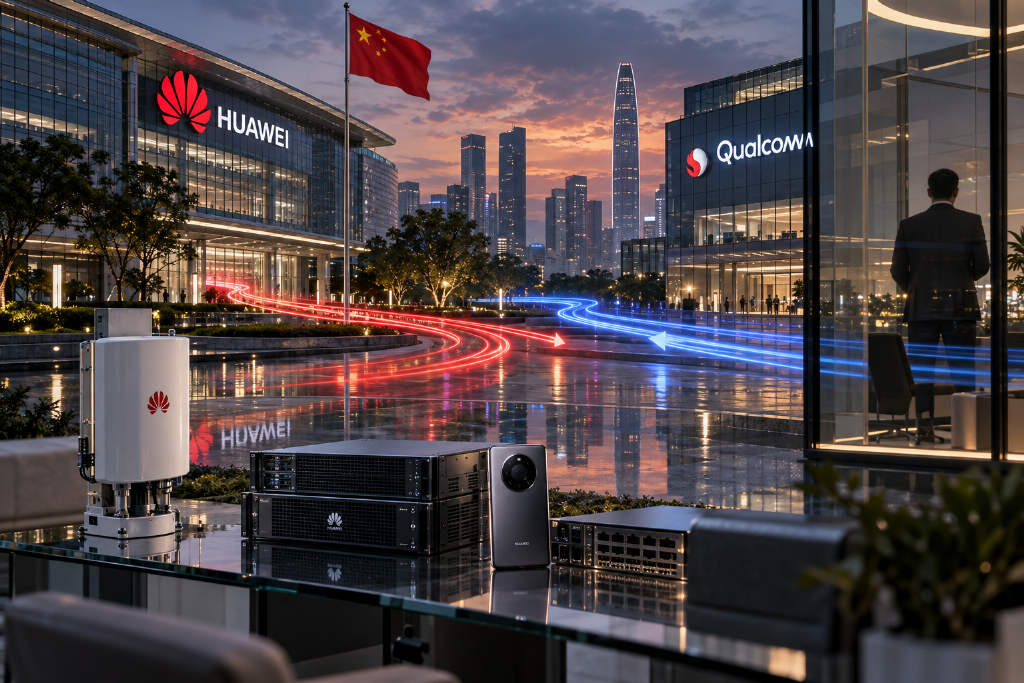
Qualcomm shares rose more than 4% in premarket trading on Oct. 5, the same day Huawei announced a broad, multi-year patent licensing agreement with the U.S. chip company. The agreement covers cross-licensing of patent portfolios in 5G, computing, artificial intelligence and networking. Qualcomm will also acquire some of Huawei’s U.S. patents in computing, AI and networking.
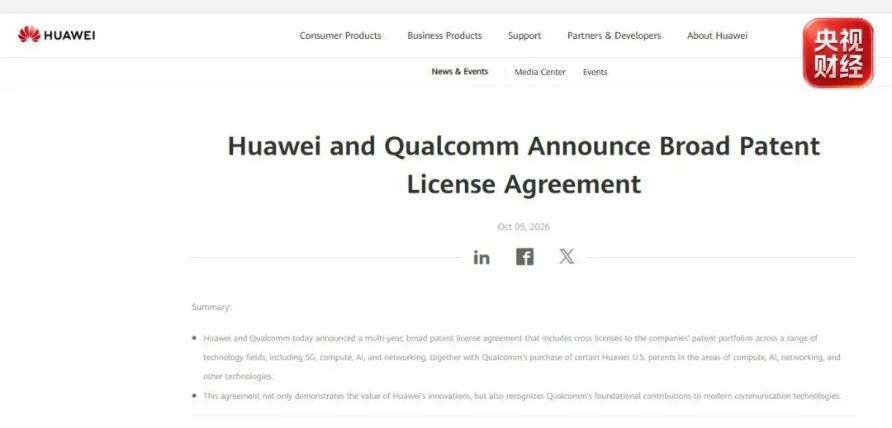
Set against a longer timeline, the deal marks a notable turn in a relationship that began with Huawei paying patent licensing fees to Qualcomm in 2001.
A 25-year reversal in licensing flows
From paying royalties to collecting them
The timeline laid out in the source runs through several milestones. In 2001, Huawei paid Qualcomm patent licensing fees for the first time and continued to do so for years, while also fighting several rounds of cross-border patent disputes. In 2011, Huawei received patent licensing income from Motorola for the first time. In May 2019, Huawei was added to the U.S. Entity List, cutting it off from advanced foundry capacity and EDA tools. In 2021, Huawei’s intellectual property licensing business posted positive income for the first time.
In April 2026, a report from the China Academy of Information and Communications Technology said Huawei ranked first globally in valid 5G patent families with an 11.7% share, while Qualcomm ranked second with 8.05%. In May 2026, Huawei introduced what the article calls the “Tao Law.” In September 2026, the Kirin 9050 Pro launched with the Mate XT2. Later that month, the eighth round of China-U.S. trade talks produced what the article described as reciprocal tariff cuts of “30 billion to 30 billion.” Then, on Oct. 5, 2026, the two companies signed the agreement.
After public debate intensified, Qualcomm said on Oct. 6, 2026 that it was not a “net payer” and denied that the transaction involved logic folding. The article says the dispute over wording continues, but argues that the timeline itself shows the direction of the relationship has changed.
More than 680 patents, about 0.23% of Huawei’s total
The structure of the deal has two main parts. One is cross-licensing of patent portfolios in 5G, computing, AI and networking. The other is Qualcomm’s purchase of some of Huawei’s U.S. patents in computing, AI and networking, while Huawei retains patent rights for those technologies in other regions.
According to China Central Television Finance, Qualcomm will pay to use more than 680 Huawei patents, some of them registered in the United States. The article says Huawei has about 296,000 valid or pending patents, which would put the 680-plus patents at roughly 0.23% of the total. After the transaction, cumulative revenue from all of Huawei’s patent licensing agreements is expected to exceed $6.9 billion. The article stresses that this figure refers to the cumulative total across all agreements, not the price of this specific deal, which neither side disclosed.
Qualcomm’s own time pressure
The article says Qualcomm is under pressure on two fronts. On one side, Apple’s in-house modem effort is advancing, threatening a key source of licensing income. On the other, Samsung’s 2 nm process had only just pushed yield above 60% in the first quarter of 2026, still below Qualcomm’s 70% threshold for placing orders. In that reading, Qualcomm’s purchase of Huawei patents is tied to its positioning in the post-Moore era, including areas such as logic folding and near-packaged optics.
The piece frames the deal not as a favor from one side to the other, but as a transaction both companies had reasons to make on their own schedules.
Huawei’s shift to a different coordinate system
Restrictions after 2019 and a change in direction
The article treats the period after May 2019 as a turning point for Huawei. With access to extreme ultraviolet lithography blocked, the traditional path of geometric scaling ran into a wall at the 5 nm stage. Looking back, the piece argues that those years pushed Huawei toward a different technical route rather than waiting for lithography tools alone to solve the problem.
Two different paths for Chinese self-developed chips
The article describes the past two years as a breakout period for Chinese in-house chip efforts, but says the breakout has taken very different forms.
One path is Huawei’s. In May 2026, He Tingbo, president of Huawei’s semiconductor business unit, presented the “Tao Law,” replacing “geometric scaling” with what the article calls “time scaling.” The idea is to shorten signal travel rather than simply shrink transistors. The article says more than 80% of the energy in chip modules is spent moving data rather than computing. Logic folding stacks circuits vertically so signals can travel shorter distances. Based on the figures cited in the piece, transistor density rises 55% on the same process, while power consumption in NPU, GPU and CPU performance cores falls 66%, 58% and 41%, respectively.
The first commercial product using that approach, the Kirin 9050 Pro, launched in September 2026 with the Mate XT2, and the article says overall device performance improved 31% from the previous generation. In media exchanges, Richard Yu said the chip’s Balong baseband, ISP, mobile security processor, Lingxi CPU, Maliang GPU and the Da Vinci architecture-based NPU for AI workloads were all self-developed designs. The article also says, citing market chatter, that first-sale volume for the later Mate 90 series exceeded 270,000 units, with the “Ultra” version carrying the 9050 Pro accounting for about 40%.
The other path in the article is Xiaomi’s. It says Xiaomi launched the Xuanjie O1 in May 2025 after cumulative investment of more than 13.5 billion yuan and a team of more than 2,500 people. The chip uses TSMC’s second-generation 4 nm process, and its benchmark scores matched flagship Snapdragon chips of the same period. The article calls it one of the most serious in-house efforts in the history of China’s consumer electronics industry.
Still, the piece draws a sharp distinction between the two routes. It says the Xuanjie O1 uses a CPU based on an ARM architecture license, an ARM reference GPU and TSMC manufacturing. By contrast, it says the Kirin 9050 Pro’s CPU, GPU, baseband and NPU no longer rely on outside blueprints. The article adds that more than a year after launch, only a limited number of devices had adopted the Xuanjie O1, making it harder to amortize the large R&D bill. It also argues that chip companies without standard-essential patents remain in a weaker bargaining position. In that framing, Qualcomm is not paying Huawei for benchmark scores, but for the small share of Huawei’s 296,000 patents that others cannot easily work around.
Richard Yu’s public comments on the route
At an international media roundtable on Sept. 29, Richard Yu said Huawei had “basically shaken off dependence on U.S. technology” through self-developed chips, the Harmony operating system and domestic supply chains. He also said China is developing EUV capability but still relies on DUV at this stage, and described logic folding as a way to improve capability when access to certain technologies is restricted.
The article reads those remarks as a public confirmation of Huawei’s route: keep pursuing lithography-related progress, but do not wait for a single path to open. It says Huawei’s cumulative R&D spending from 2007 through the end of 2025 exceeded 1.8 trillion yuan.
Yu also said Huawei only resumed domestic production of smartphone chips in 2023, after several years focused on survival under difficult conditions. On Harmony, he said Huawei launched the system in 2019, later than Android, though Huawei had long been one of the biggest contributors to the Android community. He cited the failures of Microsoft Windows Phone, Samsung bada and Nokia Symbian, then said, “Although we started later, we succeeded.” Devices running HarmonyOS 6 and HarmonyOS 7 now exceed 90 million, the total is expected to top 100 million by year-end, the ecosystem has more than 450,000 apps and services, and registered developers worldwide number 11 million.
He also acknowledged cost and capacity pressure. Over the past two years, prices for memory components surged, adding more than $200 in hardware cost per phone. Huawei absorbed as much of that as it could and raised prices more slowly than peers, but profit margins still fell sharply. The bigger bottleneck is capacity. Domestic advanced semiconductor capacity cannot yet meet fast-growing demand, and Ascend AI chips share the same production line as smartphone chips. The article links that to Eric Xu’s comment that “the bottleneck is not demand, but capacity.” It also says Huawei’s overseas annual handset sales have fallen to only a few million units from its 2019 peak as the global leader.
In the same week, Xiaomi announced on Oct. 7 that HyperOS 4 would be “fully compatible with the Apple ecosystem,” with two-way message sync, shared cloud photo albums and even AirDrop support on new flagship devices. The article uses that move as a contrast, saying one company is selling compatibility while the other is trying to build an ecosystem that others would need to adapt to. The figures cited for Harmony are 450,000 apps and services and 11 million developers.
From single chips to system-level competition
Dependence and reduced dependence in computing power
The article says the same contrast appears in electric vehicles. Xiaomi’s SU7 is described as a hit product, but its intelligent driving compute comes from Nvidia Orin and its cockpit chip from Qualcomm’s 8295. The piece presents that as the same logic seen in the smartphone business: integrate the best global parts into a strong product. It says that route can produce results quickly.
Huawei, in the article’s telling, is taking another route. At Huawei Connect in September, Eric Xu said Ascend’s share in the Chinese market had surpassed Nvidia’s, that the 950DT supernode would enter volume supply by year-end, and that the 950PR had already launched in the first half. He repeated that the bottleneck is capacity rather than demand. He also responded to calls from “U.S. peers” to slow AI development, saying Chinese models are weaker and therefore need to move faster, not slower.
The unit of AI competition is moving upward
The article argues that the more important point is not the market-share number itself, but how that share is being won. In AI, the basic unit of competition is shifting upward from a single chip. When thousands or tens of thousands of accelerators train and run inference together, what matters is not the peak performance printed on one chip’s spec sheet, but the effective compute the whole system can sustain. Interconnects, scheduling, fault tolerance, power delivery and cooling start to matter more.
In that context, the article lists assets Huawei holds: the Lingqu bus, all-optical interconnects, near-packaged optics, supernode architecture, and three decades of systems engineering across communications, storage, data centers and digital energy. At Huawei Connect 2026, the company explicitly pointed strategy toward “supernodes + clusters.” The article says Huawei is betting on changing the contest from “whose chip is stronger” to “who can organize more chips into an efficient whole.”
It then points to two late-September developments moving in opposite directions but toward the same conclusion. DeepSeek worked with Huawei to develop and open-source a series of low-level software tools for Ascend, turning a model company from an infrastructure user into a co-builder. Around the same time, AMD agreed to acquire Fei-Fei Li’s World Labs for about $8.2 billion, pushing a chip company upward into model research. The article says the distance between models and compute infrastructure is shrinking, and the old linear chain of “chips, servers, cloud, models, applications” is becoming a feedback system.
The piece also says systems are not a cure-all. Nvidia’s deepest moat is not the GPU alone, but the two decades of CUDA libraries, toolchains, talent and code assets built around it. That kind of path dependence is hard to replicate quickly. Huawei’s own CANN stack is still moving from “usable” to “easy to use.” And a shortage of advanced manufacturing capacity cannot be solved by system architecture alone. In the article’s wording, systems act more like a multiplier: chips, interconnects and software provide the base capability, while systems engineering determines how much of that capability can actually be released. It also notes that rivals are moving in the same direction, so system competition is not unique to Huawei.
What the agreement is taken to mean
The article closes by saying there are two real paths: building products by integrating other companies’ chips, and building chips by defining one’s own architecture. In its view, only the second path leads to the head of the table. The Oct. 5 agreement is presented as the first time that seat was confirmed by an act of payment.
From 2001 to 2026, over 25 years, the direction of a bill has reversed. The article treats that reversal as the record of one company moving from buying technology to selling it, and as a dividing line between two Chinese chip paths: one that pushes to the front of the old map, and one that tries to draw a new map where no road existed.
It also ties the deal to a broader change in AI. Data from the International Energy Agency, as cited in the article, show that capital expenditure by five large technology companies exceeded $400 billion in 2025 and is expected to rise by about 75% in 2026, while frontier data center capacity has more than tripled over the past 18 months. Models iterate in months, chips in years, and data centers and power grids over a decade. In that structure, the article argues, whoever controls the definition of the lower layers is no longer just a passenger on someone else’s timetable.
Yu’s wording was “basically shaken off,” not completely. The extra $200-plus in cost per device, tight capacity shared with Ascend, and overseas sales that have fallen from the top spot to only a few million units a year all remain part of the picture. The article ends by saying the road has only just been drawn and not many are on it yet, but ownership of the map is changing.
This article was originally published by the WeChat public account “师天浩观察” (ID: shitianhao01) and written by Chen Cong.