
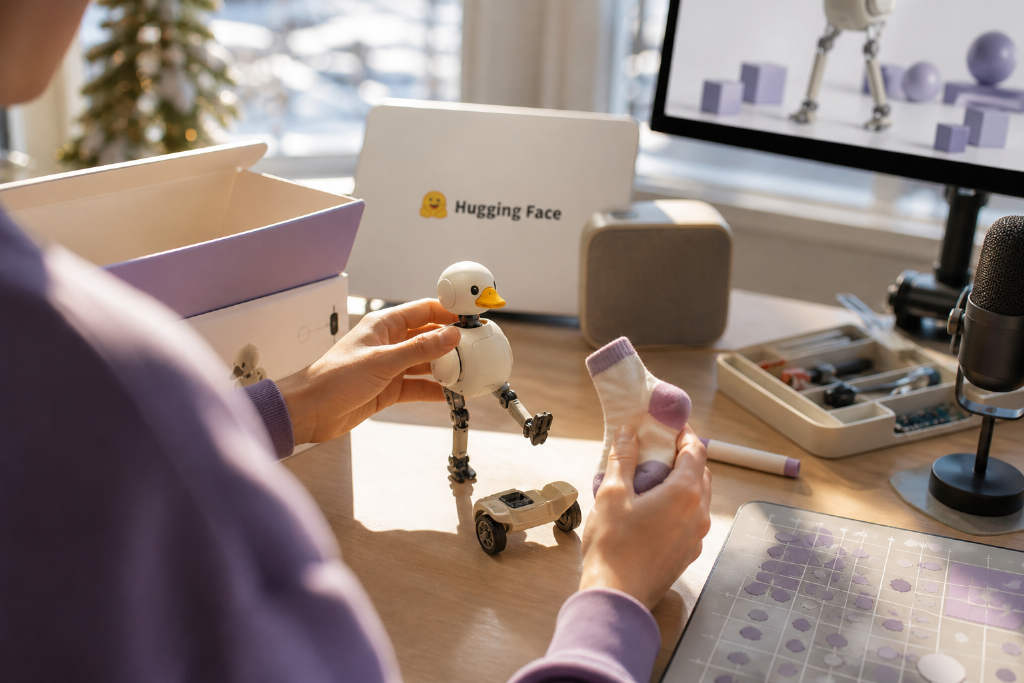
Pollen Robotics, owned by Hugging Face, opened preorders for Microduck on Aug. 27, introducing a $399 biped robot duck built around reinforcement learning and low-cost embodied AI development.

Microduck stands 25 centimeters tall, weighs under 800 grams, comes in white, graphite, lavender, and sky blue, and is scheduled to ship before Christmas. It can walk, squat and stand back up, recover after being pushed over, and use detachable roller bases for a skating mode. Its hinged beak can pick up small objects such as socks or markers. The company’s framing is explicit: treat it like a living creature, not an assistant. It has no voice interaction and does not speak, though it includes a microphone and speaker, and each unit generates its own distinct "voice identity" during setup.
A consumer-friendly robot built around movement
The box includes the robot, one battery, a USB-C cable, and a game controller. Once charged and paired, the duck is ready to use.
Microduck ships with seven preinstalled behavior policies. According to the report, each is an independent action model trained with reinforcement learning. Using the controller stick makes the robot walk forward with a waddling but stable gait. Releasing the stick stops it in place. Button inputs trigger actions such as squatting, standing, and kicking a ball. Its ability to get back up after being knocked over appears to be one of the most attention-grabbing motions.

The beak is part of the control system as well. A move called "Grab" lets the robot lower its head, open its beak, pick up a small object from the floor, and lift it while walking. The accessory pack also includes a ball to kick, a laser pointer for camera tracking, and NFC tags. Users can assign behaviors to those tags, place them on a desk, and have the duck trigger actions when it scans them.
The report says the unboxing philosophy is closer to Nintendo than Boston Dynamics. A buyer does not need to know how to code to start using it. If they do have technical skills, the system opens up much further. Every factory behavior can be retrained, and entirely new behaviors can be created from scratch and deployed back to the physical robot.
Hugging Face says the duck form was chosen because the robot’s proportions and waddling gait already resemble a duck. The four colors are meant to make a group feel like different characters rather than identical machines. The package also includes stickers for cosmetic customization, and multiple ducks can play soccer together.
From Open Duck Mini to a commercial product
Microduck did not emerge in isolation. It grew out of Open Duck Mini, an open-source project started by Pollen Robotics engineer Antoine Pirrone.

The idea was inspired by the BDX robot featured in Disney’s Galactic Starcruiser experience. Pirrone set out to recreate that kind of expressive biped character with 3D printing and inexpensive servos. The report says the bill of materials was around $400, assuming the builder already had access to a printer and soldering equipment.
Open Duck Mini collected more than 2,600 stars on GitHub. In June this year, two Open Duck Mini robots appeared on stage at Google I/O, running Google’s Gemma 4 model locally on Raspberry Pi 5 and Jetson Orin Nano hardware for on-device voice inference without the cloud. That demo, according to the report, was a moment when many people realized that a language model of decent quality could already run locally on hardware costing only a few hundred dollars.
Microduck takes a different route. Open Duck Mini drew the most attention when it used small models to "talk" on-device. Microduck’s main selling point is control: strategy models that make a robot act. Its seven preloaded behaviors are reinforcement learning policies trained in the MuJoCo physics simulator and then deployed to the hardware, where they run at 50 Hz.
Seen that way, Pollen turned a community project into a commercial, mass-produced product without changing the underlying idea. The aim remains to give more people a physical platform for reinforcement learning and sim-to-real work.

Open-source software, closed hardware
Pollen says the Microduck software stack is fully open source under the Apache 2.0 license. That includes the SDK, the MuJoCo simulation environment, and the full reinforcement learning training pipeline. The seven factory behavior policies are also public, so users can fork them, modify them, retrain them, and redeploy them to the robot. The company also encourages users to publish newly trained behaviors to the community so other ducks can learn them.
Hugging Face CEO Clem Delangue promoted the launch on X with a simple line: "A $399 open-source robot that you can teach new tricks with reinforcement learning."
Even so, the term "open-source robot" comes with limits. Pollen Robotics has said clearly that the hardware design and circuit schematics will not be open source. Users can inspect, change, and retrain the software brain that makes the duck move, but they cannot access the design files for the body itself.
That leaves Microduck with a split structure: an open software layer and a closed hardware shell. For open-source purists, that is an obvious compromise. From a commercial standpoint, the logic is easy to follow. Hardware remains Pollen’s moat, while open software is used to build an ecosystem. The report argues that this is exactly where Hugging Face has been strongest for years. Open model weights helped turn Hugging Face Hub into an AI counterpart to GitHub, and now the company wants to extend the same logic to robot behavior policies.

Where it fits in Hugging Face’s embodied AI push
Microduck becomes easier to understand in the context of Hugging Face’s broader robotics effort over the past two years.
In early 2024, Hugging Face hired Remi Cadene away from Tesla as chief research scientist to lead a new open-source robotics project. A few months later, LeRobot was released. The report describes it as an end-to-end open-source toolkit for robot learning, positioned as "Transformers for robotics," with dataset hosting, model training, and physical simulation under one roof.
In April 2025, Hugging Face acquired Pollen Robotics, based in Bordeaux, France, and brought roughly 20 employees into the team. Pollen’s flagship product, Reachy 2, is a research-grade humanoid robot priced at about $70,000 and already deployed at top universities including Cornell and Carnegie Mellon. That price point, however, keeps it in a narrow market.
Three months after the acquisition, in July 2025, Reachy Mini was released. It is a 28-centimeter desktop robot starting at $399 and focused on conversational interaction, facial animation, and visual recognition. At CES in January this year, Nvidia CEO Jensen Huang used DGX Spark with Reachy Mini during his keynote and called it "your own office R2-D2." Pollen said Reachy Mini has shipped 3,000 units in total.

From there, the product logic is straightforward. LeRobot is the platform. Pollen builds the hardware. Reachy Mini covers interaction. Microduck covers action. The two product lines complement each other rather than compete. Reachy Mini has a head, antennas, and speech, making it better suited for conversational AI and vision models. Microduck has legs, locomotion, and object grabbing, making it a better fit for reinforcement learning and motor control experiments.
The report’s conclusion on this point is clear: Hugging Face is trying to put the two core research tracks of embodied AI on the desktop for under $500.
The Nvidia acquisition reports in the background
Microduck’s preorder launch came on the same day multiple media outlets reported that Nvidia was close to a deal to acquire Hugging Face for about $12.9 billion. If completed, it would be one of the largest acquisitions in Nvidia’s history.
The report says Nvidia’s interest is not hard to parse. A thriving open-model ecosystem drives GPU demand, and every round of training or inference on Hugging Face Hub can translate into more compute consumption. At the same time, Nvidia has been building out a full embodied AI stack that runs from simulation to deployment, including Isaac Sim, the GR00T foundation model, and the Cosmos world model.

In that setting, Hugging Face brings LeRobot, Pollen’s hardware capability, and a developer community that could fill two gaps in Nvidia’s system: a low-cost hardware on-ramp and a self-reinforcing community loop. The report argues that a $399 duck could become a cheap but effective user acquisition tool inside Nvidia’s robotics strategy. Students, researchers, and hobbyists could run a full reinforcement learning workflow on Microduck first and then grow naturally into Nvidia’s embodied AI ecosystem.
There is also uncertainty. Hugging Face has built its identity around openness and neutrality, hosting models from Meta, Google, Mistral, and others. If the company were to end up under Nvidia, it remains unclear whether that neutrality would hold and whether the community would respond by shifting elsewhere.
The report ends on a narrower point about the robot itself. Microduck will not solve the central technical problems of robotics, and Pollen acknowledges that. What it may do is give more people a chance to touch those problems directly. At a stage when embodied AI is still far from large-scale commercialization, getting more people into the field may matter as much as any single technical breakthrough.
