
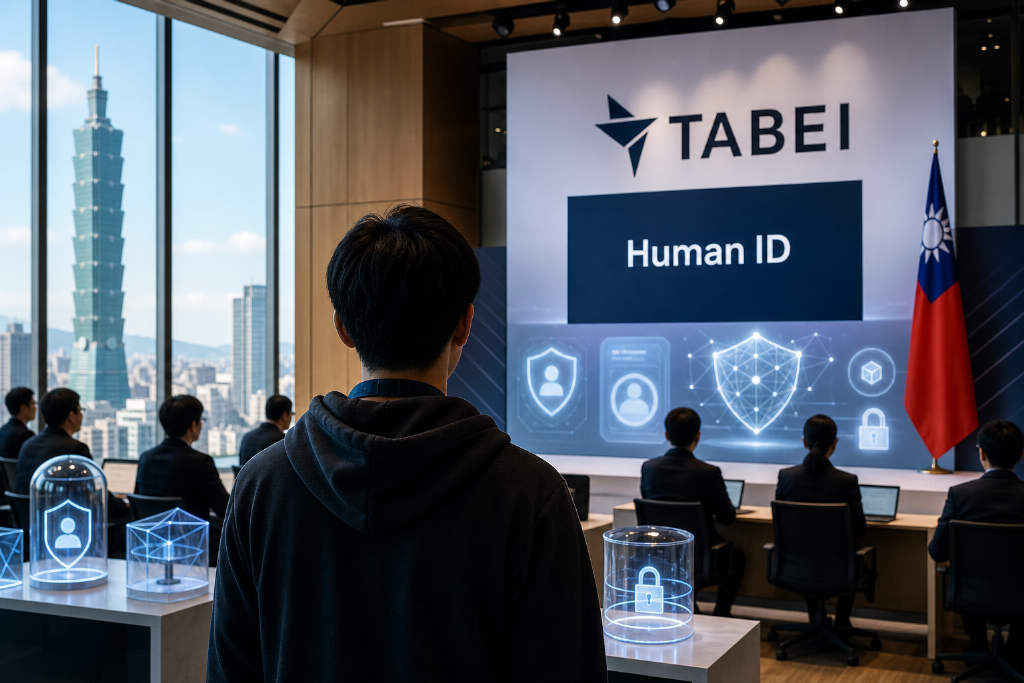
Human ID won Taiwan’s 2026 Trustworthy AI Hackathon, taking the $5,000 first prize after emerging from a field of 20 finalist teams. The competition was guided by Taiwan’s National Development Council and organized by TABEI. It received applications from 50 teams after registration opened in July, with finalists selected through a written review. Participants came from AI engineering, cybersecurity, blockchain development, healthcare, supply chains and finance.

The hackathon centered on the question, “Your Agent Is Not Actually Your Agent.” The theme addressed the trust gap created as AI applications move from carrying out commands to taking autonomous action. The organizers asked who an AI agent represents, what it has been authorized to do, how its operating limits should be defined, how an audit trail should be preserved and whether its authorization can be revoked quickly after an abnormal event.
Six Industry Problems Shaped the Competition
The six challenge tracks were drawn from industry problems rather than designed as technology demonstrations. They covered carbon footprints in manufacturing and trade, DPP (Data Privacy Protection) data-flow controls, suspicious-activity detection under privacy requirements in electronic payments, cross-industry data cooperation between healthcare and insurance, fragmented credentials in government services, digital trust and inclusive finance for migrant workers, and verifiable credentials for RBA (Responsible Business Alliance) supply-chain compliance.
The topics were developed through a closed expert session in June and two industry forums in July. The process was intended to keep the technical frameworks tied to business requirements.

TABEI chair Takasaki Jun said at the opening that the event was created to break down data silos between industries and use blockchain and cryptography as infrastructure for cross-sector cooperation. Taiwan’s PKI and credential systems have more than 30 years of development behind them, he said, with some stages having moved ahead of international practice.
With AI agents introducing a new trust framework, Taiwan should take part in setting standards instead of waiting for international standards to be finalized and then adopting them passively, Takasaki said. The “industry sets the problem, the hackathon solves it” model brings cryptographic digital trust and privacy computing into operating processes. It also redesigns trust procedures and inserts trust anchors intended to prevent AI systems from losing control or acting maliciously.
Nicole Chan, chair of the Artificial Intelligence Foundation and the Taiwan Digital Trust Association, said AI development has entered what she called “deep water.” Companies are shifting AI from an experimental tool to a core Corporate Agent, she said, making verifiable identity and authorization mechanisms necessary parts of digital-trust infrastructure. Governance must also involve multiple stakeholders and connect with international standards.
Chan said the judges were looking for projects that solved real industry problems and had trust designs that could be deployed. Technical spectacle was not the main criterion.

Human ID Pairs Human and Agent Credentials
After two days of continuous development, the finalists presented their work at Demo Day on Aug. 31. Human ID, which focused on next-generation identity and credential deployment, finished first among the 20 finalist teams.
The event also joined with international organization GLEIF to present a Trustworthy AI Governance Innovation Contribution Award to Weng Chung-ho, chair of the Association for Digital Finance and Data Protection of the Republic of China. The award recognized his work promoting digital trust in healthcare and insurance.
In a keynote, Weng said AI risk has changed from generative AI “saying the wrong thing” to AI agents “doing the wrong thing.” Agents can call tools autonomously and trigger transactions, he said, raising the level of risk. Citing a survey, he said 71% of companies claimed to use AI agents, while only 11% had deployed them in production. He attributed the 60-percentage-point gap to companies being unwilling to give the systems full control.

Weng identified three technical pillars for trustworthy AI-agent governance: cryptographically verifiable Identity; a Boundary built through behavior scoring and cascading circuit breakers; and Evidence stored on a tamper-resistant audit chain. He compared the framework with a clearing system for an agent economy and described it as a prerequisite for scaling the market.
Judges Focused on Governance and Deployment
The Demo Day panel consisted of a head judge and nine judges from academia, healthcare, consulting, technology, investment and professional services. After each presentation, the panel asked questions about deployment feasibility and compliance design.
Industry-scenario fit accounted for 35% of the score, followed by the feasibility of trusted-technology integration at 25%, presentation and demo quality at 25%, and problem insight and creativity at 15%. The judges shared the view that technical showmanship was no longer the deciding factor. Teams had to place AI inside controllable protocols and governance principles while making personal-data sovereignty and cross-sector compliance operational.
Winners
- First place, $5,000: Human ID. The team targeted identity impersonation in the AI-to-AI, or A2A, era. Its dual identity system uses Human ID for natural-person verification and Agent ID for companies and robots. The design combines zero-knowledge proofs with MyData data-sovereignty principles, and the team has filed a U.S. provisional patent application covering its core concept. Judges said the project was closely aligned with governance principles involving zero-knowledge proofs, personal-data sovereignty and cross-industry deployment.
- Second place, $2,000 each: BuLuanPay and Carbon Data Three Musketeers. BuLuanPay built a trusted collaboration layer for cross-border customs declarations. It uses vLEI to verify companies and signers, then has an AI agent automatically compare the consistency of customs documents. Carbon Data Three Musketeers developed a pre-audit tool for emissions data. Its two-sided SaaS model helps companies consolidate information and identify missing items before a formal inspection.
- Third place, $1,000 each: AI-LocalKing, Stable Book and NewJeans always five. AI-LocalKing built “Baro,” an AI agent for generating ESG reports, with evidence sources for every number in the report. Stable Book proposed a carbon-data disclosure system for textile supply chains, keeping the data inside factories while taking only verifiable proof outside. NewJeans always five worked on anti-fraud defenses for AI agents, using six checks and cryptographic endorsements across parties to raise the cost of fabrication and preserve a complete record.
- Special awards, $1,000 each: Blockchain Is Not Just One Block and Guardian Angel. Blockchain Is Not Just One Block uses AI to reconstruct fragmented timelines and create a cross-agency risk radar for detecting identity changes and breaks in government procedures before and during an event. Guardian Angel designed a dual-agent, five-layer verification system for student-loan applications. It combines MyData with a digital-credential wallet, while a rules engine controls key decisions and prevents the AI from bypassing those controls.
Other finalist projects also showed a strong focus on practical use. Their designs included dynamic trust-score management for corporate virtual-asset vaults, a transparent registration mechanism for government data authorization, a claims platform for migrant workers and anti-fraud controls for cross-border KYC. The projects covered supply chains, finance, government services and inclusive finance.

Results Set for November Presentation
The hackathon formed part of the National Development Council’s policy research program on a trustworthy AI economy combined with privacy computing and trust technologies. TABEI said one objective was to build an early model of Taiwan’s DPI, or Digital Public Infrastructure, on the basis of international standards and connect it with interoperable identity-verification mechanisms.
TABEI said more than 870,000 migrant workers in Taiwan lack a national identity card and a natural-person certificate, leaving them with cross-border trust challenges. The “migrant-worker economy” was identified as one application area with room for a breakthrough.
The winning projects and other selected results will be presented at the 11th Blockchain Enthusiasts Annual Conference in November and included in the annual policy white paper.