

China’s humanoid robot trade is attracting heavy capital in 2026, but IT Juzi says the gap between funding heat and industrial adoption is hard to ignore.

In the article carried by MarsBit, IT Juzi said primary-market investors poured 93.5 billion yuan into the sector in the first half of the year, or more than 400 million yuan per working day on average. Yet actual factory orders remain limited. The article frames the question plainly: is the sector genuinely hot, or just overheated?
100 billion-yuan valuations are spreading fast
IT Juzi said the number of humanoid robot companies valued above 10 billion yuan jumped from three to 22 in one year. Some companies completed four funding rounds in three months, with a new TS, or term sheet, signed before funds from the previous round had even arrived.
The article then compares those valuations with shipment levels. Global annual sales were estimated at 22,000 units. Spread across those 22 companies, that would mean fewer than 1,000 units sold per company per year on average. On that basis, each robot would be supporting roughly 10 million yuan in market value.
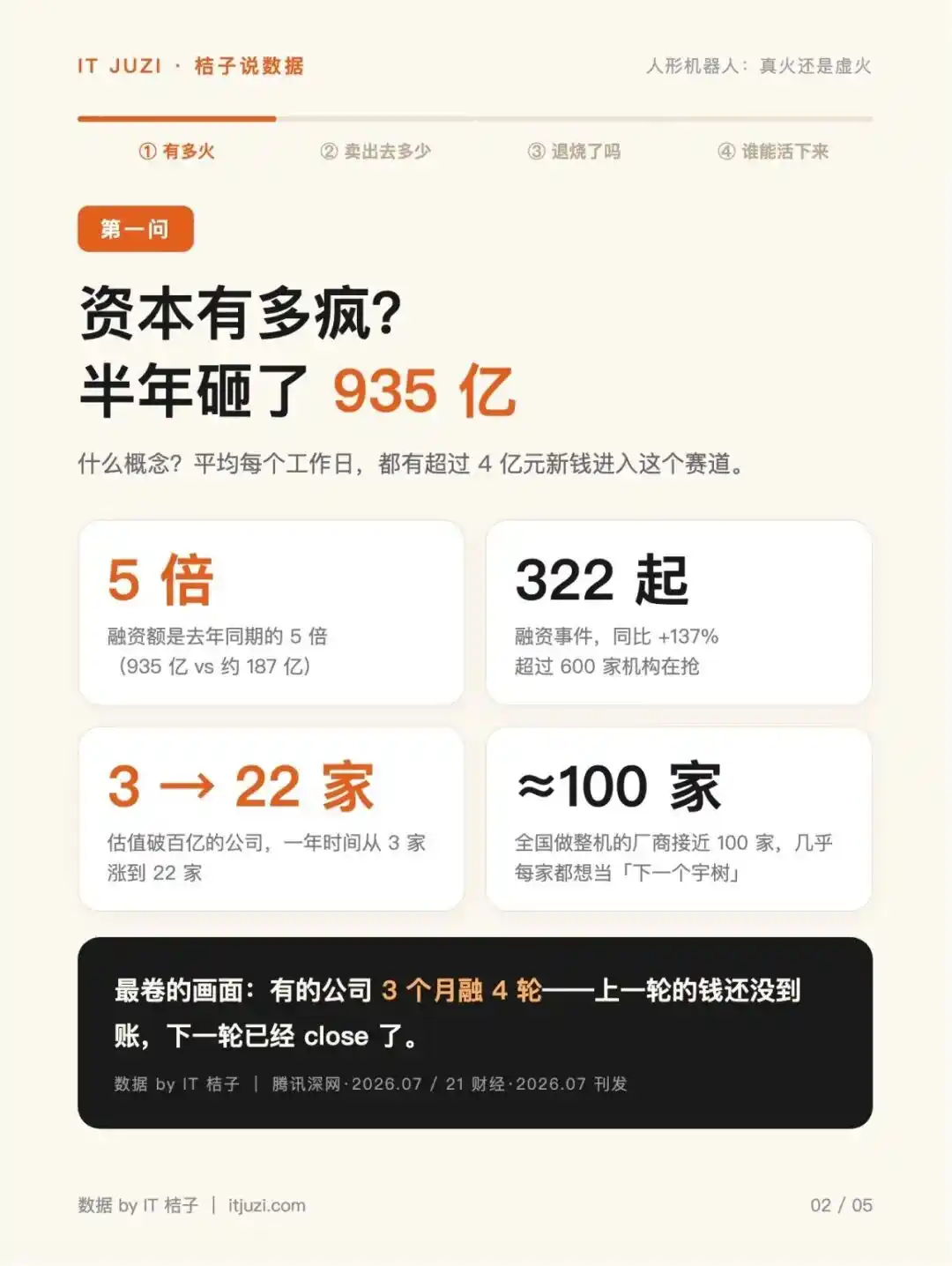
IT Juzi called that math absurd for any hardware manufacturing business. In its view, the rush is being driven less by a clear commercialization path than by fear of missing out, or FOMO. After breakthroughs in large-model technology, investors became afraid of missing the next 「iPhone moment」, sending hot money into what the article described as a large toy still sitting in the lab and pushing it into unicorn-level valuations.
Most sold robots are still not doing real industrial work
IT Juzi argues that fundraising momentum has not translated into broad use on production floors.
According to the article, only about 20,000 robots were sold globally over a full year. Of those sold units, roughly 80% were not working in factory lines or warehouse logistics. Instead, they were used for dance and commercial performances, research and education, and data collection. Fewer than 20% were actually put to work in factories and warehouses.
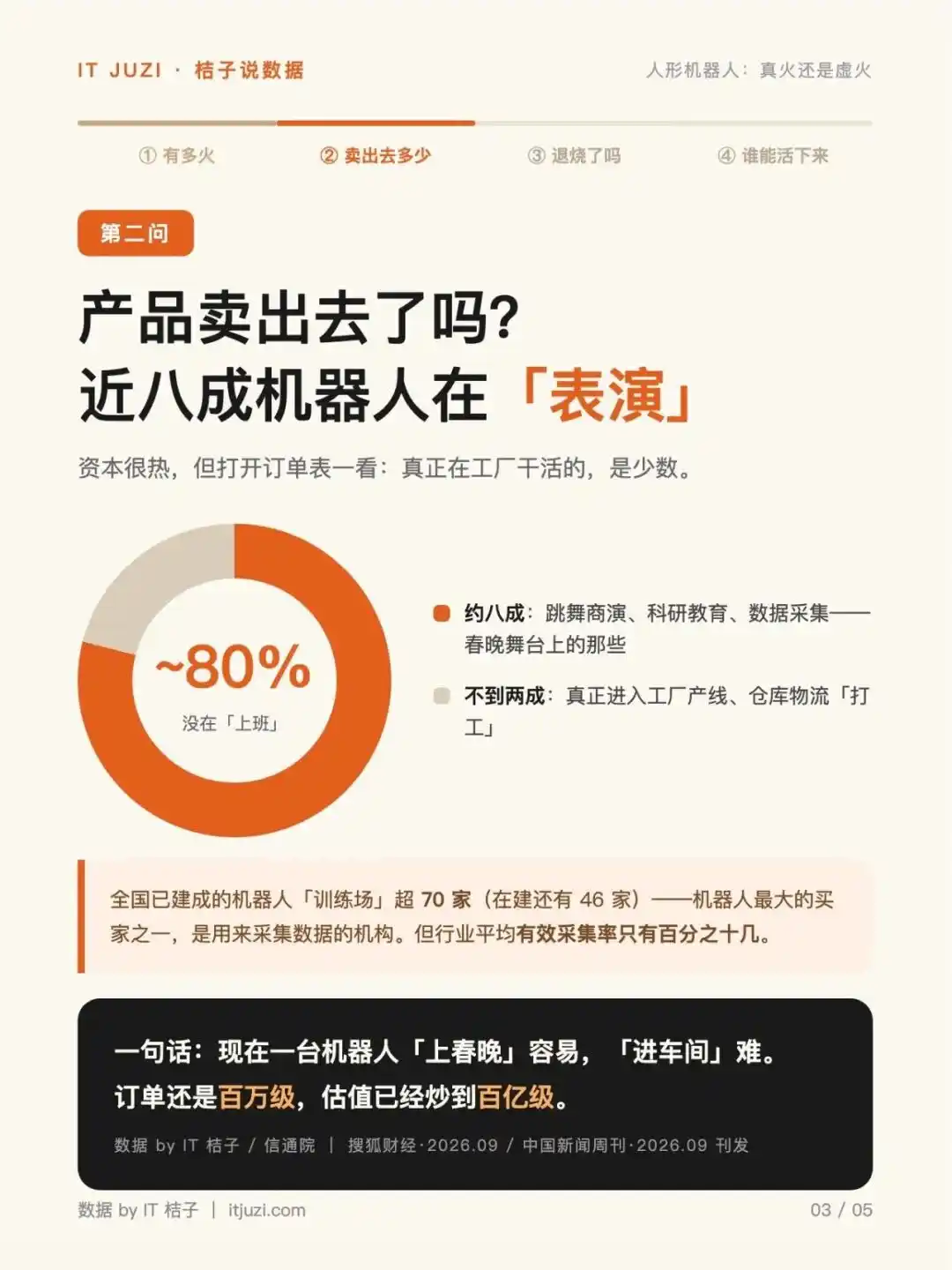
That imbalance has also produced another data point. China has built more than 70 robot training grounds, with another 46 under construction. IT Juzi said the biggest buyers of robots right now are institutions using them to collect data, while the industry’s average effective data collection rate is only in the low teens.
The article sums up the picture with a blunt line: getting a robot onto the Spring Festival Gala stage is easy; getting it into a workshop is hard. Orders are still measured in the millions, while valuations have already been pushed into the tens of billions.
Unitree’s post-listing slide exposed pricing strain
IT Juzi said Unitree, described in the article as the first listed humanoid robot stock, surged on its debut in August and then quickly lost half its value. The piece treats that move as a pricing anchor for the wider industry.
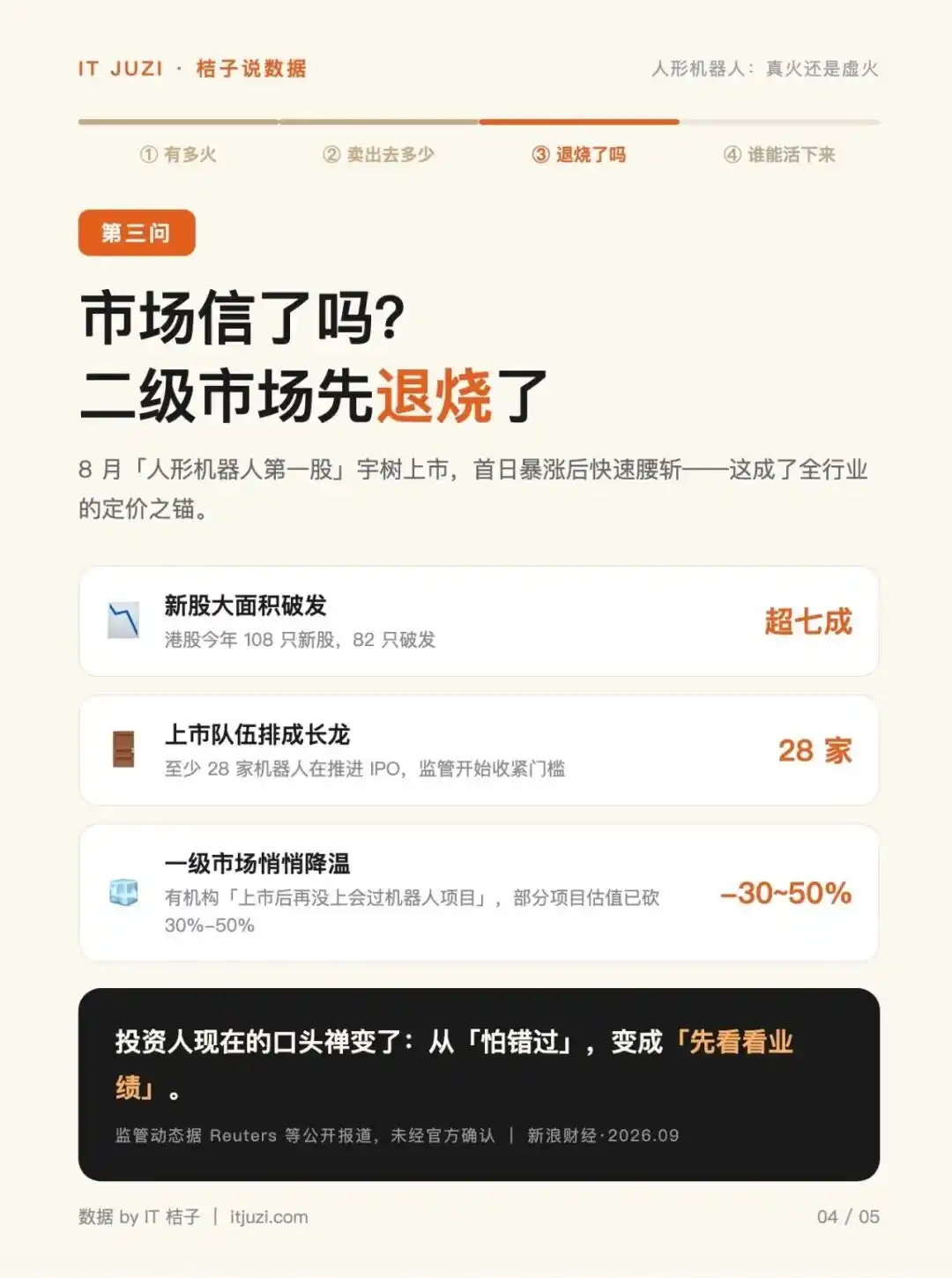
In Hong Kong, 82 of this year’s 108 newly listed stocks have fallen below their offering price, or more than 70% of the total. At least 28 robot companies are still waiting in the IPO pipeline, while listing standards are starting to tighten.
The cooling is also showing up in private markets. IT Juzi said some institutions have stated clearly that they have not taken another robot project to committee after the listing. Valuations for some projects have been cut by 30% to 50%. Investor psychology, the article said, has shifted from fearing they might miss the opportunity to fearing they may get trapped.
If lofty private-market valuations cannot be validated in public markets, IT Juzi said, the inversion between primary and secondary market pricing will directly hit these companies’ ability to raise follow-on funding.
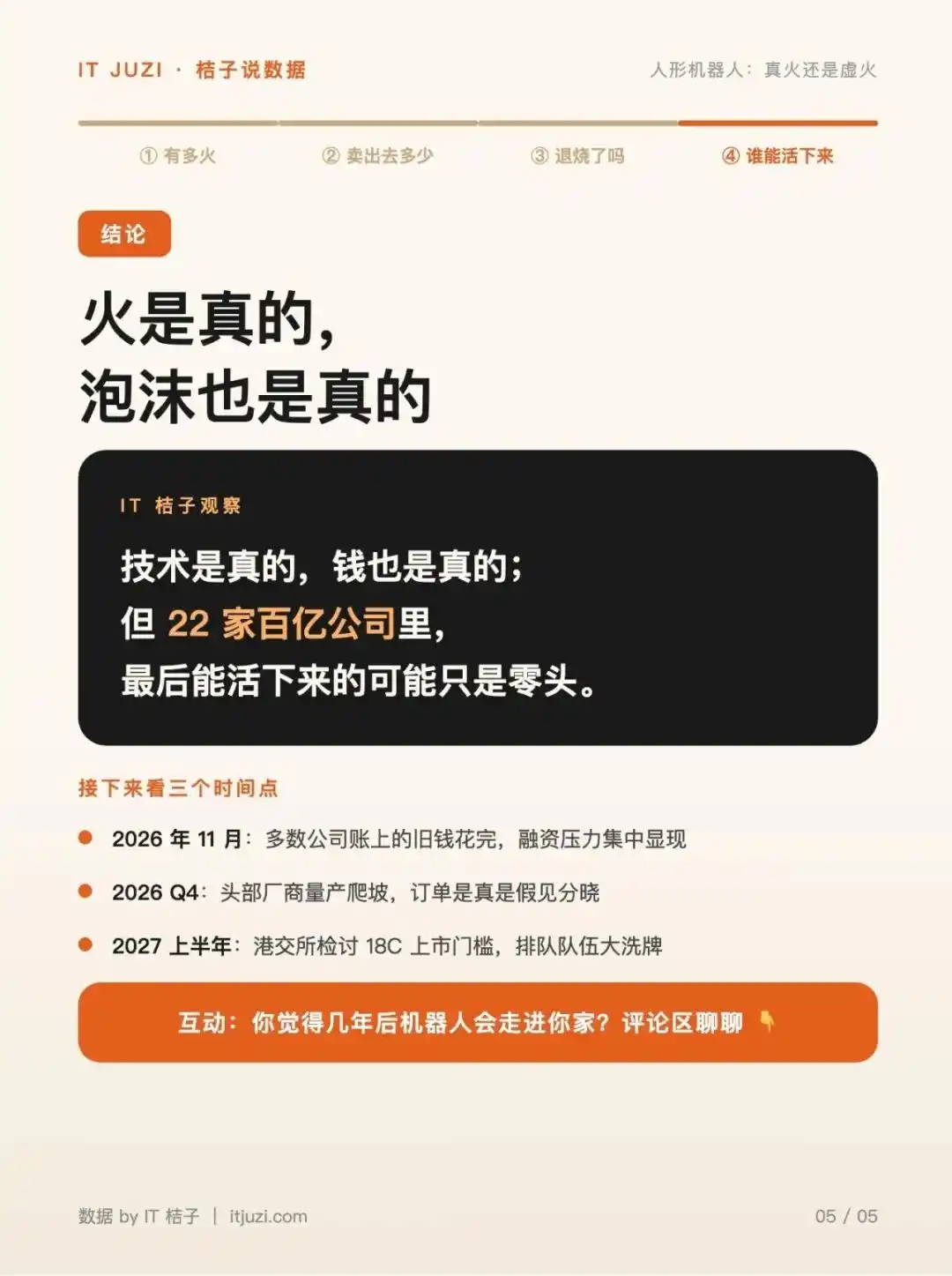
IT Juzi’s view: the heat is real, and so is the bubble
The article’s conclusion is direct: 「the heat is real, and so is the bubble.」
In the next phase of bubble-clearing, IT Juzi said the survivors are unlikely to be the companies with the flashiest pitch decks. Instead, it points to three traits:
- Companies focused on practical scenarios, rather than chasing humanoid form for its own sake, and able to close a commercial loop in specific B2B settings such as hazardous operations or specialized logistics.
- Companies that can control supply-chain costs and push hardware prices down to levels the market will actually pay for, instead of relying on expensive component stacking.
- Companies with enough cash flow on hand to last through 2028.
The article was originally published on the WeChat public account IT Juzi, with IT Juzi credited as the author.